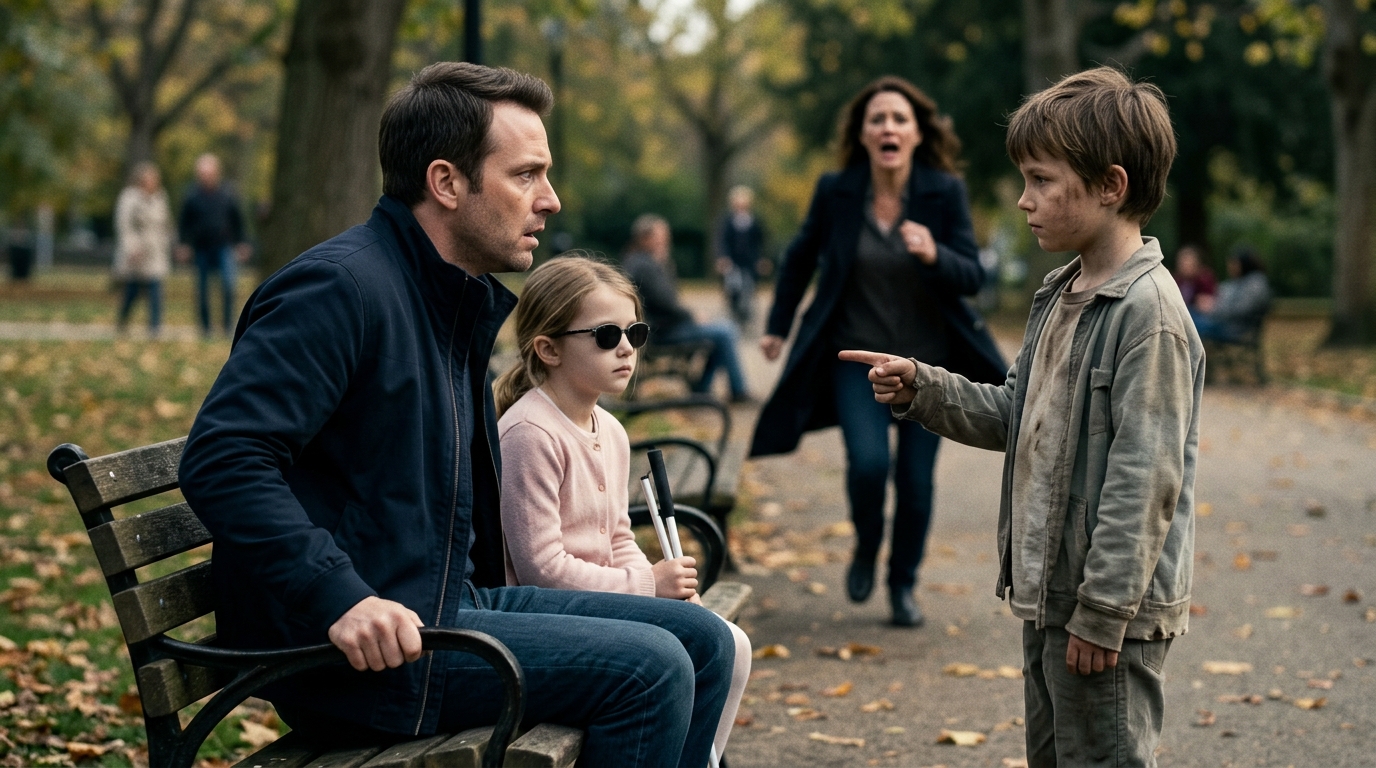
“Your daughter is not blind.”
The words hit me harder than a scream.
For a moment, the whole park seemed to fall silent around us. The children on the swings, the barking dogs, the distant traffic beyond the trees—all of it faded into a dull, impossible hum.
The boy stood a few feet away from me.
Dirty hoodie.
Torn jeans.
Hair damp with sweat or rain.
Maybe twelve years old.
Maybe thirteen.
Too young to speak with that much certainty.
His finger was pointed straight at me.
No hesitation.
No fear.
Just a terrible, steady conviction.
My seven-year-old daughter, Lily, sat beside me on the bench with her small white cane resting across her lap. Her dark sunglasses covered the eyes doctors said were failing from a rare neurological disease no one could treat.
“What did you just say?” I snapped.
The boy stepped closer.
“She’s not sick,” he said quietly. “Someone is doing this to her.”
My grip tightened on the bench.
Then I saw movement behind him.
My wife was running across the grass.
Fast.
Too fast.
“Marcus!” Eleanor shouted, panic breaking through her voice.
The boy didn’t turn.
He only raised his finger again.
This time, he pointed past me.
At my wife.
“It’s her.”
My body went cold.
Eleanor stopped for half a second, and in that tiny pause, I saw something on her face I had never seen before.
Not confusion.
Not concern.
Fear.
Then Lily moved.
Just slightly.
Her head turned—not toward her mother’s voice, but toward the boy.
She had not done that in months.
Her lips parted.
“Daddy,” she whispered, trembling. “I see light.”
The entire world collapsed in one breath.
And just when I turned toward my wife, ready to ask the question that would destroy our family, the boy stepped backward.
His eyes filled with a warning I did not yet understand.
“You’re too late,” he whispered.
Then he disappeared into the crowd.
The Boy In The Park
Before that afternoon, I believed my wife had saved us.
That is the cruelest part.
When Lily first started complaining that the sunlight hurt her eyes, Eleanor was the one who insisted we see specialists. She was the one who kept folders of medical records, dosage charts, appointment cards, and insurance forms. She was the one who sat beside Lily’s bed at night, stroking her hair while our daughter cried because the world was turning blurry.
The diagnosis came after months of tests.
Idiopathic optic neuropathy.
Rare.
Progressive.
Unpredictable.
Those were the words the doctors used when they did not want to say helpless.
I was a corporate fraud analyst by trade. Numbers made sense to me. Patterns made sense to me. Medical tragedy did not. So I clung to what the specialists told us.
Eleanor did too.
At least, that was what I believed.
She became saintly in the eyes of everyone around us. The country club wives brought casseroles. Her friends organized fundraisers. Parents from Lily’s school sent cards and plush toys. People called Eleanor brave, devoted, inspiring.
And she wore the role beautifully.
Too beautifully.
Every morning at seven and every afternoon at three, she gave Lily her prescribed eye drops. She labeled every bottle. She kept alarms on her phone. She corrected me if I touched the wrong medication.
“You don’t want to mix them up,” she would say gently.
I used to feel grateful for that.
Now I hear the warning inside it.
That Tuesday, Eleanor had suggested the park because Lily had been quiet all morning. She said fresh air might help. I was exhausted from remote meetings and insurance calls, so I agreed.
Eleanor went to buy water from a concession stand while Lily and I sat near the pond.
That was when the boy appeared.
He did not look like a child asking for help.
He looked like a child delivering a sentence.
“Your daughter is not blind.”
I should have dismissed him immediately. Any normal father would have.
But something about him stopped me.
Maybe it was the way he looked at Lily.
Not with pity.
Not curiosity.
Recognition.
When Eleanor shouted his name, I felt the first crack open inside me.
Marcus.
She knew him.
My wife knew the dirty boy in the park.
And she had never mentioned him once.
“Marcus!” she shouted again, closing the distance between us. “Don’t listen to him, David!”
I turned to her slowly.
“Who is he?”
Her mouth opened.
No answer came.
The boy backed away, but his eyes stayed locked on mine.
“She did it before,” he said.
Eleanor’s face twisted.
“Stop it!”
That scream did not sound like a mother protecting her child from a stranger.
It sounded like a woman trying to keep a grave closed.
Lily’s hand tightened around mine.
“Daddy,” she whispered again. “It’s bright.”
I looked down at her.
She was staring toward the pond.
Not perfectly.
Not clearly.
But her head was angled toward the sunlight reflecting off the water.
For eight months, Lily had not reacted to light that way.
For eight months, she had moved through our home like a child walking underwater.
Now her pupils, hidden behind the dark lenses, were responding to something her mother insisted she could no longer see.
Eleanor reached us breathless.
“David, he’s disturbed,” she said quickly. “He used to be around one of my old families. He’s obsessed with me. We need to call the police.”
“One of your old families?”
She froze.
Before we married, Eleanor had worked as a private caregiver for wealthy families in California. She rarely talked about it. She said those years exhausted her. She said the families were demanding, cold, and cruel.
Now a boy from that past stood in front of me, accusing her of hurting our daughter.
And Lily could suddenly see light.
I turned back toward Marcus.
But he was already stepping into the crowd.
“Wait!” I shouted.
He stopped only once.
“You’re too late,” he whispered.
Then he was gone.
The drive home was suffocating.
Eleanor talked the entire time.
She said Marcus had mental problems. She said his family had accused her of things years ago because they wanted money. She said he had probably followed her online after seeing posts about Lily’s illness.
Her voice was fast.
Too fast.
I said almost nothing.
I watched Lily in the rearview mirror.
She kept turning her head toward passing shapes.
Trees.
Cars.
Flashes of sun.
Small movements that should have filled me with hope.
Instead, they terrified me.
Because Eleanor had missed Lily’s afternoon eye drops.
For the first time in months, our daughter had gone more than eight hours without medication.
And for the first time in months, she could see light.
The Bottle In The Bathroom
The moment we got home, Eleanor tried to take Lily upstairs.
I stopped her.
“I’ll do it.”
Her hand tightened on Lily’s shoulder.
“She needs rest.”
“I said I’ll do it.”
For one second, my wife looked at me like a stranger.
Then she smiled.
Soft.
Wounded.
Perfectly rehearsed.
“Of course,” she said.
I carried Lily upstairs and locked her bedroom door behind us.
My hands shook so badly I could barely set her on the bed.
“Daddy?” she asked.
“Yes, sweetheart?”
“Am I in trouble?”
That broke something in me.
I knelt in front of her and took off her sunglasses.
Her eyes were red, sensitive, watering in the soft bedroom light.
But they moved.
They followed my face.
Not perfectly.
But enough.
“No,” I whispered. “You are not in trouble.”
I found her medical bag inside the top drawer of her dresser.
Eleanor kept it there in a pale pink pouch with Lily’s name embroidered on it. Inside were wipes, gauze pads, prescription printouts, and three small white bottles.
I picked up the one Eleanor used every morning and afternoon.
The label read:
Lubricating ophthalmic solution.
But beneath the pharmacy sticker, a second label showed faintly where the top one had not fully covered the plastic.
Cyclopentolate Hydrochloride.
I was not a doctor.
But I knew how to research.
I opened my laptop with one hand while holding the bottle with the other. The first results were clinical. The second page was more specific.
Cyclopentolate was a powerful eye medication used to dilate pupils and temporarily paralyze focusing muscles. It could cause light sensitivity, blurred vision, confusion, and temporary loss of functional sight.
Temporary.
That word struck me harder than any diagnosis.
Temporary.
Lily was not going blind.
She was being blinded.
Twice a day.
By the woman who kissed her forehead afterward.
I gripped the edge of the desk until my knuckles ached. A sound came out of me, low and ugly, not quite a sob and not quite rage.
I wanted to run downstairs.
I wanted to grab Eleanor.
I wanted to scream until the house cracked open.
Instead, I looked at Lily.
She was sitting quietly on the bed, blinking at the lamp.
“Daddy,” she whispered, “the room is yellow.”
I pressed my fist against my mouth.
The room had always been yellow.
She had just not been allowed to see it.
I took photos of the bottle. The label. The second label beneath it. The dosage chart in Eleanor’s handwriting. The timestamps on her phone alarms, which I could see on the shared family tablet.
Then I remembered Marcus.
She did it before.
I needed to know who he was.
Downstairs, I could hear Eleanor pacing. Her heels clicked across the hardwood floor, stopped, turned, clicked again. At one point, she spoke into her phone too quietly for me to hear.
I opened my laptop and searched Eleanor’s maiden name.
Eleanor Vance.
Private caregiver.
California.
Marcus.
Blindness.
At first, nothing meaningful appeared.
Then I changed the search.
Eleanor Vance child vision loss.
A local archived article from eleven years earlier loaded slowly.
The headline turned my stomach.
Wealthy Heiress Diagnosed With Rare Childhood Blindness; Family Establishes Lifelong Medical Trust.
The photograph showed a coastal California family standing outside a hospital.
A father.
A mother.
A little girl in dark glasses.
A younger Eleanor standing beside them, face composed in sorrow.
And behind them, half-hidden near the edge of the frame, stood a boy with angry eyes and a clenched jaw.
Marcus.
The article named the child as Chloe Sterling, age six. It described a mysterious, untreatable vision condition. It praised the family’s devoted private caregiver, Eleanor Vance, for her “tireless support.”
I scrolled further.
Three months after Chloe’s diagnosis, a medical trust had been activated for lifelong care. Eleanor had been granted administrative access as caregiver.
Six months later, she vanished.
So did a large portion of the trust funds.
No charges were filed.
The family could not prove deliberate harm.
The article ended with a sentence that felt like a warning written years too early.
The child’s older brother, Marcus Sterling, has publicly insisted his sister was poisoned, though doctors found no evidence supporting that claim.
No evidence.
I looked at the bottle in my hand.
Marcus had not been a disturbed boy in the park.
He had been the only witness no one believed.
And now he had found us.
But why had he said too late?
I searched our own family trust documents next.
My father had left a generation-skipping trust for Lily when he died. Fifty million dollars. I was trustee. Eleanor had no direct access.
Unless Lily suffered a catastrophic permanent disability.
My hands went numb as I pulled the trust binder from the office safe.
Section 8.
Medical Incapacity.
If Lily were declared permanently disabled and I were deemed negligent, unstable, or unfit, the primary medical caregiver could petition for emergency conservatorship over the trust.
Primary medical caregiver.
Eleanor.
My eyes moved to the calendar on my desk.
Today’s date was circled in red.
Final neurological evaluation — Dr. Aris.
The paperwork had been submitted that morning.
That was what Marcus meant.
Too late.
Eleanor had already triggered the trust.
Before I could stand, a crash shook the house.
The front door flew open downstairs.
Heavy boots hit the foyer.
A man shouted, “David Carter! Police! Come down with your hands visible!”
I looked toward Lily’s locked bedroom door.
Then toward the bottle on the desk.
And in that instant, I understood my wife had not panicked in the park.
She had activated a plan.
The Trap She Built For Me
When I reached the top of the stairs, four police officers stood in my foyer.
Two child protective services workers stood behind them.
And Eleanor stood near the fireplace, sobbing into her hands.
She looked destroyed.
Perfectly destroyed.
Her hair was loose. Her mascara had streaked. Her blouse was half untucked, as if she had been through some terrible struggle.
“I tried to stop him,” she cried. “I didn’t know what else to do.”
The lead officer looked up at me.
“David Carter?”
“Yes. What is this?”
“Come down slowly.”
“My daughter is upstairs. My wife has been poisoning her.”
Eleanor let out a broken cry.
“See? He’s saying it again. He’s trying to blame me.”
One of the CPS workers held up a clear evidence bag.
Inside were empty medication vials, printed receipts from an offshore pharmacy, and an old laptop I recognized from our garage.
“We received a report that you were inducing symptoms in your daughter to access a trust fund,” she said.
My mouth went dry.
“That is not mine.”
“The laptop search history suggests otherwise.”
Eleanor staggered forward.
“He told me if I didn’t help him, he would hurt Lily permanently,” she sobbed. “I was scared. I thought I could protect her if I stayed close.”
I stared at her.
Even then, part of me could not process it.
The woman I married.
The mother of my child.
Standing in our living room, framing me with the same calm precision she used to measure eye drops.
The officers moved toward the stairs.
“Hands where we can see them.”
“She called you before we even got home,” I said.
No one reacted.
“She planted all of this.”
“Sir, keep your hands visible.”
“You need to test the bottle upstairs.”
“We will examine all evidence.”
“You don’t understand. The drops are the evidence.”
Eleanor looked at me through her tears.
For a fraction of a second, the performance slipped.
A tiny smirk touched the corner of her mouth.
Only I saw it.
Only a husband would know that expression.
It said: I won.
They handcuffed me at the bottom of the stairs.
The steel closed around my wrists.
Lily cried out from upstairs.
“Daddy?”
I twisted toward her voice.
“Don’t let her touch the drops!” I shouted. “Lily, don’t let Mommy give you anything!”
One officer shoved me toward the wall.
“Enough.”
Eleanor collapsed dramatically into a chair.
“She’s terrified of him,” she whispered.
The CPS worker moved toward the stairs.
“No,” I said. “Please. Listen to me. She can see light because Eleanor missed the dose.”
The worker paused.
For one second, I thought maybe she heard me.
Then Eleanor spoke.
“He has been feeding Lily fantasies all afternoon. He’s confusing her.”
The pause ended.
I was pushed toward the front door.
And that was when I saw it.
A tiny blue light blinking from the bookshelf.
Inside the eye of Lily’s old teddy bear.
The nanny camera.
Six months earlier, we had suspected a temporary nanny of stealing jewelry from our bedroom. I installed hidden cameras in the common areas and medical prep station. Eleanor hated them. I told her I had removed them after the nanny quit.
I had not.
I had forgotten about them.
So had she.
“Wait,” I said.
The officer shoved me again.
“Move.”
“There are cameras.”
Eleanor stopped crying.
The silence was immediate.
Heavy.
I looked at the lead officer.
“I installed motion-activated cameras months ago. Kitchen. Living room. Hallway. Lily’s medical station. They upload to encrypted cloud storage.”
Eleanor’s face emptied.
The lead officer looked at her.
Then at me.
“Where?”
“My phone. Right pocket. App is called HavenCam. Passcode is Lily’s birthday.”
Eleanor stood so fast the chair scraped backward.
“He’s lying. He edits videos for work. He can fake anything.”
“I investigate fraud,” I said. “I don’t fake footage.”
The officer removed my phone and opened the app.
Eleanor lunged.
An officer blocked her.
The lead officer tapped the camera labeled Kitchen — Med Prep.
Yesterday morning.
The video loaded.
Eleanor appeared on screen in her robe, humming softly. She opened Lily’s real lubricating eye drops, emptied the bottle into the sink, and used a syringe to refill it from a vial marked Cyclopentolate.
The room went silent.
On the recording, Lily entered wearing pajamas.
Eleanor smiled.
“Come here, Lily-bug,” she said. “Mommy has your medicine.”
My knees nearly gave out.
The officer fast-forwarded.
Last week.
Same routine.
A month earlier.
Same routine.
Then he opened the living room camera from two nights before.
Eleanor sat on the couch speaking into her phone.
“The evaluation is Tuesday,” her recorded voice said. “Once Aris files permanent disability, I petition for conservatorship. David will be handled. I’ve already built the offshore pharmacy trail on his old laptop.”
The CPS worker covered her mouth.
The lead officer lowered my phone slowly.
Eleanor’s face had changed completely.
The tears were gone.
The grieving wife was gone.
The devoted mother was gone.
All that remained was a woman cornered by her own arrogance.
“Eleanor Carter,” the officer said, voice tight with disgust, “turn around.”
She did not scream.
She did not plead.
She stared at me with pure hatred as the cuffs locked around her wrists.
“This isn’t over,” she whispered.
I looked toward the stairs.
“No,” I said. “It is for you.”
But I was wrong about that.
Because arresting Eleanor did not end the nightmare.
It only opened the door to everything she had done before us.
The Boy Who Had Been Right
Marcus Sterling was found two days later sleeping behind a bus station.
He had been following Eleanor for months.
Not randomly.
Not obsessively.
Methodically.
After his sister Chloe was chemically blinded, Marcus became the child no adult wanted to hear. He told police. Doctors. Lawyers. Reporters. Teachers.
Everyone said grief had made him unstable.
So he learned to stop asking permission to be believed.
He tracked Eleanor through old caregiver networks, charity photos, society pages, marriage announcements, and eventually posts about Lily’s “brave journey with rare blindness.”
He saw the pattern immediately.
Wealthy child.
Rare diagnosis.
Devoted caregiver.
Trust fund.
Medical power.
He came to our town with nothing but a backpack, an old photo of his sister, and the kind of fury that keeps a boy alive when hope is too expensive.
When Marcus entered Lily’s hospital room, he stopped at the door.
He looked smaller there.
Not like the fearless boy in the park.
Like a child who had spent too many years fighting adults and expecting to lose.
Lily was sitting up in bed under specialist care. Her eyes were uncovered. Sensitive, red, watering, but improving. The doctors believed her vision would recover significantly because we had stopped the chemical exposure in time.
Chloe had not been that lucky.
Marcus stared at Lily.
Then at me.
“I tried to be earlier,” he said.
His voice cracked on the last word.
I crossed the room and knelt in front of him.
“You saved her.”
He shook his head.
“You listened.”
That sentence broke me.
Because he was right.
That was the difference between Lily and Chloe.
Not Marcus’s courage.
He had been brave both times.
The difference was that this time, someone listened before the damage became permanent.
Eleanor’s trial became national news.
The tabloids called her the Blindness Wife.
The prosecutors called her something simpler.
A predator.
They linked her to Chloe Sterling’s case, to forged prescriptions, to offshore pharmacies, to trust documents, to hidden financial accounts, and to Dr. Aris, who had accepted large payments to support a permanent disability declaration without proper independent testing.
Eleanor claimed I had abused her.
Then she claimed Marcus had fabricated everything.
Then she claimed she suffered from untreated trauma.
But the cameras did what no one had done for Marcus years earlier.
They told the truth without trembling.
At sentencing, Chloe Sterling appeared in court with her parents.
She was seventeen by then. She had partial vision in one eye and severe damage in the other. Marcus sat beside her, holding her hand.
When Chloe addressed the court, Eleanor looked away.
The judge noticed.
So did everyone else.
“You stole light from children,” Chloe said. “And then you stood beside them while people praised you for helping them through the dark.”
Eleanor received forty-five years.
Dr. Aris received prison time too.
The trust remained protected for Lily, but I stopped thinking of that money as security. Money had been the thing Eleanor tried to turn into a weapon.
Lily’s real security became quieter.
Doctors who checked everything twice.
A therapist who helped her sleep without fear of medicine.
A father who never again mistook organization for love.
For months, Lily asked whether Mommy was sick.
I never knew how to answer perfectly.
So I answered honestly in pieces a child could hold.
“Mommy did something very wrong.”
“Mommy cannot come home.”
“It was not your fault.”
“You are safe.”
Some nights she believed me.
Some nights she didn’t.
Healing is not a straight road, especially when the person who hurt you used a gentle voice.
But spring came.
And with it, sunlight.
The first day Lily asked to go back to the park, I almost said no.
Then I remembered Eleanor had stolen enough from her.
So we went.
The pond looked the same. Children shouted near the swings. Dogs pulled at leashes. Wind moved through the trees.
Lily wore a sunhat instead of dark glasses.
She still squinted.
Still moved carefully.
But she walked without the white cane.
Marcus came too.
He stood awkwardly near the bench, hands in his hoodie pocket, pretending not to care that Lily had made him a friendship bracelet with blue beads.
She handed it to him solemnly.
“For finding the light,” she said.
Marcus turned away fast, wiping his face with his sleeve.
I looked out across the pond so he could have his dignity.
A few minutes later, Lily tugged my hand.
“Daddy?”
“Yes, sweetheart?”
“The water is sparkly.”
I looked down at her.
Her eyes were narrowed against the brightness, but she was smiling.
Not because everything was fixed.
Not because the nightmare had vanished.
Because she could see the light on the water.
And this time, no one was going to take it from her.
Marcus sat beside us on the bench.
The same bench where he had destroyed my world and saved it in the same breath.
For a while, none of us spoke.
We just watched the sun scatter across the pond.
A father.
A daughter.
A boy who had been right.
And in that quiet, I understood something I would carry for the rest of my life.
The truth does not always arrive clean.
Sometimes it comes in torn clothes, dirty shoes, and a voice everyone else has learned to ignore.
Sometimes it points at the person you love most and says the sentence you least want to hear.
And sometimes, if you are lucky enough to listen before it is too late, it gives your child the world back.
One ray of light at a time.