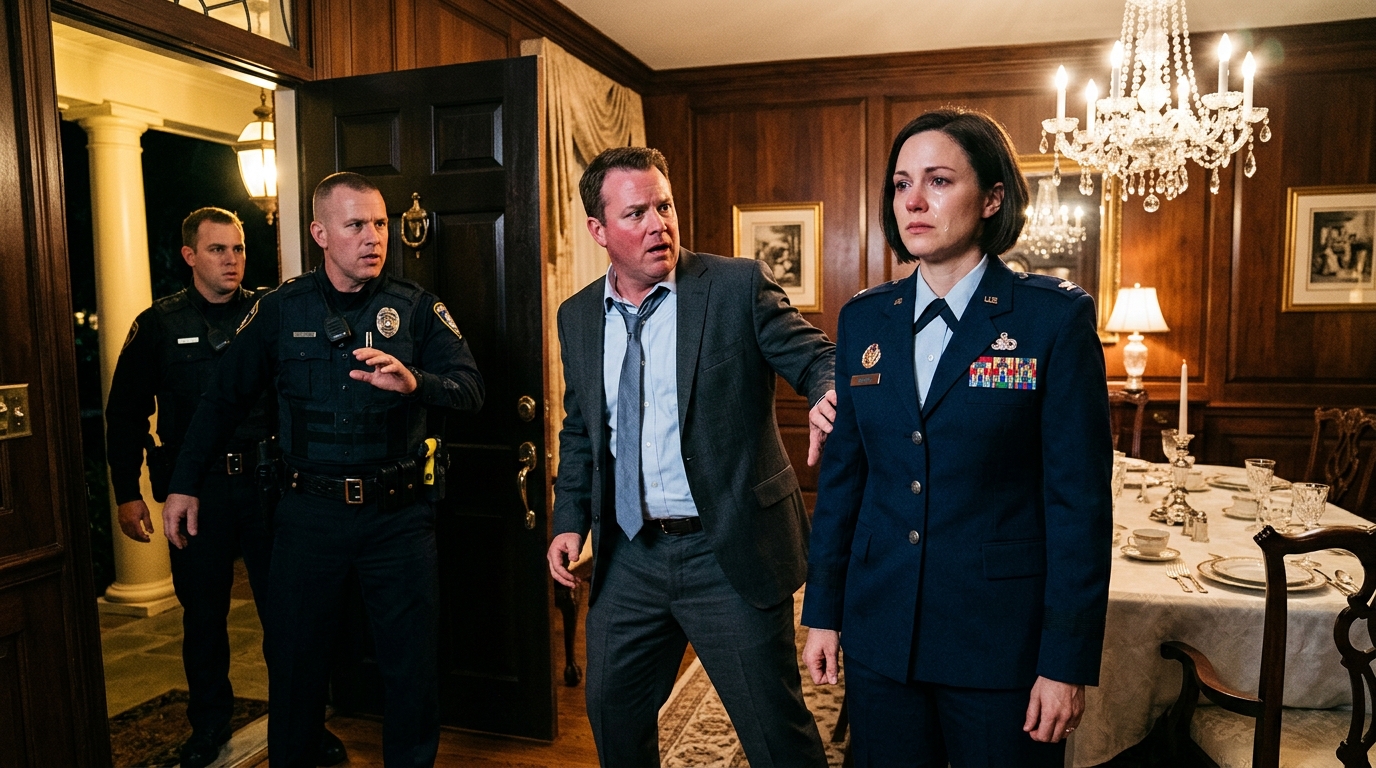
“SHIT! GET AWAY FROM MY WIFE!”
The roar ripped through the elegant dining room.
Crystal chandeliers shimmered above the long mahogany table, their light scattering across polished silver, untouched wine glasses, and plates of food no one would remember eating.
For one breath, nobody moved.
Not the guests seated around the table in dark suits and silk dresses.
Not the caterer frozen near the kitchen doors with a tray in both hands.
Not the elderly woman clutching her pearls at the far end.
All eyes turned toward the man standing beside the fireplace.
Victor Hale.
Real estate developer.
Political donor.
Charity board member.
A man who had spent his adult life believing money could turn volume into authority.
His face was crimson with fury.
One hand gripped his wife’s arm so tightly his knuckles had gone white.
His wife, Colonel Elise Hale, stood before him in full military dress uniform.
Dark blue jacket.
White shirt.
Medals across her chest, glinting softly beneath the chandelier.
Each one a story no one in that room had ever asked her to tell.
Her hair was pinned neatly. Her posture was straight. Her face was wet with tears.
Silent tears.
Not weak.
Not pleading.
Just falling.
Victor tightened his grip.
“You don’t get to humiliate me in my own house,” he hissed.
Elise did not pull away.
That frightened the room more than if she had fought.
Her gaze remained steady, fixed somewhere past his shoulder, as if she were holding herself in place by looking at a truth only she could see.
One of the guests, a councilman named Robert Keene, shifted uncomfortably.
“Victor, maybe let her—”
Victor snapped toward him.
“Stay out of my marriage.”
The councilman went quiet.
Everyone did.
They had watched the evening crack open slowly.
At first, the dinner had been beautiful.
A private celebration for Victor’s new veterans housing initiative, hosted in his lakefront mansion for donors, politicians, and press-friendly community leaders.
Elise had arrived late in uniform because Victor insisted she wear it.
“People respect sacrifice when it stands beside the money,” he had told her earlier that afternoon.
She had looked at him in the mirror.
“Is that what I am tonight?”
He smiled.
“Don’t be dramatic.”
At dinner, he praised her service.
Her bravery.
Her deployments.
Her resilience.
He placed one hand over hers for the photographer and called her “my warrior.”
Elise sat still through all of it.
Then a guest asked how Victor’s foundation chose which disabled veterans qualified for housing.
Victor smiled smoothly.
“We work through a rigorous need-based process.”
Elise lifted her eyes.
“No, you don’t.”
The table went silent.
Victor’s smile held for half a second too long.
“Elise.”
She set down her fork.
“You promised this money would build homes.”
His fingers tightened around his glass.
“It will.”
“You already moved half of it into shell contractors.”
A soft gasp came from the far end of the table.
Victor’s smile vanished.
“Elise, you’re tired.”
There it was.
The sentence he used when she became inconvenient.
Tired.
Overwhelmed.
Triggered.
Unstable.
Her tears had started then, but her voice did not break.
“Don’t do that.”
Victor stood.
She stood too.
He grabbed her arm.
The photographer lowered his camera.
Victor saw that and exploded.
“SHIT! GET AWAY FROM MY WIFE!”
As if the room had attacked him.
As if the camera had hurt him.
As if Elise’s truth were a weapon pointed at his throat.
Then came the knock.
Sudden.
Decisive.
Three hard strikes against the heavy front door.
Everyone turned.
The butler opened it with shaking hands.
The door swung inward.
Two uniformed officers stood beneath the porch light, rain dripping from the brims of their caps.
Behind them were two federal agents in dark jackets.
One officer stepped into the foyer.
“Nobody move!”
The command cut through the house.
Sharp.
Undeniable.
Victor’s expression cracked.
The fury drained from his face so quickly it left him almost gray.
His hand loosened on Elise’s arm.
She stepped away.
Still crying.
Still composed.
Her eyes met the officers’.
A silent understanding passed between them.
Victor looked from his wife to the police.
“What is this?”
The lead officer, Sergeant Anya Cross, walked into the dining room.
“Victor Hale?”
He swallowed.
“Yes.”
She held up a warrant.
“You’re under arrest for fraud, coercive control, unlawful surveillance, witness intimidation, and conspiracy to misappropriate federal veterans housing funds.”
The room went ice cold.
Victor stumbled back.
“No.”
Elise wiped one tear from her cheek.
Her voice was quiet.
“The police you threatened to call,” she said, “weren’t coming for me.”
The Woman He Thought Was Just A Symbol
Before Victor Hale turned her uniform into decoration, Elise Mercer had earned every medal on it.
She grew up in a small house outside Dayton, Ohio, raised by a father who fixed buses and a mother who taught high school history. Discipline in their home did not mean coldness. It meant showing up. Paying attention. Doing the thing you said you would do even when nobody applauded.
Elise joined the Army at nineteen.
Not for glory.
Not for politics.
For college money, yes.
For escape, partly.
But mostly because she wanted a life where courage had a clear definition.
That belief did not survive unchanged.
War taught her that courage was often messy.
A medic crawling through smoke.
A sergeant admitting he was afraid.
A commander choosing the slower road because the faster one would get civilians killed.
Elise became that kind of officer.
Careful.
Respected.
Unflashy.
The soldiers under her trusted her because she listened before ordering and never asked anyone to carry weight she would not touch herself.
She met Victor at a fundraiser after her second deployment.
He was charming then.
Or seemed to be.
He approached her not with pity, but admiration.
“Colonel Mercer,” he said, holding out his hand. “I’ve wanted to meet you. People keep telling me you’re the only honest person in this room.”
She raised an eyebrow.
“And did that make you curious or nervous?”
He laughed.
“Both.”
That was how it began.
Victor listened beautifully.
That was his first talent.
He asked about her work with injured veterans, about the housing gaps she had seen, about service members discharged into bureaucracy and debt.
He seemed angry about the right things.
“Why are people who served sleeping in cars?” he asked one night.
Elise thought the anger was compassion.
Later, she would learn Victor liked problems because problems created stages.
A year into their marriage, Victor proposed the Hale Veterans Housing Initiative.
He would fund the first phase.
She would advise.
Together, they would build transitional homes for veterans with disabilities, PTSD, traumatic brain injury, and families at risk of homelessness.
Elise hesitated.
“I won’t be your uniform in the brochure.”
Victor placed his hands on her shoulders.
“I would never reduce you to that.”
She believed him.
Not blindly.
But enough.
The early months were good.
Land was purchased.
Architects hired.
Veterans interviewed.
Elise sat with men and women who had lost limbs, marriages, sleep, memory, and trust. She wrote down what they actually needed.
Not inspirational murals.
Accessible bathrooms.
Soundproofing.
Child-safe spaces.
Transport access.
On-site legal aid.
Mental health care that did not feel like punishment.
Victor praised her detailed notes.
Then slowly stopped using them.
The designs changed.
Cheaper materials.
Fewer units.
More event space.
A “donor visibility pavilion.”
Elise objected.
Victor smiled.
“Funding requires optics.”
She pushed harder.
He softened his voice.
“Elise, you’re used to command structures. Nonprofits are different.”
Then came the first missing invoice.
A contractor billed for foundation work before construction began.
Then a shell company she did not recognize.
Then a transfer labeled community outreach that led to a consulting firm registered to Victor’s college friend.
Elise asked questions.
Victor called her anxious.
She asked the accountant.
The accountant resigned within a week.
She asked the project manager.
The project manager told her privately, “Colonel, I was told not to speak to you without Victor present.”
That night, Elise confronted her husband in the kitchen.
He did not yell.
Not then.
He smiled sadly.
“You’re spiraling.”
The word hit her like a slap.
“Don’t use that on me.”
“I’m worried about you.”
“No, you’re worried I’m reading.”
His face changed.
Only for a second.
Enough.
After that, the house became smaller.
Not physically.
The mansion still had too many rooms.
But Elise felt watched in all of them.
Victor asked where she was going.
Who she called.
Why she needed passwords.
Why she seemed agitated.
Why she was drinking coffee at midnight.
Why her old Army friend Marcus had texted her.
Why she locked her study door.
He never said, You cannot leave.
He said, “You’re not well enough to drive tonight.”
He never said, I control you.
He said, “Let me handle this before you embarrass yourself.”
He never said, No one will believe you.
He said, “People know trauma changes perception.”
That was the cruelty of it.
He used the language of care to build a cage.
The File Hidden In The Medal Case
Elise found proof because Victor underestimated grief.
He underestimated many things.
Workers.
Veterans.
Women.
Silence.
But especially grief.
In her closet, behind her uniforms, Elise kept a locked wooden case containing medals, old photographs, folded flags from fallen friends, and letters from soldiers she had commanded.
Victor never touched it.
Not out of respect.
Out of discomfort.
He disliked anything that reminded him her life had existed before his narrative of it.
Inside the false bottom of that medal case, Elise began hiding copies.
Bank transfers.
Emails.
Contract revisions.
Photographs of empty construction lots listed as completed site improvements.
A private memo describing disabled veterans as “high-empathy donor drivers.”
That phrase made her physically ill.
High-empathy donor drivers.
Men and women who had lost pieces of themselves reduced to fundraising texture.
She copied everything she could.
Then she called Marcus Vale.
Major Marcus Vale had served under her during her final deployment. He was retired now, working as an investigator for a federal inspector general’s office. He owed Elise his life, though she hated when he phrased it that way.
When she called, he did not ask if she was sure.
That was why she trusted him.
He asked, “Are you safe?”
Elise looked toward the hallway where Victor’s footsteps had paused outside her study.
“No.”
Marcus went quiet.
Then said, “Tell me what you need.”
They built the case slowly.
Carefully.
Elise could not simply leave.
That was what people always asked later.
Why didn’t she just leave?
Because Victor had already prepared the story.
A decorated colonel unraveling under untreated trauma.
A wife paranoid about her husband’s charity.
A woman triggered by veterans’ suffering.
A woman unstable enough to misread business documents.
He had spoken to doctors.
To donors.
To friends.
To her own brother.
He had created concern before she created accusation.
If she left too soon, he would bury her in sympathy.
If she exposed him without protection, he would destroy the evidence and call her breakdown tragic.
So Elise stayed.
And documented.
She smiled at galas.
She sat through dinners.
She let him introduce her as “my warrior” while a recorder hidden beneath her medal bar captured his private threats between speeches.
The plan for the final dinner was simple.
Victor would host donors in the house.
He would announce Phase Two of the veterans housing initiative.
Federal agents would already have warrants ready, but they needed confirmation that Victor intended to solicit additional funds using falsified completion reports.
Elise would confront him publicly enough to stop the donor transfer and privately enough to avoid endangering guests.
Victor did the rest himself.
He grabbed her.
Threatened the room.
Confirmed the shell contractors.
And, without realizing the house was already under surveillance by warrant, shouted that he would have her “committed before letting her burn everything.”
That line sealed the coercive control charge.
The officers arrived four minutes later.
At the dining table, Victor looked at Sergeant Cross and tried to become respectable again.
“This is a misunderstanding,” he said.
His voice shook.
Nobody who had heard him roaring seconds earlier believed the softness.
“My wife has been under enormous psychological strain.”
Elise’s face tightened.
Sergeant Cross looked at her.
“Colonel Hale, do you need medical attention?”
Victor answered first.
“She needs rest.”
Cross did not look at him.
“I asked Colonel Hale.”
Elise inhaled.
Her arm throbbed where his fingers had dug into her skin.
“No,” she said. “I need him away from me.”
The room heard it.
So did Victor.
His eyes snapped toward her, filled with betrayal.
That was almost laughable.
Men like Victor often feel betrayed when their victims stop cooperating with the lie.
The officers moved in.
Victor stepped back.
“This is my home.”
Cross nodded.
“Yes. That’s why the warrant covers the residence.”
One federal agent walked toward Victor’s study.
Another toward the stairs.
Victor’s face changed.
Not fear of arrest.
Fear of discovery.
“Do not go into my office without my attorney.”
The agent held up the warrant.
“Already covered.”
The guests watched as Victor Hale, host of the evening, founder of the charity, husband of the decorated colonel he had just publicly grabbed, was handcuffed beneath his own chandelier.
Elise did not look away.
She owed herself that.
The Husband Who Called Control Love
The trial revealed what Elise had lived.
Not all at once.
Not cleanly.
Courtrooms prefer timelines.
Abuse rarely does.
Prosecutors built the financial case first.
The Hale Veterans Housing Initiative had raised forty-eight million dollars over three years. Less than nine million reached actual housing work. Of the promised hundred and twenty units, only seventeen were completed, and five failed accessibility inspections.
Money moved through shell contractors.
Then consulting agreements.
Then private investment accounts.
Then campaign donations tied to zoning approvals for Victor’s other real estate projects.
The veterans were photographed.
Profiled.
Quoted.
Paraded at fundraisers.
Then left waiting.
One man, Sergeant Luis Alvarez, testified that Victor’s team used his image on donation materials for eighteen months before his wheelchair-accessible apartment was canceled for “budget restructuring.”
He slept in his van for seven of those months.
Elise sat in the courtroom and cried silently as he spoke.
Luis looked at her and shook his head.
Not in blame.
In recognition.
Victor’s defense tried to separate him from the worst of it.
Complex nonprofit structures.
Delegated decisions.
Miscommunication.
Ambitious projections.
Then prosecutors played the recordings.
Victor in his study, voice low:
“Donors don’t pay for drywall, Elise. They pay for redemption.”
Victor on the phone:
“Move the veteran families to the site tour after the press arrives. Make sure the amputee kid is near the front.”
Victor at the dinner, captured beneath Elise’s medal bar:
“If you open your mouth tonight, I will make every doctor you ever saw swear you’ve been unstable for years.”
The courtroom went still.
Elise did not lower her eyes.
Then came the personal case.
Coercive control.
Surveillance.
Threats.
Medical manipulation.
Financial isolation.
The prosecutor showed how Victor paid a private security firm to track Elise’s movements. How he accessed her therapy records through a physician he later rewarded with foundation consulting money. How he drafted a crisis statement claiming Elise had suffered a service-related breakdown before she ever confronted him publicly.
He had planned her discrediting like a press rollout.
Victor’s attorney tried to frame it as concern.
“Mr. Hale was worried about his wife.”
Sergeant Cross testified.
“Worried husbands don’t prepare psychiatric statements to release after fraud exposure.”
Marcus Vale testified too.
He described Elise’s careful evidence chain, her fear, her refusal to endanger donors or staff, her insistence that the veterans’ money be frozen before Victor could move it overseas.
Victor watched him with hatred.
Marcus did not care.
When Elise took the stand, the courtroom filled early.
Reporters expected drama.
They expected tears.
They got the truth.
Quiet.
Precise.
Devastating.
The prosecutor asked, “Colonel Hale, why did you attend the dinner in uniform?”
Elise looked at the jury.
“Because my husband wanted to use it.”
“And why did you agree?”
“Because I needed him to believe he still controlled the room.”
Victor stared at the table.
“Were you afraid?”
“Yes.”
“Of what?”
“That if I spoke too soon, he would destroy the evidence. If I waited too long, more veterans would be used.”
The prosecutor paused.
“And in the dining room, when he grabbed you, why didn’t you pull away?”
Elise’s voice tightened.
“Because I wanted everyone to see what he became when I stopped performing loyalty.”
The room went silent.
Victor’s attorney cross-examined aggressively.
“Colonel Hale, you are trained in combat, correct?”
“Yes.”
“You could have physically defended yourself from my client.”
“Yes.”
“But you did not.”
“No.”
“Why?”
Elise looked at him.
“Because whether I could break his wrist has nothing to do with whether he abused me.”
The attorney blinked.
A murmur moved through the gallery.
She continued before he could recover.
“Strong women can be controlled. Soldiers can be threatened. Medals don’t make you immune to being isolated, discredited, or hurt by someone you trusted.”
The jury heard that.
So did every camera outside the courtroom.
Victor was convicted on fraud, conspiracy, money laundering, witness intimidation, unlawful surveillance, and coercive control-related charges under state statutes tied to domestic abuse and intimidation. Several associates pled guilty. The doctor who provided private records lost his license and faced charges. Two foundation executives cooperated.
At sentencing, Victor finally looked at Elise.
“You ruined me,” he said.
She stood at the victim impact podium in uniform again.
Not because he asked.
Because she chose it.
“No,” she said. “I stopped helping you look whole.”
The Veterans Who Were More Than Donor Stories
The recovered money did not fix everything.
Elise hated when articles implied it did.
Forty-eight million stolen did not return years to veterans living in cars.
It did not repair marriages strained by homelessness.
It did not restore dignity to people used in glossy brochures while their applications sat unread.
But restitution mattered.
The court placed the remaining foundation assets under independent receivership. Elise refused to lead it.
“I was used as the face once,” she told the judge. “Do not make me the face again. Put veterans in charge.”
A new board formed.
Sergeant Luis Alvarez joined.
So did Captain Dana Brooks, a double amputee and disability-access attorney.
So did Denise Harper, widow of a veteran who had died waiting for housing assistance.
Elise accepted an advisory role with no salary.
She attended the first board meeting in civilian clothes.
Not because she was ashamed of the uniform.
Because she wanted them to see her without it too.
The housing initiative was renamed The Open Door Veterans Trust.
No donor pavilions.
No staged suffering.
No photographs without consent.
No gala speeches before walls were built.
The first completed home under the trust went to Luis Alvarez and his daughter.
Elise attended the move-in privately.
Luis rolled through the front door, stopped in the hallway, and touched the wall like he needed to confirm it was real.
His daughter ran straight to the bedroom.
“Dad! There’s a window!”
Luis laughed.
Then cried.
Elise stood on the porch, looking away to give him privacy.
He noticed anyway.
“Colonel.”
She turned.
“Thank you,” he said.
She shook her head.
“I should have caught it sooner.”
“Maybe.”
The honesty startled her.
Luis continued.
“But you caught it.”
That was not absolution.
It was enough for that moment.
Elise moved out of Victor’s mansion the week after sentencing.
She took little.
Uniforms.
Medal case.
Books.
Her mother’s quilt.
A chipped mug from her first duty station.
She left the chandeliers.
The wine cellar.
The dining table.
The bedroom with its locked feeling.
The house was seized as part of restitution.
Months later, it was sold.
The money funded housing.
Elise visited once before the sale, walking through empty rooms with Sergeant Cross beside her.
In the dining room, sunlight fell across the floor where Victor had grabbed her.
Cross asked, “Do you want a minute?”
Elise looked at the spot.
“No.”
Then after a pause, “Actually, yes.”
Cross waited near the doorway.
Elise stood beneath the chandelier and let memory come.
His grip.
The guests.
The command at the door.
Her own tears.
The silent understanding with the officers.
For months, she had wondered if crying made the moment look weak.
Then letters began arriving.
From women.
Veterans.
Police officers.
Nurses.
Teachers.
A retired general’s wife.
A young lieutenant.
They wrote versions of the same sentence.
I thought being strong meant it couldn’t happen to me.
Elise kept the letters in a box beside the medal case.
Not trophies.
Reminders.
She had not cried because she was weak.
She cried because her body knew the truth was finally leaving captivity.
At the empty dining table, she touched her arm where bruises had long faded.
Then she walked out.
The Door That Opened For Her
Two years later, Elise stood outside a finished housing complex on a cold morning in March.
Not a mansion.
Not luxury.
Something better.
Practical.
Beautiful in its usefulness.
Wide doors.
Ramps built into the landscape instead of added like apologies.
Sound-insulated units.
Courtyards.
On-site counseling offices.
Childcare rooms.
A legal clinic.
A small memorial wall listing veterans and families harmed by the original Hale fraud.
At the entrance was a plaque:
THE OPEN DOOR VETERANS TRUST
Built with recovered funds. Governed by those it serves.
No mention of Victor.
Elise had insisted.
“Let his name stay in the court record,” she said. “Not on the door.”
At the opening, no one wore tuxedos.
There was coffee in paper cups.
Folding chairs.
Kids running between adults.
A service dog sleeping through speeches.
Luis spoke first.
Dana Brooks after him.
Denise Harper cut the ribbon.
Elise stood in the back.
She preferred it that way.
Then Dana called her name.
“Colonel Mercer.”
Elise closed her eyes briefly.
Mercer.
She had taken her name back after the divorce finalized.
The crowd turned.
She walked forward.
No uniform today.
Dark coat.
Simple scarf.
Her medal case remained at home.
The applause made her uncomfortable.
She waited until it faded.
“I don’t want to give a speech,” she said.
Luis called out, “Too bad.”
Laughter moved through the crowd.
Elise smiled.
A little.
“I spent too long in rooms where people talked beautifully about sacrifice while quietly benefiting from it,” she said. “So I’ll be plain.”
The crowd quieted.
“This building exists because people were harmed. Because veterans were used. Because money was stolen. Because I ignored small wrongs at first, then feared the cost of naming larger ones.”
She looked at the residents.
“It also exists because witnesses came forward. Because investigators listened. Because survivors told the truth even when lawyers tried to make truth sound unstable.”
Her voice tightened.
“I used to think courage was something you proved once. It isn’t. It’s maintenance. Daily. Boring. Exhausting. Necessary.”
She looked toward the open doors.
“So may this place be less about courage and more about rest. May nobody here have to perform suffering to deserve help.”
No one clapped immediately.
That made her glad.
Then Luis’s daughter, now nine, started clapping.
Everyone followed.
After the ceremony, a young woman approached Elise near the coffee table.
She wore an Army sweatshirt and held her sleeves over her hands.
“My boyfriend says I’m unstable,” she said quickly, as if afraid she would lose the words.
Elise turned fully toward her.
“Are you safe today?”
The woman’s eyes filled.
“I don’t know.”
Elise set down her coffee.
“Then let’s start there.”
Years later, people still told the story of the elegant dinner where a powerful man screamed at his military wife, grabbed her arm, and threatened to call the police—only for officers to arrive and arrest him instead.
They remembered the chandelier.
The medals.
The tears.
The sudden knock.
The command at the door.
The way Victor Hale’s face turned pale when he realized the police were not there for her.
Those were the dramatic parts.
But Elise remembered something smaller.
The moment Sergeant Cross asked her, not Victor, if she needed medical attention.
I asked Colonel Hale.
It was the first time in months that someone in a room full of people treated her answer as the one that mattered.
That was where freedom began.
Not with handcuffs.
Not with headlines.
With being asked directly.
And believed.
Elise kept serving after retirement, though not in uniformed command. She trained investigators and advocates on coercive control among high-status abusers. She spoke to military families about the danger of assuming rank, toughness, or public success protects anyone from private manipulation.
She used her own story carefully.
Never as spectacle.
Always as a door.
Sometimes, after speaking, someone would ask why she cried that night if she was not afraid.
Elise always answered the same way.
“I was afraid. I was also brave. Those are not opposites.”
Victor died years later in prison after a heart attack.
A reporter called asking for comment.
Elise declined.
Not out of mercy.
Out of disinterest.
He had taken enough of her voice.
He did not get her silence as a final tribute either.
Instead, that afternoon, she visited the Open Door complex. Children were drawing chalk stars on the sidewalk. Luis was arguing with a maintenance worker about garden beds. Dana was in the legal clinic, terrifying an insurance company on speakerphone.
Elise sat on a bench beneath a young maple tree and watched people enter and leave through doors that opened easily.
No buzzers controlled by donors.
No staged tours.
No polished speeches required to justify help.
Just doors.
Open.
Useful.
Real.
A little boy ran past, then stopped in front of her.
“Are you the soldier lady?” he asked.
Elise smiled.
“I was.”
“My dad says you helped build this.”
“A lot of people did.”
“But you cried on TV.”
Elise blinked.
Children had a gift for walking straight into truth.
“Yes,” she said. “I did.”
“Were you sad?”
“Yes.”
“Scared?”
“Yes.”
He thought about that.
“Did you still win?”
Elise looked at the building.
At the ramp.
At the families.
At the life made possible from money once stolen.
Then she looked back at him.
“I told the truth,” she said. “That mattered more.”
The boy accepted that and ran off.
Elise sat beneath the tree as evening light softened the courtyard.
The memory of the dining room no longer owned her.
It remained.
It always would.
The grip on her arm.
The rage.
The tears.
The knock.
But memory had changed shape.
Once, it had been the night Victor’s control became visible.
Now it was also the night her own voice stopped hiding.
People thought the officers saved her.
They helped.
They acted.
They mattered.
But Elise had opened the door before they arrived.
With evidence.
With patience.
With tears.
With a uniform he tried to use and she reclaimed.
The police he threatened to call did come.
Not for the fragile wife he invented.
Not for the unstable soldier he planned to present.
They came for the man who believed power meant owning the room, the story, and the woman standing inside both.
And when the command rang through the house—
Nobody move—
the only person who truly stopped moving was Victor.
Elise had already begun walking out.