Almost there.
The words were barely louder than the evening wind.
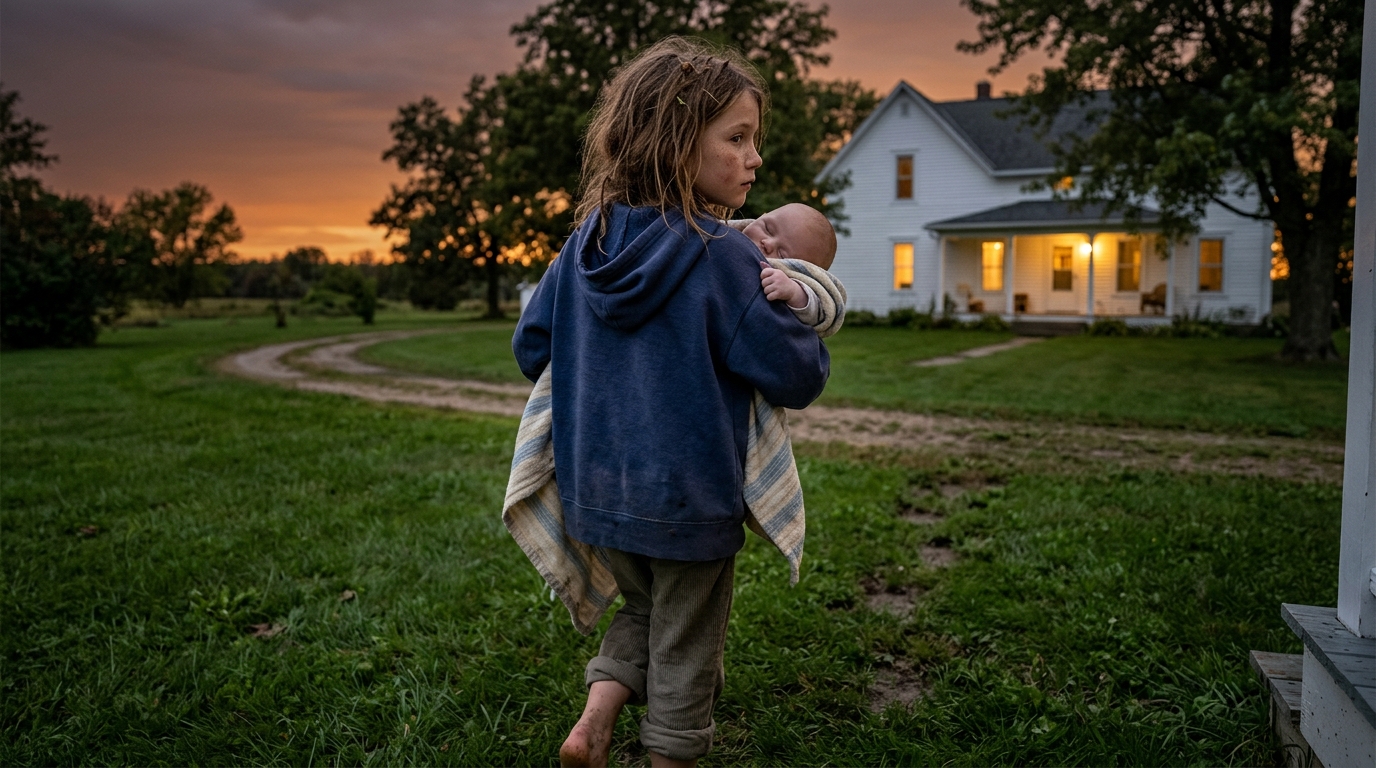
A little girl moved through the damp grass with a baby in her arms.
Her bare feet sank into the cold lawn with every step. Mud clung to her ankles. Small cuts marked her heels. Leaves and twigs tangled in her wild brown hair, and dirt smudged one freckled cheek where she had wiped away tears with the back of her hand.
She could not have been more than nine.
Maybe ten.
Too young to be walking alone through the deepening dusk.
Too young to be carrying a baby as if the whole world depended on the strength of her thin arms.
But she did not stop.
Ahead of her, at the end of a long winding lawn, stood a white house with warm lights glowing in the windows.
A porch lamp flickered softly.
A single beacon in the dark.
The girl stared at it like it was not a house at all, but a promise.
The baby against her shoulder breathed in small, even puffs. One tiny hand clutched the torn collar of her dress, fingers curled trustingly against her skin.
The girl tightened her hold.
“I’ve got you,” she whispered.
Her voice trembled.
But it did not break.
Behind her, beyond the trees, far down the hill, a dog barked.
She froze.
The baby stirred.
The girl turned her head, eyes wide, listening.
Another bark.
Then a shout.
Distant.
Male.
Angry.
Her small body went rigid.
“No,” she breathed.
She looked back at the white house.
Still too far.
The lawn seemed endless.
The sky had turned bruised purple at the edges. Gold faded behind the tree line. Fireflies flickered in the grass like tiny warnings.
She started walking again.
Faster now.
Each step left a dark footprint in the dew.
Her arms ached.
Her chest burned.
Her legs shook so badly she nearly fell twice.
But each time the baby made the smallest sound, she pulled him closer and kept going.
“Almost there,” she said again.
Not to herself.
To him.
To the baby her mother had placed in her arms three hours earlier with shaking hands and a face full of fear.
Run to the white house.
Don’t stop.
Don’t knock at any other door.
Ask for Mrs. Whitmore.
If they say she’s not there, don’t believe them.
Tell her your name.
Then give her the bracelet.
The girl had not understood.
Not fully.
She only knew her mother was crying.
Her mother never cried where anyone could see.
Now the girl reached the stone path leading to the porch.
Her knees nearly buckled with relief.
Warm light spilled through lace curtains.
Inside, people were laughing.
A dinner party.
Silver clinked.
Music played softly.
The little girl climbed the first porch step.
Then the second.
She lifted one muddy hand and knocked.
Too softly.
No one heard.
She swallowed, then knocked again.
Harder.
Inside, the laughter dimmed.
Footsteps approached.
The door opened.
A woman in a black evening dress stood there, pearls around her throat, gray hair pinned neatly, her expression already irritated by the interruption.
Then she saw the child.
Barefoot.
Filthy.
Shaking.
Holding a baby wrapped in a torn blue blanket.
The woman’s face changed.
Not softened.
Hardened.
“Good Lord,” she said. “What is this?”
The girl looked up.
Her lips trembled.
“Are you Mrs. Whitmore?”
The woman’s eyes narrowed.
“Who are you?”
The baby whimpered.
The girl shifted him higher against her shoulder.
“My name is Lily.”
The woman’s hand tightened on the doorframe.
For one small second, fear crossed her face.
Then vanished.
“Go around to the service entrance,” she said coldly. “This is not—”
Lily reached into the pocket of her torn dress.
Her fingers closed around the one thing she had protected the entire journey.
A thin silver bracelet.
Tiny.
Old.
Engraved with a small crescent moon and the initials E.W.
She held it up.
“My mama said you’d know this.”
The woman stopped breathing.
Behind her, a man’s voice called from the dining room.
“Eleanor? Who is it?”
Mrs. Whitmore stared at the bracelet as if the dead had reached through the door and touched her throat.
Lily’s eyes filled.
“She said to tell you,” the girl whispered, “that he’s alive.”
The room behind the woman went silent.
The baby opened his eyes.
Mrs. Whitmore looked from the bracelet to the baby.
Then to Lily.
And all the color drained from her face.
Because the silver bracelet had belonged to her daughter.
The daughter she buried eight years ago.
The House With The Warm Lights
Eleanor Whitmore had spent eight years teaching the world not to mention her daughter’s name.
Not because she did not love Emily.
She did.
In the ruined, controlling, unfinished way some mothers love daughters they never truly understood.
Emily Whitmore had been nineteen when she disappeared.
Beautiful.
Stubborn.
Too kind to the wrong people, according to Eleanor.
Too unwilling to accept the life arranged for her.
She was supposed to marry a senator’s son.
She was supposed to help preserve the family name.
She was supposed to smile at charity luncheons, wear pearls, produce children with respectable bloodlines, and never ask why the Whitmore money smelled faintly of other people’s labor.
Instead, Emily fell in love with Daniel Reyes.
A groundskeeper’s son.
A scholarship student.
The kind of young man Eleanor’s friends called “promising” until he stood too close to their daughters.
Eleanor had forbidden it.
Emily had laughed.
Not cruelly.
Worse.
Sadly.
“You can forbid me from a room,” she said. “Not from a life.”
Eleanor slapped her.
It was the only time.
She regretted it immediately.
But regret, in women like Eleanor, often came disguised as pride.
Three weeks later, Emily was gone.
Her car was found near the river after a storm.
No body at first.
Then a coat.
A shoe.
A bracelet missing from her wrist.
Police called it accidental drowning.
Eleanor accepted that because the alternative was admitting Emily had left her willingly.
A funeral was held.
A memorial stone placed beneath the old oak.
The silver bracelet was never recovered.
Eleanor told herself the river took it.
Now, eight years later, a barefoot girl stood at her door holding that exact bracelet in muddy fingers.
Behind Eleanor, guests were standing from the dinner table.
Her husband, Charles Whitmore, appeared in the hall, face stern.
“What is going on?”
Eleanor did not answer.
She could not.
The little girl swayed.
The baby gave a weak cry.
Only then did Eleanor notice how pale the child was.
How blue her lips looked.
How tightly she held the baby, not from drama, but because her arms had nearly stopped working.
Charles stepped closer.
“Eleanor?”
Lily whispered, “Please. My brother’s cold.”
Brother.
The word struck Eleanor strangely.
Not son.
Brother.
She reached for the baby by instinct.
Lily pulled back immediately.
“No.”
Eleanor froze.
The child’s eyes were terrified now.
Not of the house.
Of losing him.
“My mama said only Mrs. Whitmore,” Lily whispered. “Nobody else.”
Charles’s face darkened.
“Who sent you?”
Lily looked at him.
Then at Eleanor.
“My mama.”
“What is her name?” Eleanor asked.
The girl swallowed.
“Anna.”
Eleanor frowned.
Not Emily.
Of course not Emily.
And yet—
Lily’s mouth.
The shape of her eyes.
The little crease between her brows when she was scared.
Something old and impossible moved beneath Eleanor’s ribs.
“Anna who?”
Lily’s voice became smaller.
“Anna Reyes.”
Charles stepped back as if slapped.
Eleanor turned to him.
“You know that name?”
He said nothing.
That was answer enough.
The baby began crying harder.
A woman from the dining room came forward.
“Eleanor, the child needs to come in.”
It was Margaret Bell, Eleanor’s oldest friend and the only woman in the room brave enough to interrupt money with common sense.
Eleanor stepped aside.
Lily hesitated.
Then crossed the threshold.
The warm light fell over her mud-streaked face.
The baby’s blue blanket was soaked at one corner. His tiny cheeks were flushed with cold. Lily’s arms trembled violently now that safety was close enough to make her body admit exhaustion.
Margaret took off her shawl and wrapped it around Lily’s shoulders.
Lily flinched.
Then whispered, “Thank you.”
Charles looked toward the driveway.
“Were you followed?”
Lily’s face changed.
Eleanor saw it.
Yes.
The answer was yes.
Before anyone could ask more, headlights swept across the front windows.
A car came fast up the long drive.
Too fast.
Lily turned toward the sound and made a small broken noise.
“He found us.”
Eleanor grabbed her arm gently.
“Who?”
The girl looked toward the door.
“The man who took Mama.”
The dining room went still.
Charles’s face turned gray.
Outside, tires crunched over gravel.
A car door slammed.
Then a man’s voice called through the night.
“Mrs. Whitmore! I know the girl is in there.”
Eleanor recognized the voice before she saw the face.
Victor Hale.
Her husband’s attorney.
The man who handled every difficult family matter.
The man who had arranged Emily’s funeral.
The man who told Eleanor eight years ago that grief required closure.
Lily clutched the baby tighter.
Eleanor looked at the silver bracelet in her hand.
Then at Charles.
Then toward the door.
For the first time in eight years, she understood that closure had not been given to her.
It had been constructed around her like a cage.
The Bracelet From The River
Victor Hale entered the house as if he owned it.
He did not wait for permission.
He pushed through the front door in a dark overcoat, rain mist clinging to his shoulders, his silver hair immaculate despite the wind outside.
Two men stood behind him on the porch.
Not police.
Not staff.
Security.
Eleanor saw that instantly.
And something inside her cooled.
Victor smiled politely.
“My apologies for the disturbance.”
No one answered.
His gaze moved to Lily.
Then to the baby.
For one second, his expression hardened.
There.
Eleanor saw it.
Not surprise.
Frustration.
He had expected to find them.
He had not expected the dinner guests.
Victor turned to Charles.
“This is a private matter.”
Margaret Bell stepped closer to Lily.
“A child arriving barefoot with a baby is not private. It’s an emergency.”
Victor’s smile tightened.
“Mrs. Bell, I assure you—”
“You assure too much.”
The room shifted.
Victor looked back at Eleanor.
“Eleanor, the girl is confused. She belongs to an unstable woman who has been making false claims against your family.”
Lily whispered, “Mama’s not unstable.”
Victor ignored her.
“She likely stole that bracelet.”
Eleanor held up the silver bracelet.
“From whom?”
Victor did not answer quickly enough.
Charles spoke at last.
“Eleanor, let Victor handle this.”
She turned slowly toward her husband.
Let Victor handle this.
How many years had that sentence shaped her life?
Emily is emotional. Let Victor handle this.
The police need direction. Let Victor handle this.
The press must not twist our tragedy. Let Victor handle this.
The estate needs protection. Let Victor handle this.
Eleanor’s voice was quiet.
“What did you do?”
Charles looked wounded.
That old trick.
“I lost a daughter.”
“No,” Eleanor said. “What did you do before I lost her?”
The room held its breath.
Victor stepped between them.
“This is not helpful.”
Eleanor looked at him.
“I was not speaking to you.”
Lily, still wrapped in Margaret’s shawl, reached into the baby’s blanket and pulled out a folded piece of paper sealed in plastic.
“My mama said if Mrs. Whitmore didn’t believe me, give her this.”
Victor moved.
Fast.
Toward the paper.
Eleanor moved faster than anyone expected.
She stepped in front of Lily.
“Do not touch her.”
Victor stopped.
The softness fell from his face.
For a moment, the room saw the man beneath the lawyer.
Cold.
Impatient.
Dangerous.
Lily handed the paper to Eleanor.
Eleanor opened it carefully.
Inside was a letter written in shaky handwriting.
Mrs. Whitmore,
My name is Anna Reyes. My mother was Emily Whitmore. She did not drown. She ran because she was pregnant and afraid of what your husband would do when he found out. Daniel Reyes was my father. They were married in secret two days before she disappeared.
Eleanor gripped the paper.
The room blurred.
She kept reading.
Emily died when I was little. Before she died, she told me the bracelet was proof. She said if I was ever in danger, I had to find you. I waited because I thought danger had passed. It had not. Victor Hale found us after my son was born. He said the Whitmore bloodline had to be “contained.” He took me tonight. Lily escaped with the baby. If they reach you, please know: I am not asking for money. I am asking you to stop them from erasing my children the way they erased my mother.
Eleanor’s hands shook so badly Margaret reached to steady the page.
At the bottom was a name.
Anna Reyes Whitmore.
And beneath it:
The baby’s name is Gabriel. Lily knows where I hid the rest.
Eleanor looked up.
Victor’s face was pale now, but not frightened.
Calculating.
Charles had sunk into a chair.
“Emily was pregnant,” Eleanor whispered.
He covered his face with one hand.
That answer broke something that had been waiting in her for eight years.
“You knew.”
Charles did not deny it.
Lily’s voice trembled.
“My mama said Grandpa Charles sent the men.”
Charles flinched.
“No.”
The word came out too late.
Victor seized the opening.
“Enough. This child has been coached by a criminal.”
Eleanor laughed once.
It was not a pleasant sound.
“A criminal?”
Victor reached into his coat.
One of the guests gasped.
But he removed a document packet.
“Emergency custody order. Anna Reyes was detained tonight for psychiatric evaluation after making threats against the Whitmore family. The children must be returned to authorized care.”
Lily began shaking.
Eleanor looked at the papers.
Then at Victor.
“Which judge signed this?”
“Judge Harlan.”
Margaret hissed, “Of course.”
Eleanor knew the name.
Judge Harlan had presided over Emily’s estate matters after her presumed death. An old friend of Charles. A hunting companion. A man whose wife wore Whitmore pearls to galas.
Eleanor folded the custody order once.
Then again.
Victor’s eyes narrowed.
“Eleanor.”
She tore it in half.
The room gasped.
Victor’s two men stepped forward.
Then the sound came.
A knock at the open doorway.
Not loud.
Not dramatic.
Just firm.
A woman stood on the porch holding a badge.
Detective Anya Cross.
Behind her were two uniformed officers.
“Good evening,” she said. “I’ll take the child’s statement now.”
Victor turned white.
Eleanor looked at him and understood.
He had not come to rescue anyone.
He had come to retrieve evidence before someone outside his reach heard the truth.
The Daughter Who Was Never Dead
Detective Cross had been looking for Anna Reyes for three months.
That was the first thing she told Eleanor after officers removed Victor’s men from the porch and secured the house.
Not publicly.
Not in front of everyone.
In the library, where Lily sat on the leather sofa with Gabriel asleep against her, still refusing to let the baby out of arm’s reach.
Margaret stayed beside her.
Eleanor sat across from Detective Cross.
Charles remained near the fireplace, gray and silent.
Victor was not arrested yet.
He stood in the foyer with an officer watching him, calling attorneys in a voice that had lost some of its smoothness.
Detective Cross opened a folder.
“Anna contacted my office after discovering old records tied to Emily Whitmore’s disappearance.”
Eleanor whispered, “Why didn’t she come to me?”
Cross did not soften the answer.
“Because she believed you helped erase Emily.”
Eleanor looked down.
Had she?
Not intentionally.
But intention felt like a small defense beside eight years of silence.
Cross continued.
“Emily Whitmore married Daniel Reyes in a county clerk’s office under the name Emily White. We have the certificate. They intended to leave the state. She was pregnant.”
Charles made a sound.
Eleanor looked at him.
He would not meet her eyes.
Detective Cross placed a photograph on the table.
Emily.
Younger.
Hair loose.
Smiling at Daniel Reyes, who held her hand like she was something holy and real.
Eleanor touched the edge of the photograph.
“She looks happy.”
Charles closed his eyes.
Cross said, “According to Anna, Emily and Daniel were stopped before they could leave. Daniel was beaten and warned off. Emily was taken to a family property outside the city.”
Eleanor’s voice broke.
“Taken by whom?”
Cross looked at Charles.
He finally spoke.
“I wanted to talk sense into her.”
Eleanor stared at him.
“Talk sense?”
“She was nineteen. Pregnant. Married to the gardener’s son. She was going to throw away everything.”
“She was your daughter.”
“I know.”
“No,” Eleanor said. “You do not.”
Charles’s face crumpled.
“I did not know Victor would—”
“Would what?”
Silence.
Detective Cross answered.
“Records suggest Victor Hale arranged for Emily to be moved through a private clinic under a false name. When she escaped, he staged the river evidence. Her coat. Her shoe. The accident report.”
Eleanor felt sick.
“She was alive.”
“Yes.”
“For how long?”
Cross looked at Lily.
The child was listening.
Too closely.
Eleanor realized the detective was choosing words carefully.
“Emily lived under assumed names for several years. She gave birth to Anna. Daniel Reyes found them once. He died shortly afterward in what was ruled a workplace accident.”
Lily whispered, “Mama said Grandpa Daniel fell.”
Detective Cross’s face tightened.
“Yes.”
Eleanor understood the look.
Another accident.
Another convenient death.
Charles whispered, “I didn’t know.”
Eleanor turned on him.
“You keep saying that as if it absolves you.”
He looked ruined.
Good, she thought.
Then hated herself for the satisfaction.
But the room still smelled of Lily’s wet clothes, baby formula, fear, and the mud she had tracked across Eleanor’s perfect rug.
Let him be ruined.
Some ruin was overdue.
Detective Cross leaned toward Lily.
“Lily, can you tell us where your mother hid the rest?”
Lily’s fingers tightened around Gabriel.
“My mama said only after Mrs. Whitmore promises.”
Eleanor’s throat closed.
“What promise?”
Lily looked at her.
“You have to promise not to give us back.”
Eleanor stood.
Too fast.
The room tilted slightly.
She crossed to the sofa and slowly knelt in front of the child.
Her knees protested.
She ignored them.
Lily watched her carefully.
A child who had learned adults could be doors or traps.
Eleanor placed the silver bracelet on the low table between them.
“I should have protected your grandmother,” she said.
Lily blinked.
Nobody had told her that version yet.
“I did not,” Eleanor continued. “I believed the story that hurt her because it was easier than fighting my own husband. I cannot undo that.”
Her voice trembled.
“But I can promise this: I will not give you back to anyone who harmed your mother. I will not let them erase you.”
Lily stared at her.
“For real?”
“For real.”
“Even if Grandpa Charles says?”
Eleanor looked at Charles.
His face folded.
“Especially then,” she said.
Lily nodded.
Then whispered, “The tree.”
“What tree?”
“The one with the angel.”
Eleanor knew it immediately.
The memorial oak.
Where Emily’s stone stood.
Where Eleanor had placed flowers every year for a daughter who was never in the ground.
Lily looked down at Gabriel.
“Mama said the truth is under the angel.”
The Angel Beneath The Oak
They went at dawn.
Eleanor insisted on coming.
So did Lily.
Detective Cross objected at first because the property needed to be secured and the child needed rest. Lily refused to sleep until her mother was found. Eleanor understood that kind of refusal.
Some fears do not rest because adults order them to.
The memorial oak stood at the far end of the Whitmore grounds, past the rose garden and the old stone fountain that no longer worked.
A small angel statue sat beneath the tree, hands folded, face tilted downward in permanent mourning.
Emily Whitmore
Beloved Daughter
Forever In Our Hearts
Eleanor had chosen the words.
Now they felt obscene.
Beloved, yet not believed.
Forever in our hearts, while alive somewhere without help.
Lily stood beside the stone, holding Margaret’s hand while another officer held Gabriel. For the first time, Lily had allowed someone else to carry him, but only because Margaret promised not to step more than three feet away.
Detective Cross’s team carefully lifted the angel statue.
Beneath it was a metal box wrapped in plastic and oilcloth.
Eleanor covered her mouth.
Inside were documents.
A marriage certificate.
Emily’s letters.
Daniel Reyes’s statement.
Photographs of Anna as a baby.
A hospital bracelet.
Bank records.
A flash drive.
And a small cassette tape labeled:
For my mother, if she ever asks why I ran.
Eleanor sat down in the wet grass.
No one told her not to.
Detective Cross played the tape later in the library, after making copies under evidence protocol.
Emily’s voice filled the room.
Young.
Unsteady.
Alive.
“Mom, if you hear this, I’m either safe enough to send it or gone enough that the truth can’t hurt me more.”
Eleanor bent forward, both hands over her mouth.
“I married Daniel because I love him. Not because I wanted to shame you. Not because I was confused. Not because he tricked me. I know that’s what Dad will say.”
Charles sobbed once.
Eleanor did not look at him.
Emily continued.
“I’m pregnant. Her name will be Anna if she’s a girl. Daniel says she’ll have your stubborn chin. I told him that’s not a compliment.”
A broken laugh escaped Eleanor.
It dissolved into a sob.
“I didn’t drown. If they say I did, they lied. Dad sent Victor to bring me home. Victor said families like ours do not let blood wander into the wrong names. I was scared. I ran. Daniel helped me.”
A pause.
“I wanted to call you. I did. But I kept remembering the night you slapped me, and how Dad stood there, and how quiet the house got after. I didn’t know if you would choose me.”
Eleanor closed her eyes.
There are sentences that enter the body and never leave.
I didn’t know if you would choose me.
The tape crackled.
“If Anna ever finds you, please don’t make her prove she belongs. Children should not have to arrive with evidence.”
Lily leaned against Margaret, eyes wet.
Eleanor reached for her hand.
The child hesitated.
Then took it.
The tape ended with Emily whispering:
“I love you, Mom. I just couldn’t survive your silence.”
No one spoke for a long time.
Then Detective Cross’s phone rang.
She answered, listened, and her expression sharpened.
“We found Anna.”
Lily stood so fast she nearly tripped.
“Alive?”
Cross nodded.
“Alive.”
The Mother In The Locked Room
Anna Reyes was found in a private psychiatric facility forty miles away.
Not admitted properly.
Not processed through ordinary channels.
Held under emergency evaluation papers signed by Judge Harlan and supported by a statement from Victor Hale claiming she had attempted to extort the Whitmore family and posed a risk to her children.
The facility had not questioned why no children were brought in.
They had not questioned why Anna arrived sedated.
They had not questioned why Victor’s men remained in the hall.
Money makes some places very incurious.
Detective Cross arrived with a warrant, two officers, and a county child protection supervisor not tied to Judge Harlan’s network.
Eleanor came too.
She was told to wait in the car.
She did not.
When they opened the locked room, Anna was sitting on the edge of a narrow bed in a paper gown, one wrist bruised from restraint, hair tangled around her face.
She looked up slowly.
Her eyes were Emily’s.
Older.
Harder.
Alive with terror.
“Where are my children?”
Eleanor stopped in the doorway.
For a second, Anna seemed to see only another elegant older woman connected to all the people who had hurt her family.
Then her gaze dropped to Eleanor’s hand.
The silver bracelet.
Anna’s mouth opened.
“My mother’s bracelet.”
Eleanor could not speak.
Detective Cross stepped forward.
“Anna, Lily and Gabriel are safe.”
Anna broke.
Not loudly.
Her face collapsed inward, and she folded over herself like the words had cut the strings holding her upright.
“Safe?” she whispered.
“Yes.”
“With who?”
Cross glanced at Eleanor.
Anna saw the glance and stiffened.
“No.”
Eleanor stepped closer.
“I understand why you would say that.”
“No,” Anna repeated, voice rising. “No Whitmores. No. My mother said—”
“I know what your mother said.”
“You don’t know anything.”
Eleanor accepted the blow.
“I know I failed her.”
Anna stared.
The honesty confused her more than denial might have.
Eleanor continued, voice shaking.
“I know she ran because she could not trust me to choose her. I know your father Daniel was harmed. I know Victor buried the truth. I know Charles let him start it. I know you have no reason to trust me.”
Anna’s eyes filled with rage and tears.
“Then why are you here?”
“Because Lily came to my door carrying your son.”
Anna’s hands flew to her mouth.
“She made it?”
“Yes.”
“Barefoot?”
“Yes.”
“She carried him?”
“All the way across the lawn.”
Anna closed her eyes, sobbing now.
“My baby.”
Eleanor moved no closer.
“She saved him. She saved you.”
Anna looked at her.
“Where is Victor?”
“In custody.”
“For now.”
“Yes,” Eleanor said. “For now.”
That answer mattered.
It was not false comfort.
Anna nodded weakly.
“I want my children.”
Cross stepped in gently.
“We’ll get you medically cleared first.”
“No.”
“Anna—”
“No more rooms,” Anna said, shaking. “No more doctors they choose.”
Eleanor removed her coat and placed it around Anna’s shoulders.
Anna flinched but did not push it off.
Eleanor said, “Then we choose the doctor. You, Detective Cross, and the child protection supervisor. Not me. Not Charles. Not Victor. You.”
Anna looked at the coat.
Then at Eleanor.
“You sound like her.”
“Emily?”
“My mother said you could be kind when no one important was watching.”
Eleanor’s throat closed.
“She was generous.”
“She was honest.”
“Yes,” Eleanor whispered. “She was.”
Anna was reunited with Lily and Gabriel that afternoon in a hospital room guarded by two officers.
Lily ran into her arms so hard they both nearly fell.
“Mama!”
Anna held her daughter with one arm and reached for Gabriel with the other, sobbing into both of them.
“I told you almost there,” Lily cried.
“You got there,” Anna whispered. “You got there, my brave girl.”
Eleanor stood by the door.
Not entering.
Not claiming.
Not interrupting.
Anna looked up at her over Lily’s head.
Their eyes met.
No forgiveness.
No trust.
But something had opened.
A door not yet crossed.
That was enough for the first day.
The Trial Of The Quiet House
The Whitmore scandal unfolded in layers.
At first, the press wanted the simple version.
Wealthy family discovers hidden granddaughter.
Little girl saves baby brother.
Elegant grandmother confronts dark family secret.
But Detective Cross did not allow the story to stay sentimental.
The investigation tied Victor Hale, Judge Harlan, and Charles Whitmore to a pattern of coercive family containment: private clinics, false psychiatric evaluations, sealed custody orders, intimidated partners, erased records, and strategic declarations of instability whenever women or lower-status relatives threatened the family name.
Emily had been one case.
Anna nearly became another.
There were others.
A former housekeeper’s son.
A cousin disinherited after reporting trust fraud.
A driver fired and institutionalized briefly after claiming to witness Daniel Reyes being assaulted.
Records emerged.
People came forward.
The Whitmore estate, once known for charity dinners and garden parties, became a symbol of polished cruelty.
Charles did not escape.
He was charged with conspiracy, unlawful restraint tied to Emily’s original abduction, obstruction, and later financial crimes related to payments made through estate accounts.
He tried to cooperate after Victor turned on him.
Eleanor watched him shrink in court.
For years, she had believed him strong.
Now she saw that strength had often been only the ability to let other men do uglier things while he looked away.
On the stand, Charles wept.
“I only wanted my daughter home.”
The prosecutor asked, “Home or controlled?”
He had no answer.
Victor Hale’s trial was colder.
He showed no remorse.
He described Emily as “reckless,” Daniel as “opportunistic,” Anna as “unstable,” Lily as “a child used by adults.”
When asked why he sent men after a barefoot girl and an infant, he replied, “To ensure their safety.”
The jury saw Lily’s photographs from that night.
Bleeding feet.
Mud.
The baby’s cold-reddened face.
The torn dress.
They heard Anna describe being taken.
They heard Emily’s tape.
They saw the documents under the angel.
Eleanor testified too.
Her attorney advised against full honesty.
She ignored him.
“Mrs. Whitmore,” the prosecutor asked, “did you know your daughter was alive after the river incident?”
“No.”
“Did you ask enough questions?”
Eleanor looked at Anna sitting in the gallery with Lily beside her.
“No.”
“Why not?”
“Because the answer might have required me to oppose my husband.”
The courtroom went silent.
“And why is that important now?”
Eleanor’s voice broke.
“Because my silence taught dangerous men that my daughter was alone.”
Victor was convicted on kidnapping, conspiracy, fraud, falsifying medical and custody documents, obstruction, and multiple counts tied to intimidation and unlawful confinement. Judge Harlan resigned before being indicted. Charles accepted a plea that included prison time and a public admission that Emily Whitmore had not drowned.
The memorial stone under the oak was removed.
Not immediately.
Anna requested time.
So did Eleanor.
One year after Lily’s arrival, they gathered beneath the tree.
Eleanor.
Anna.
Lily.
Gabriel, now toddling unsteadily.
Margaret Bell.
Detective Cross.
A small crew lifted the false stone from the earth.
Emily’s name was not erased.
It was moved.
A new marker was placed beside Daniel Reyes’s grave in the city cemetery.
Emily Whitmore Reyes
Beloved Mother. Beloved Wife.
She ran toward love and deserved to be followed by truth.
Daniel Reyes
Beloved Father.
He chose love over fear.
Anna stood before the stones holding Gabriel.
Lily held Eleanor’s hand without thinking.
When she realized, she looked down.
Then did not let go.
Eleanor cried quietly.
Anna saw.
For once, she did not look away.
The Girl Who Made It Almost There
Healing did not turn the Whitmore house warm overnight.
Anna refused to live there.
Eleanor did not ask twice.
Instead, she set up an independent trust controlled by Anna and a court-appointed advisor, funded from her own assets and restitution recovered from Charles’s estate. Anna used part of it to buy a modest house near Lily’s school, with a fenced yard, a yellow kitchen, and locks she chose herself.
Eleanor visited only when invited.
At first, that was rarely.
Then every other Sunday.
Then Wednesdays, because Lily decided Eleanor was better at helping with spelling than Anna, which Anna called betrayal.
Gabriel learned to walk in that yellow kitchen.
He fell often.
He laughed more.
Lily slept with a night-light for two years. She hid crackers under her pillow. She woke whenever a car slowed outside. She refused shoes that tied because laces reminded her of running.
Anna learned not to say, “You’re safe now,” too quickly.
Safety had to prove itself.
Eleanor learned too.
She learned to ask before touching.
To call before coming.
To never say “our family” unless Anna said it first.
To accept that money could help but not absolve.
To sit in discomfort without polishing it into a lesson.
One evening, Lily found the silver bracelet in Eleanor’s hand.
They were sitting on the porch while Anna put Gabriel to bed.
“Was it really Grandma Emily’s?” Lily asked.
Eleanor nodded.
“Yes.”
“Why did you lose it?”
“I didn’t. She wore it when she left.”
“But you didn’t find her.”
“No.”
Lily thought about that.
“Why?”
The question had no mercy because children deserve answers more than adults deserve comfort.
Eleanor looked out at the yard.
“Because I believed people who made it easier for me not to look.”
Lily frowned.
“That’s bad.”
“Yes.”
“Did you love her?”
Eleanor closed her eyes.
“Yes.”
“But not right?”
The words entered cleanly.
Painfully.
Eleanor nodded.
“Not right.”
Lily leaned against the porch rail.
“I think Mama loves me right.”
“She does.”
“She still gets mad.”
“Love right doesn’t mean never getting mad.”
“What does it mean?”
Eleanor looked through the window, where Anna stood over Gabriel’s crib, one hand resting gently on his back.
“It means when the world comes for your child, you stand between them and it.”
Lily considered that.
“Like I did with Gabriel.”
Eleanor smiled through tears.
“Yes. Like you did.”
Years passed.
Lily grew taller.
Her feet healed, though faint scars remained across her soles. She became fiercely protective of other children, the kind of girl who noticed who was left out and sat beside them without making a performance of kindness.
At fourteen, she asked to hear Emily’s full tape.
Anna hesitated.
Eleanor said nothing.
It was not her decision.
Lily listened with her hands folded tightly in her lap.
When Emily’s voice said, Children should not have to arrive with evidence, Lily began to cry.
Anna held her.
Eleanor sat nearby, weeping silently.
Afterward, Lily asked, “Did I arrive with evidence?”
Anna touched her face.
“You arrived with your brother.”
“And the bracelet.”
“Yes.”
“And the letter.”
“Yes.”
“And bloody feet.”
Anna closed her eyes.
“Yes.”
Lily looked at Eleanor.
“That’s too much.”
Eleanor nodded.
“It was.”
“I was little.”
“Yes.”
“You should have found us first.”
No one spoke.
Eleanor accepted the sentence as it was.
True.
“I should have.”
Lily cried harder then.
Not because Eleanor agreed.
Because agreement made the anger safe enough to feel.
Eleanor did not ask for forgiveness.
Years later, Lily gave it in pieces.
A birthday invitation.
A handmade card.
A phone call from college.
A casual “Grandma Eleanor” spoken while distracted.
That last one made Eleanor sit down.
When Anna noticed, she smiled faintly and said, “Don’t make it weird.”
Eleanor cried anyway.
The White House In The Dusk
The white house with warm lights no longer belonged to Charles Whitmore.
After his conviction, Eleanor sold part of the estate and transferred the main house into a family justice foundation created by Anna, Lily, and several advocates who had exposed Victor Hale’s network.
They named it The Almost There House.
Lily objected at first.
“It sounds like we didn’t make it.”
Anna said, “You did make it.”
“Then why almost?”
Eleanor answered softly, “Because too many people are still walking.”
The house became a protected emergency residence for women, children, and family members escaping coercive control through wealth, guardianship abuse, private psychiatric threats, inheritance traps, and custody manipulation.
No plaques with donor names in gold.
No portraits of rich men.
No locked front gate.
The black iron gate was removed and replaced with a simple wooden sign:
COME TO THE FRONT DOOR.
Lily insisted on that.
“If they’re scared,” she said, “don’t send them around back.”
On the tenth anniversary of the night she crossed the lawn, Lily returned to the house for a small gathering.
She was nineteen.
Gabriel was ten.
Anna stood beside the porch holding a lantern.
Eleanor, older and slower now, sat near the steps with a blanket over her knees.
The lawn stretched out before them, green and calm under the evening sky.
Lily took off her shoes.
Anna looked at her.
“You don’t have to.”
“I know.”
She stepped into the grass.
Cool.
Damp.
Soft beneath her feet.
For years, she could not stand the feeling.
Now she walked slowly across the lawn, not running, not carrying anyone, not chased by headlights or fear.
Gabriel ran after her.
“You’re dramatic,” he called.
“You were heavy,” she called back.
“I was a baby.”
“You were still heavy.”
He laughed and caught up.
Halfway across the lawn, Lily stopped.
The sunset painted the sky in gold and fire, just as it had that night.
She remembered the baby’s breathing against her neck.
The ache in her arms.
The dog barking behind her.
The white house glowing ahead.
Almost there.
She had said it to Gabriel.
But now she understood she had been saying it to herself too.
Almost there.
Almost safe.
Almost believed.
Almost held by someone who would not send them back.
Anna joined her in the grass.
Then Eleanor, slowly, with Gabriel helping her across the uneven ground.
They stood together where Lily’s footprints had once marked the dew.
Eleanor looked toward the porch.
“I saw you from that door,” she said.
Lily nodded.
“You almost sent me away.”
Eleanor’s eyes filled.
“Yes.”
“But you didn’t.”
“No.”
Lily looked at her.
“Why?”
Eleanor touched the bracelet on her wrist.
She wore it now only on that anniversary, with Anna’s permission.
“Because your mother put Emily’s truth in your hands, and you were braver than my shame.”
Lily took that in.
Then nodded once.
Not forgiveness exactly.
History.
They walked back to the porch together.
Inside, families were eating dinner at long tables that had once hosted donors, lawyers, and men who hid crimes in polite language. Children laughed in rooms where silence used to rule. A woman in the library was speaking with an advocate. A boy slept on a couch under a quilt, one hand wrapped around a toy truck.
The house had changed.
Not because walls repent.
Because people decide what they will no longer allow walls to protect.
Years later, people still told the story of the little girl who walked barefoot across the lawn at dusk, carrying a baby to the glowing white house.
They remembered the cold grass.
The fading sky.
The baby’s tiny hand.
The bracelet.
The grandmother at the door.
The attorney who came to take them back.
The hidden box beneath the angel.
The mother found alive.
The daughter who was never dead.
But Lily remembered the weight.
Gabriel’s small body against her chest.
The way her arms burned.
The way fear made the house seem farther away with every step.
The way she kept saying almost there because if she said anything else, she might stop.
She learned later that children should not have to be brave that way.
She also learned that saying so did not make her bravery less real.
At twenty-eight, Lily became an attorney.
Of course she did.
Anna joked that the world should have seen it coming when Lily cross-examined a toaster at age eleven for burning waffles.
Lily worked with The Almost There House, helping families challenge false custody orders, coercive guardianships, private psychiatric holds, and inheritance threats.
On her desk, she kept three things.
A photograph of Anna holding Gabriel after the hospital reunion.
A small stone from the old memorial oak.
And a framed copy of Emily’s words:
Children should not have to arrive with evidence.
When clients came in shaking, embarrassed, afraid they would not be believed, Lily would point to the front window.
Beyond it, the lawn stretched toward the road.
“Start at the beginning,” she would say. “You made it to the door.”
Because that mattered.
Sometimes survival is not a dramatic victory.
Sometimes it is a child crossing wet grass with bleeding feet.
Sometimes it is a baby breathing against her neck.
Sometimes it is a knock almost too soft to hear.
Sometimes it is an old woman opening a door and deciding, at last, not to protect the lie.
The night Lily arrived, she thought the white house was the end of the journey.
It was not.
It was the first door.
After that came truth.
Trials.
Grief.
Rage.
Repair.
Names restored.
Stones replaced.
Mothers believed.
Children allowed to sleep.
But before all of that, there was the lawn.
The dusk.
The promise.
Almost there.
And a little girl who kept walking until almost became enough.