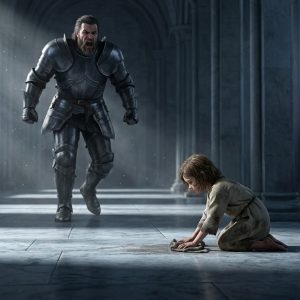
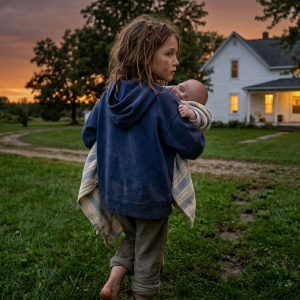
“STOP HIM! ENOUGH, BOY, STAY BACK!”
The command tore through the arena like a blade.
But the child did not stop.
He was barely more than a toddler, small enough that the guards could have lifted him with one hand if they had reached him in time.
Bare feet.
Tattered brown tunic.
Dust on his cheeks.
Hair tangled from running.
His little legs carried him into the pit with the unsteady determination of a child who did not understand danger—or understood it too well and had run out of safer choices.
The crowd rose in waves.
Gasps.
Shouts.
A woman screamed.
Phones lifted.
Thousands of faces leaned over the stone arena walls, hungry with horror, ready to witness tragedy and later claim they had tried to look away.
At the center of the pit stood the beast.
A monstrous armored bull, black as burned iron, twice the size of any animal a child should ever stand near. Metal plates were strapped across its shoulders. Iron guards capped its horns. Chains dragged from the rings around its neck, each link clattering against the dust.
Its name was not a name.
Only a title.
The King’s Fury.
A beast known across three kingdoms for killing soldiers, goring prisoners, shattering gates, and reducing trained handlers to prayers.
It pawed the ground now, nostrils flaring, breath steaming in the cold morning air.
The royal guard had brought it into the arena for the Festival of Strength, where noble houses wagered on condemned men brave or foolish enough to face it.
But the condemned man had already fallen.
Blood marked the dirt near the east gate.
The handlers were moving in with spears.
The crowd wanted the beast dragged back.
Then the boy slipped through the broken lower rail and ran into the pit.
“Seize him!” a voice boomed from the royal balcony. “Now!”
The guards rushed.
But the bull heard them.
Its huge head swung toward the movement.
The guards froze.
One more step, and the child would be trampled between panic and command.
“Boy,” Captain Rourke shouted from the arena wall, voice cracking beneath his armor. “Stay still!”
The child did.
Not because he obeyed.
Because he had reached the center.
He stood ten paces from the beast, chest rising fast, small hands clenched, tears shining in eyes too young to hold that much grief.
No fear.
Not exactly.
Only a desperate plea.
The bull lowered its head.
The crowd went silent.
The boy reached slowly into his tattered tunic.
A guard whispered, “God help him.”
No weapon came out.
No knife.
No charm.
No shield.
Only a crumpled piece of crimson cloth.
Faded.
Dirty.
Torn at the edges.
But embroidered in one corner with a golden crest nearly worn away by time.
A sun split by a sword.
The crest of House Veyr.
Dead house.
Disgraced house.
A house the king had declared traitor five years earlier.
The boy held the cloth toward the beast with both trembling hands.
“Please,” he choked.
His voice was tiny in the enormous arena.
But somehow, it carried.
“Look at me.”
The bull’s heavy breathing filled the silence.
Its amber eyes, burning with rage moments before, fixed on the red cloth.
The chains dragged once in the dirt.
Then stopped.
The boy took one step closer.
The guards did not breathe.
The crowd did not move.
The bull’s massive head began to lower.
Not in attack.
Not to gore.
Slowly.
Deliberately.
Toward the boy’s outstretched hand.
Toward the forgotten emblem.
The child’s face crumpled.
“My father said you would remember this,” he whispered.
The bull snorted against the cloth.
Its nostrils flared.
A low, broken sound came from deep within its chest.
The boy stepped closer still.
“If you remember him,” he said, voice cracking, “don’t leave me too.”
The beast’s eyes changed.
The fury did not vanish.
It shifted.
Behind it, something ancient flickered.
Something wounded.
Something that had survived chains, iron, blood, and men shouting orders.
Recognition.
The bull lowered its forehead until it touched the crimson cloth.
The child pressed his small hand to the beast’s nose.
Then the arena heard him sob.
“Papa’s gone,” he whispered. “And they’re coming for me now.”
On the royal balcony, King Alaric stood.
His face had gone white.
Beside him, Lord Cassian Vorn, the king’s adviser, gripped the railing hard enough that his jeweled rings flashed in the sun.
Because the cloth had not only stopped the beast.
It had named the lie.
And the child in the dust was not a beggar.
He was the son of the man the kingdom had executed as a traitor.
The Beast That Once Had A Name
Before the arena called him the King’s Fury, the bull had a name.
A simple one.
Bran.
He had been born in the high meadows of Veyrhold, where wind moved through silver grass and the mountains stood blue against the horizon. He was not bred for killing. He was raised for strength, yes, but also for field work, ceremony, and the old mountain games where riders tested courage without cruelty.
House Veyr had kept such bulls for generations.
They were war beasts only in legend, though nobles in the capital preferred the legend. In truth, the mountain bulls were intelligent, stubborn, loyal to familiar scents, and dangerous only when abused.
Lord Elias Veyr knew that better than anyone.
He was not the largest man in the kingdom. Not the loudest. Not the most politically skilled. But animals trusted him in a way men sometimes envied.
He could enter a stable where trained handlers hesitated.
He could calm a panicked horse with one hand on its neck.
He could stand before Bran when the bull was young and wild, holding out a crimson house banner, and wait until the animal chose trust instead of force.
His son, Rowan, grew up watching from the fence.
“Why doesn’t he hurt you?” Rowan asked when he was three.
Elias laughed.
“Because I don’t teach him that my hands mean pain.”
Rowan considered that carefully.
“Do bad hands make bad beasts?”
His father’s smile faded slightly.
“Sometimes.”
“Can good hands fix them?”
“Sometimes,” Elias said. “But not always fast enough.”
The crimson cloth came from an old banner.
Elias tore a strip from it after Bran’s first training season and stitched the golden crest into the corner himself. Badly. His wife, Mira, teased him for it.
“That embroidery is a crime against noble heritage.”
“It is recognizable,” Elias said proudly.
“To blind goats, perhaps.”
Bran knew it.
That mattered more.
The cloth smelled of the Veyr stables, mountain smoke, Elias’s hands, Rowan’s laughter, and grain stored in pinewood bins. Elias carried it whenever he worked with Bran. When Rowan got older, he was allowed to hold it too.
Only outside the fence.
Always outside.
“Never mistake trust for ownership,” Elias warned him. “Bran chooses. We do not command his heart.”
Rowan remembered those words even when everything else became smoke.
The fall of House Veyr began with a sealed message.
Then soldiers.
Then accusation.
King Alaric had been on the throne only two years, young enough to fear betrayal and proud enough to punish uncertainty like treason. Lord Cassian Vorn, his chief adviser, brought evidence that House Veyr had conspired with northern rebels.
Forged maps.
Intercepted letters.
Coin transfers.
A witness who swore Elias Veyr had promised mountain passes to enemies.
Elias denied it.
Mira denied it.
Their household guards denied it.
No one listened.
The capital needed a traitor.
Cassian gave them one.
The king sent soldiers at dawn.
Veyrhold burned before midday.
Mira was killed in the first assault, trying to get children from the servants’ hall into the old root tunnels. Elias was captured alive.
Rowan was four.
His nurse shoved him into a grain cart beneath sacks of barley and pressed the crimson cloth into his hands.
“Do not cry,” she whispered.
He cried anyway.
Quietly.
Through a crack in the boards, he saw men drag his father across the courtyard.
Elias was bleeding.
Still upright.
Still refusing to lower his head.
Bran roared from the stables.
Not like an animal.
Like thunder with a heart inside it.
A soldier struck the bull with a burning pole.
Another chained him.
Another laughed.
Rowan clutched the crimson cloth so hard the gold thread cut into his palm.
That was the last time he saw his father before the execution.
The capital called it justice.
Lord Elias Veyr was beheaded in the west square for treason.
His lands were seized.
His name erased from banners.
His household scattered.
His son presumed dead.
Bran was taken to the royal arena, renamed the King’s Fury, and made into proof that even Veyr’s beasts now belonged to the crown.
But animals remember what men rename.
And Rowan lived.
For five years, he moved through the kingdom under other names.
A kitchen boy.
A stable rat.
A beggar.
A ghost.
The nurse died of fever the second winter. After that, Rowan survived by carrying water, stealing bread, sleeping under market stalls, and keeping the crimson cloth tucked beneath his tunic.
At night, he whispered to it.
Not because cloth could answer.
Because it still smelled faintly of a world where he had been loved.
Then, on the morning of the Festival of Strength, he saw the posters.
THE KING’S FURY RETURNS.
The picture was crude.
The name was wrong.
But the torn white scar above the left horn was not.
Bran.
His father’s bull.
The last living creature who had known House Veyr before the fire.
Rowan had no plan beyond reaching him.
Children rarely do.
Adults call that foolish.
Sometimes it is.
Sometimes it is the only path left when every proper door belongs to liars.
So Rowan entered the arena through the lower market gate, waited until the beast came out, watched a condemned man fall, and then climbed the rail.
Because if Bran remembered the cloth, then someone in the kingdom might finally ask what else they had been taught to forget.
The King Who Saw The Cloth
King Alaric had never seen the boy before.
That was what he told himself at first.
A street child.
A reckless little fool.
A spectacle inside a spectacle.
But when the bull lowered its head to the crimson cloth, something old and uneasy moved through the king’s chest.
House Veyr.
Elias Veyr.
The execution square.
The way Elias had looked at him.
Not pleading.
Not raging.
Disappointed.
That expression had haunted Alaric more than the blood.
At the time, he had been twenty-four, newly crowned, surrounded by advisers who told him strength required decisiveness. The northern border was unstable. Treasury shipments had vanished. Rebel whispers moved through taverns. Alaric feared becoming the kind of young king older lords devoured.
Cassian Vorn had arrived with evidence.
Clean evidence.
Too clean, Alaric now thought.
But then he had wanted clean.
He wanted certainty.
He wanted a traitor shaped neatly enough to execute.
Elias Veyr had refused confession.
Even under questioning.
Even when Cassian promised mercy for his house if he admitted guilt.
“I will not confess to your lie so your fear may sleep,” Elias said.
Alaric signed the death order anyway.
The kingdom applauded.
House Veyr burned into history.
And yet now, in the arena below, a child held a scrap of Veyr cloth, and the beast Alaric had been told was untamable bowed to it like a lost soldier recognizing a flag.
Cassian leaned close.
“Your Majesty, order the guards to seize the boy.”
Alaric did not look at him.
“Why?”
“He is dangerous.”
“He is five.”
“Old enough to carry a symbol.”
Alaric’s eyes remained on the pit.
The boy had his forehead pressed against the bull’s nose now, sobbing into the crimson cloth. The beast stood still, chains hanging, massive body trembling not with rage but restraint.
The crowd watched in stunned silence.
Alaric heard whispers beginning.
Veyr.
That’s Veyr cloth.
Is that the dead house?
Who is the boy?
Cassian’s voice sharpened.
“Majesty.”
Alaric turned then.
His adviser’s face was controlled, but his eyes were bright with panic.
That was the first thing that frightened the king more than the bull.
Cassian never panicked.
Not during border raids.
Not during plague negotiations.
Not during the famine riots when people threw stones at the palace gates.
But a child with a scrap of cloth had made him afraid.
Alaric stood.
His voice carried through the arena.
“No one touches the boy.”
The guards froze.
Cassian’s jaw tightened.
“Majesty, the beast—”
“The beast is calmer than my council.”
A ripple moved through the royal balcony.
Below, Captain Rourke lifted his hand to halt the arena guards.
Alaric descended from the balcony himself.
That caused a different kind of panic.
Kings did not enter pits.
Not living kings.
Not wise ones.
But Alaric found himself moving down the stone stairs before fear could turn into ceremony. Cassian followed, furious under silence. Rourke and six guards surrounded them as they entered the arena.
The dust smelled of sweat, blood, and old straw.
The bull lifted its head when the king approached.
Every guard raised a spear.
Rowan turned.
For the first time since entering the pit, the child looked afraid.
Not of the bull.
Of the crown.
Alaric stopped ten paces away.
“What is your name?” he asked.
The boy clutched the cloth.
His voice was hoarse.
“Rowan.”
Cassian inhaled sharply behind the king.
Alaric heard it.
“Rowan what?”
The boy hesitated.
He looked at Bran.
Then at the crimson cloth.
Then lifted his chin with all the dignity his dirty face could hold.
“Rowan Veyr.”
The arena erupted.
Not in cheers.
In shock.
The name traveled like fire.
Veyr.
Veyr lives.
The boy is Veyr.
Cassian stepped forward.
“He lies.”
The bull swung its head toward him and snorted.
Cassian stopped.
Rowan’s eyes fixed on the adviser.
“You came to our house,” he whispered.
Cassian’s expression turned cold.
“You were an infant. You remember nothing.”
“I remember your voice.”
The crowd hushed again.
Rowan’s small hands shook, but he kept speaking.
“You told my father if he signed the confession, my mother would live.”
Alaric turned slowly toward Cassian.
Cassian laughed once.
“This is absurd. A child repeating tavern tales.”
Rowan reached into his tunic again.
The guards stiffened.
But he pulled out a second object.
A small wooden token, blackened by fire, carved with the Veyr crest on one side and a raven mark on the other.
“My father gave this to me before the soldiers came,” Rowan said. “He said if I ever found someone honest, show them the underside.”
He turned it over.
There, scratched into the charred wood with tiny, desperate letters, was a name.
Cassian.
And beneath it:
False letters. Northern gold. Ask Brannoc.
Cassian moved.
Too quickly.
Toward the token.
Bran roared.
The sound shook the arena walls.
Cassian stumbled back, face white.
Alaric looked at the token.
Then at the bull.
Then at the adviser who had guided his hand for five years.
“Who is Brannoc?” the king asked.
No one answered.
Except Captain Rourke.
His voice came slowly.
“Brannoc was the king’s courier assigned to Lord Veyr’s evidence chain.”
Alaric looked at him.
“Was?”
“He died before trial.”
Cassian said, “Fever.”
Rowan shook his head.
“My father said he was stabbed.”
The arena had become a courtroom without walls.
And for the first time in five years, the king realized the verdict had arrived before the truth.
The Courier Who Did Not Die
Brannoc was not dead.
That was the first crack in Cassian’s wall.
He had been declared dead of fever five years earlier in a roadside chapel two days after delivering the forged letters that condemned House Veyr. His body had been burned quickly, according to plague protocol.
Too quickly.
Captain Rourke remembered because he had signed the outer guard report.
He had been younger then.
Less suspicious.
More obedient.
But he remembered something else now, as the boy stood beside the bull and the king demanded answers.
Brannoc had worn a silver ring on his right hand.
A courier’s ring.
The body burned at the chapel had no right hand.
At the time, Rourke had accepted Cassian’s explanation: wolves before recovery.
Now it tasted like poison.
King Alaric ordered the arena cleared.
The crowd resisted.
Of course they did.
History had opened in front of them, and people hate being sent away before blood or truth reaches its conclusion.
But the king’s guard moved with spears drawn, and the crowd eventually poured into the streets carrying rumor faster than royal messengers could hope to control.
Rowan refused to leave Bran.
Bran refused to move without Rowan.
This created an absurd problem.
A king, a captain, six guards, one accused adviser, one dead house’s child, and a massive bull stood in the arena arguing about logistics.
Finally, Rowan said, “He’ll follow the cloth.”
He did.
The beast once called the King’s Fury walked behind a five-year-old boy through the west gate, across the service yard, and into the royal stables without killing a single man.
By sunset, everyone in the palace knew.
By midnight, half the capital did.
Cassian Vorn was not arrested that first night.
Alaric was not yet brave enough.
Or not yet certain enough.
That distinction shamed him later.
Instead, Cassian was confined to his chambers under guard while the king reopened sealed records.
Rowan was taken to a guest chamber near the royal stables. He refused a bath until someone promised the crimson cloth would not be taken. He refused food until Bran was fed. He refused sleep until Captain Rourke placed guards at the stable door who did not carry prods.
Only then did the boy sit on the edge of a bed too large for him, holding bread in both hands, and begin to shake.
Alaric visited him at dawn.
No crown.
No cloak.
Only a plain dark tunic, because standing before a child whose house he had executed made ceremony feel grotesque.
Rowan was awake, sitting by the window.
The crimson cloth lay across his lap.
“You should sleep,” Alaric said.
“My father slept before they took him,” Rowan replied. “I don’t like sleeping when soldiers are near.”
The king absorbed that.
“I am sorry.”
The boy looked at him.
“You killed him.”
The words were not shouted.
That made them worse.
Alaric sat slowly in the chair across from him.
“Yes.”
“Did you know he was innocent?”
“No.”
“Did you ask enough?”
The question struck cleaner than any accusation.
Alaric looked at the floor.
“No.”
Rowan’s eyes filled.
“Then sorry is small.”
“Yes,” the king said. “It is.”
For a long time, neither spoke.
Then Alaric asked, “What did your father tell you about Brannoc?”
Rowan touched the wooden token.
“That Brannoc carried the real letters first. Letters proving Cassian took northern gold and blamed my father. Brannoc tried to warn the king. Cassian caught him. My father helped him escape through the old quarry road.”
“Then why was Brannoc declared dead?”
“Because Cassian needed him dead.”
“Where is he now?”
Rowan hesitated.
“My nurse said if I ever found Bran and Bran remembered, then I should go where the ravens nest under the bell.”
Alaric frowned.
“The ravens nest under the bell?”
Captain Rourke, standing near the door, looked up.
“The old bell tower in Westmarket,” he said. “Abandoned after the fire. Ravens nest in the beams.”
Alaric stood.
Rowan stood too.
“You’re not going,” the king said.
Rowan lifted the cloth.
“Bran is.”
That was how the king of three provinces, his captain of guard, a presumed-dead heir, and a massive black bull walked under cover of morning fog toward an abandoned bell tower.
It was not dignified.
History rarely is while happening.
The bell tower stood in the oldest part of the capital, half-collapsed and blackened by an old fire. Ravens nested high in the beams, croaking at the intrusion.
Beneath the cracked stone floor, behind a panel marked with a faded Veyr crest, they found a narrow cellar.
And inside that cellar, they found a man.
Old before his time.
One hand missing.
Face scarred.
Alive.
Brannoc.
The courier stared at the king first.
Then at Rowan.
Then at the crimson cloth in the boy’s hand.
He began to cry.
“My lord’s son,” he whispered.
Rowan stepped back.
The grief in the man’s voice was too large.
Brannoc reached with his remaining hand toward a sealed oilskin packet hidden beneath his cot.
“I kept them,” he said.
His voice shook.
“The real letters. The ledgers. Cassian’s payments. Lord Veyr’s statement. I kept them because I knew one day the beast would remember what men chose to forget.”
The Adviser Who Built A Treason
Cassian Vorn had not always been powerful.
That mattered.
Not because it excused him.
Because it explained the hunger.
He was the third son of a minor noble house, clever enough to see doors and poor enough to resent knocking. He entered court as a clerk, became indispensable through memory, flattery, and a gift for locating other men’s weaknesses.
King Alaric’s father trusted him with small matters.
Alaric trusted him with fear.
That was Cassian’s true rise.
A young king fears rebellion, betrayal, looking foolish, appearing weak.
Cassian fed each fear carefully.
Never too much at once.
Just enough.
The northern rebellion had not been strong enough to threaten the throne. But Cassian needed it to appear so. He had taken gold from northern smugglers and border lords, not to overthrow Alaric, but to build a crisis only he could solve.
House Veyr became the perfect sacrifice.
Old.
Respected.
Remote.
Too independent.
Elias Veyr controlled mountain passes, supply roads, and loyal soldiers who valued him more than court approval. If Cassian could destroy him, he would weaken an honest house, seize mountain routes through crown authority, and present himself as savior.
The real letters proved it.
One from Cassian to a northern agent arranging false correspondence.
One payment ledger bearing his seal.
One statement from Brannoc describing how he intercepted the forged packet and brought warning to Lord Veyr.
And Elias’s final letter.
Not to the king.
To Rowan.
My son, if this reaches you, then truth has found a longer road than I hoped. Do not let grief make you cruel. Men who lie will call your mercy weakness and your anger proof. Be neither their monster nor their fool. Remember Bran. He knows the difference between hands that hurt and hands that feed.
Alaric read that letter three times.
Then sat alone for an hour.
Not because he had doubts.
Because certainty had come, and with it the full weight of what he had done.
Cassian tried to flee before dawn.
Of course he did.
His guards had been loyal to coin rather than crown.
They killed one palace guard and opened a passage beneath the east wall. Cassian reached the river gate before Bran stopped him.
No one ever fully understood how the bull got loose.
Rowan claimed he had not opened the stable.
Captain Rourke claimed locks sometimes fail under moral pressure.
The stable boy claimed the bull “looked at him like my mother when I lie.”
However it happened, Bran thundered into the river courtyard just as Cassian mounted a horse.
The horse reared.
Cassian fell hard.
Bran lowered his horned head and stood over him, not attacking, not moving, holding him there in the mud until guards arrived.
Cassian screamed for the beast to be killed.
No one obeyed.
That, perhaps, was his first true punishment.
The trial was public.
Alaric insisted.
His council protested.
A public trial would damage the throne.
A private trial would protect dignity.
An adviser’s treason should not become street theater.
Alaric listened.
Then said, “I killed an innocent man in public. I will not correct the record in private.”
Rowan attended only part of the trial.
He was too young for all of it, though he argued he had already seen worse. The king agreed and still limited his presence.
Brannoc testified.
So did Captain Rourke.
So did former clerks who had feared Cassian for years and now finally spoke.
The forged letters were displayed.
The payment ledgers read aloud.
The false witness broke under questioning and confessed he had been promised land from the seized Veyr estate.
Cassian did not confess.
Men like him rarely do when words remain.
He called the evidence manipulated.
Called Brannoc a broken traitor.
Called Rowan a child weaponized by enemies of the crown.
Then the prosecutor held up the crimson cloth.
“Do you recognize this?”
Cassian smiled coldly.
“A rag.”
Rowan, seated beside Captain Rourke, whispered, “He’s lying.”
The prosecutor said, “This rag stopped the King’s Fury.”
Cassian’s jaw tightened.
“The animal is trained.”
“By whom?”
No answer.
The prosecutor continued.
“By the man you framed. By Lord Elias Veyr. The beast remembered what the court did not.”
That sentence spread through the capital by nightfall.
Cassian was convicted of treason, conspiracy, murder, falsification of royal evidence, bribery, and unlawful seizure of noble lands.
His sentence was not execution.
That shocked the court.
Alaric chose imprisonment for life in the northern fortress he had once used to hold political enemies.
“You wanted men buried alive in false stories,” the king told him. “You may live long enough to hear the true one told.”
Some called it mercy.
Rowan did not.
He asked the king later, “Why does he get to live when my father didn’t?”
Alaric had no answer that would satisfy a grieving child.
So he gave the honest one.
“Because killing him would be easier for me.”
Rowan thought about that.
Then said, “I still hate him.”
“Yes,” Alaric said.
“Is that bad?”
“No. But do not let him raise you from inside a cell.”
Rowan did not understand then.
Years later, he would.
The House Returned To Ashes
Restoring House Veyr was not as simple as declaring innocence.
The castle was burned.
The fields seized.
The servants scattered.
The family dead.
A name can be cleared in a day.
A home takes longer.
King Alaric issued a formal proclamation.
Lord Elias Veyr was innocent.
Mira Veyr was murdered in unlawful assault.
The seizure of Veyr lands was void.
Rowan Veyr was rightful heir under crown protection until of age.
The proclamation was read in the west square, the same place Elias had died.
Alaric read it himself.
That mattered.
The crowd gathered in uneasy silence.
Rowan stood beside him wearing clean clothes he hated because they scratched, holding the crimson cloth in both hands.
Bran stood behind a reinforced barrier near the square, watched by half the guard and several terrified officials. The bull had become a symbol too quickly, and symbols are another kind of cage if no one is careful.
Alaric turned to Rowan before beginning.
“You do not have to stand here.”
“Yes,” Rowan said.
“Why?”
“Because he stood here alone.”
The king nodded.
Then read.
His voice carried across the stone.
He named the lie.
Named Cassian.
Named Brannoc.
Named the false evidence.
Named his own failure.
When he reached the sentence acknowledging Elias’s wrongful execution, the king stopped.
For a moment, his voice failed.
The crowd waited.
Rowan looked up at him.
Not kindly.
But steadily.
Alaric continued.
“I, Alaric of the House Merrow, ordered the death of an innocent man. Let this record stand against me, as it stands for him.”
That line cost him politically.
It saved something human.
After the proclamation, Rowan walked to the execution stone.
It had been scrubbed a thousand times.
He still knew.
Children know places adults pretend are clean.
He placed the crimson cloth on the stone.
Then took it back.
Captain Rourke asked later why.
Rowan said, “It’s not staying where he died. It’s coming home.”
Home was harder.
Veyrhold had become a ruin at the edge of the mountains. Grass grew through the courtyard stones. The great hall roof had collapsed. The stables were blackened bones.
Rowan walked through it silently.
Bran followed slowly, enormous body moving through the broken gate as if he too remembered the shape of what was missing.
In the old stable, Rowan found a section of wall untouched by fire.
Scratched into the wood at a child’s height were marks.
His height marks.
Four years old.
Three and a half.
Three.
Beside them, his father’s rough handwriting.
Rowan eats like a wolf and lies about sweets.
Rowan touched the marks.
Then sat down in the ash and cried until Captain Rourke carried him out.
No one told him to be brave.
That was mercy.
The king assigned funds to rebuild Veyrhold.
Rowan refused the first version.
It had too much marble.
Too many banners.
Too many rooms meant to impress visiting nobles.
“This is not a palace,” he said.
The royal architect blinked.
“What should it be?”
Rowan looked toward the fields.
“A place where people can sleep without listening for soldiers.”
That became the design.
Strong walls.
Warm kitchens.
Open stables.
A hall for hearings where common people could bring complaints against nobles without first paying a clerk.
An archive room for evidence records, courier logs, and sealed accusations, because Rowan never trusted clean stories again.
Bran lived in the rebuilt mountain pasture.
Not chained.
Not paraded.
Not used in royal festivals.
He allowed only three people near him for years: Rowan, old Brannoc, and a stable girl named Tessa who had no fear because, she said, “Bulls are easier than lords.”
Rowan liked her immediately.
Brannoc became keeper of records at Veyrhold.
Captain Rourke became Rowan’s guardian until he came of age, though he admitted freely he had no idea how to raise a noble child who preferred sleeping in stables.
King Alaric visited once each year.
The first visits were terrible.
Rowan refused to speak to him beyond courtesy.
Alaric accepted it.
On the fourth year, Rowan asked, “Do you still see my father?”
Alaric answered, “Yes.”
“In dreams?”
“In decisions.”
Rowan considered that.
“Good.”
It was not forgiveness.
But it was something better than forgetting.
The Boy Who Became The Hand That Fed
Rowan grew into a man who made liars uncomfortable.
That was how courtiers described him.
Not handsome, though he was in a weathered mountain way.
Not charming, though people trusted him.
Not gentle, though animals did.
Uncomfortable.
Because he listened too closely.
Asked for documents.
Remembered dates.
Noticed who benefited from convenient deaths.
And never, ever accepted the phrase everyone knows as evidence.
At eighteen, he took formal control of House Veyr.
At nineteen, he established the Red Cloth Court, an independent royal review council for convictions based on sealed evidence, coerced confession, or noble accusation without public record.
Some nobles called it an insult to tradition.
Rowan replied, “So was executing innocent men.”
King Alaric supported it.
Not always easily.
But consistently.
Their relationship became one of the strangest in the kingdom: the king and the orphan created by his greatest failure, bound not by affection at first, but by a shared refusal to let the lie continue shaping law.
Bran aged.
The great bull slowed but remained formidable. His black hide grayed around the muzzle. The scar above his horn faded into pale roughness. He still lowered his head whenever Rowan held up the crimson cloth.
The cloth itself became fragile.
Rowan eventually had it preserved between layers of fine transparent silk, mounted in a wooden frame when not used. The gold crest was nearly gone.
He kept it in the stable office, not the great hall.
“Why not display it where guests can see?” Tessa asked once.
By then, she ran the Veyr stables with terrifying authority.
Rowan looked at Bran grazing beyond the fence.
“Because it was not made for guests.”
When Bran died, Rowan was twenty-three.
The bull lay down under the mountain ash tree at dawn and did not rise.
Rowan sat beside him with one hand on the massive forehead until the warmth left.
No crowd.
No arena.
No chains.
Only wind moving through the high grass.
Brannoc, old and frail, stood nearby.
“He waited for you,” the old courier said.
Rowan nodded.
“He always did.”
They buried Bran in the upper meadow, facing the rebuilt stables.
On the marker, Rowan ordered no titles.
Not King’s Fury.
Not royal beast.
Only:
BRAN
He remembered.
Years later, children at Veyrhold would ask if the story was true.
Did Lord Rowan really walk into an arena as a little boy?
Did the monster really bow?
Did the crimson cloth save him?
Rowan never liked the word monster.
“He was not a monster,” he would say. “He was hurt.”
“Didn’t he kill men?” one child asked.
“Yes.”
“Then?”
“Men hurt him until rage was the only language he had left. That does not make the killing harmless. It means those who taught him rage do not get to pretend innocence.”
The children usually grew quiet then.
Good.
Some stories should not become too easy.
Rowan kept the crimson cloth until the day he died, many decades later, old and silver-haired, still known for unsettling courts and calming animals.
King Alaric died before him.
Before his death, the king wrote one final decree requiring all treason charges to be tried in open court unless an independent council approved sealed evidence.
At the bottom, in his own hand, he wrote:
For Elias Veyr, whom I failed.
Rowan read it without speaking.
Then placed it in the archive.
Not forgiven.
Not forgotten.
Recorded.
That was what justice often became when time stole the people who deserved more.
On Rowan’s final winter, a young stable boy asked him what he remembered most from the arena.
The crowd?
The king?
Cassian’s face?
Bran lowering his head?
Rowan sat by the fire, the crimson cloth framed on the wall behind him.
He took a long time to answer.
“My father’s hands,” he said.
The boy frowned.
“But your father wasn’t there.”
Rowan smiled faintly.
“Yes, he was.”
In the cloth.
In Bran’s memory.
In the lesson that hands could hurt or feed.
In the choice Rowan made, again and again, not to become the thing done to him.
Years later, people still told the story of the child who stepped into the dust-choked arena and stopped the monstrous armored bull with a scrap of crimson cloth.
They remembered the roar.
The guards.
The crowd with raised phones and hungry eyes.
The faded golden crest.
The bull lowering its head.
The whisper:
If you remember him, don’t leave me too.
Some told it as a miracle.
Some as legend.
Some as proof that noble blood cannot be erased.
Rowan would have hated that last version most.
Blood had not saved him.
A nurse’s courage saved him.
A father’s teaching saved him.
A courier’s stubborn survival saved him.
A beast’s memory saved him.
And a scrap of cloth, smelling faintly of home, carried truth farther than any royal seal.
The real monster was never the bull.
It was the machinery that turns fear into verdicts, verdicts into executions, and executions into history before anyone asks who wrote the evidence.
The bull had chains.
The men had choices.
That was the difference.
And when Bran lowered his head to the crimson cloth, the arena saw what the court had refused to see five years earlier.
Recognition.
Not of a symbol alone.
But of a man who had fed instead of beaten.
Of a house burned but not erased.
Of a child who should never have had to stand before horns to be believed.
The crimson cloth remained in Veyrhold’s archive long after Rowan was gone.
Children came to see it.
So did judges.
Kings.
Soldiers.
Couriers.
Some expected it to glow.
It did not.
It was only fabric.
Faded.
Torn.
Fragile.
Powerful because of what it had survived.
Beneath it, carved into dark mountain wood, were Rowan’s chosen words:
REMEMBER BEFORE YOU OBEY.
That was all.
And it was enough.