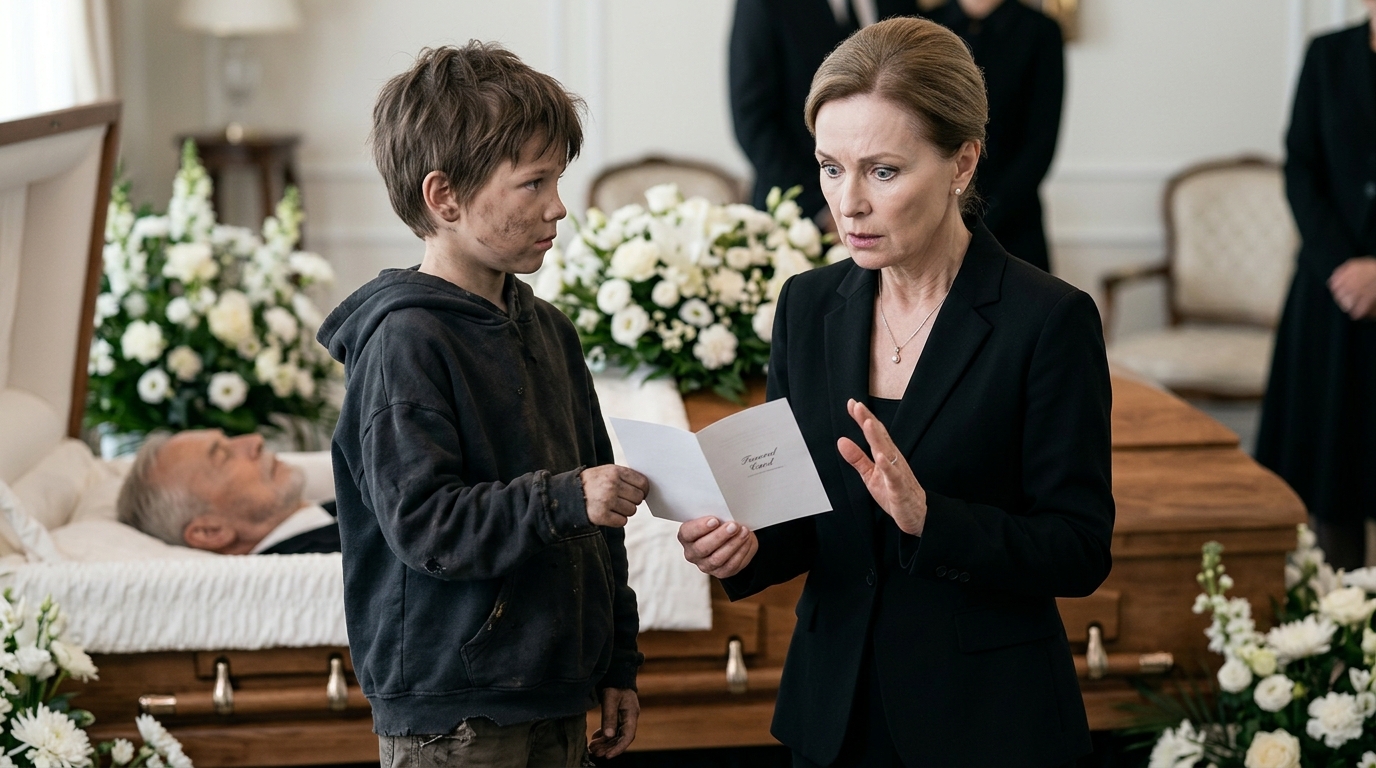
The funeral room was so quiet it felt wrong to breathe too loudly.
White flowers surrounded the open casket in careful arrangements that looked more expensive than sincere. Lilies. Roses. Pale orchids. Everything smelled of polished wood, perfume, and the kind of grief wealthy people try to keep elegant.
Black clothing blurred into the background.
Men stood with hands folded.
Women dabbed dry eyes with linen handkerchiefs.
Soft organ music drifted through hidden speakers, low enough not to interrupt the whispers.
At the front of the room, inside the casket, lay Charles Whitmore.
Seventy-eight years old.
Founder of Whitmore & Lane Shipping.
Husband.
Father.
Benefactor.
A man whose obituary called him visionary, disciplined, devoted to family, and impossible to replace.
His widow, Evelyn Whitmore, stood beside the casket like a woman carved from marble.
She wore a fitted black blazer, a delicate pearl necklace, and the practiced composure of someone who had spent her entire adult life understanding that public emotion was a privilege men were allowed more freely than women.
She had not cried in front of anyone.
Not when the doctor called time of death.
Not when the funeral director asked about flowers.
Not when her son Graham gave a short speech about legacy, duty, and strength.
Evelyn had loved Charles once.
That was the part no one in the room could understand from the outside.
Love can sour without disappearing.
It can become history.
Then evidence.
Then a wound no one touches because touching it means admitting it never healed.
She stood beside his casket now, looking at his still face, wondering whether death made liars peaceful or only silent.
Then the little boy appeared.
No one saw him enter.
Not at first.
He slipped through the side door near the coatroom, small and thin, swallowed by an oversized dark hoodie. His pants were torn at one knee. His shoes were worn nearly flat. Dirt marked his cheeks, his hair, his hands, as if life had been hard on him for too long already.
He walked straight toward the casket.
A few people turned.
A woman whispered, “Whose child is that?”
A man near the aisle frowned.
The boy stopped beside Evelyn.
Close enough that she could smell rain and old smoke on his clothes.
At first, she barely looked at him.
There were many mourners.
Employees.
Drivers.
Dockworkers.
Old friends.
People Charles had helped.
People Charles had paid to say he helped.
Perhaps this boy belonged to one of them.
Then he lifted his face.
His eyes were dark gray.
Charles’s eyes.
Evelyn’s breath caught before she could stop it.
The boy spoke with a trembling kind of bravery.
“He said if he died… you would take me.”
Several heads turned.
Evelyn’s posture stiffened.
“Take care of you?” she asked.
The boy nodded once.
Not crying.
Just waiting.
As if he had already used up the part of himself that expected kindness.
Evelyn looked at his face more carefully.
The shape of his mouth.
The line of his brow.
The slight crease between his eyes.
Something in him felt too personal.
Too familiar in the wrong direction.
Her voice dropped.
“Who are you?”
The boy looked at the man in the casket first.
Then back at her.
Like he had practiced the answer a hundred times in fear.
But he did not say his name.
Instead, he reached into the pocket of his ripped hoodie and pulled out a folded funeral card.
One of Charles’s funeral cards.
Cream paper.
Gold border.
A photograph of Charles smiling stiffly from twenty years earlier.
On the back, in shaky handwriting, were six words:
Give him the watch she hid.
Evelyn stared at it.
The room faded around her.
The flowers.
The whispers.
The casket.
The polished grief.
All of it blurred beneath the weight of those words.
Give him the watch she hid.
No one else knew about the watch.
No one living.
Or so she had believed.
Her fingers went cold.
Because years ago, Evelyn had hidden a gold watch from the man in the casket.
Not stolen.
Not exactly.
Hidden.
The one thing connecting Charles Whitmore to the child he was never supposed to acknowledge.
The boy’s voice dropped to a whisper.
“He said you know who I am.”
Evelyn looked at him.
And for the first time that day, her composure broke.
Not visibly to everyone.
But enough.
Her hand shook.
The funeral card slipped from her fingers and landed face down on the carpet.
Behind her, her son Graham said, “Mother?”
Evelyn did not answer.
She was staring at the child’s wrist.
Beneath the torn sleeve, tied with old blue thread, was a tiny brass key.
The key to a drawer she had not opened in twelve years.
The drawer where Charles’s gold watch still lay wrapped in silk.
The watch engraved with three initials that had almost destroyed their family once.
C.W.
M.L.
And a third initial Evelyn had never been able to forgive.
S.
The Watch She Hid
Twelve years earlier, Evelyn Whitmore had found the watch inside a locked drawer in Charles’s study.
She had not been snooping.
That was what she told herself at first.
Charles had been in Boston for a shipping conference. Graham was already grown and working for the company. Their daughter-in-law, Marissa, had been pregnant with their first grandchild. The house was quiet in that lonely, museum-like way large houses become when children leave and servants know better than to make noise.
Evelyn had gone into the study looking for insurance papers.
A storm had damaged the east roof, and Charles had told her the file was in the mahogany cabinet beneath the old maritime maps.
He forgot to mention the drawer was locked.
Or perhaps he assumed she would stop there.
She did not.
Marriage teaches women many things.
One of them is where men hide keys.
The drawer opened with a soft click.
Inside were documents.
Old correspondence.
A faded photograph.
A small velvet pouch.
Evelyn picked up the photograph first.
A young woman stood beside Charles on a dock, wind lifting her dark hair. She was laughing, head turned slightly away from the camera, one hand resting on her belly.
Pregnant.
Evelyn recognized her immediately.
Mara Lane.
Charles’s former business partner’s daughter.
No.
Not daughter.
Widow.
Michael Lane had co-founded Whitmore & Lane Shipping with Charles in the early years, when the business was still three trucks, a leased pier office, and more debt than sense. Michael died in a warehouse fire under circumstances that never stopped troubling Evelyn, though Charles called it tragic bad luck and refused to discuss it.
Mara had been Michael’s much younger wife.
Bright.
Quiet.
Too observant.
After Michael died, Charles had kept her close to the company for a while, saying she deserved protection and financial support.
Then Mara vanished.
Charles said she moved south.
Evelyn believed him because believing him kept her life intact.
Until she found the photograph.
The velvet pouch held the watch.
Gold.
Heavy.
Elegant.
Charles’s father had given it to him when he signed his first major shipping contract. He had worn it for thirty years. Then one day it disappeared from his wrist, and he claimed the clasp broke.
Evelyn turned it over.
The engraving on the back was new.
C.W. + M.L.
S.
Her stomach tightened.
M.L.
Mara Lane.
S.
A child.
A secret.
A betrayal dressed in gold.
There was also a letter.
Evelyn read only enough to understand the shape of the wound.
Charles,
You promised if anything happened to me, you would not let him be erased. I am not asking you to choose me. I stopped asking for that the night you told me there was no room in your name for another life. But Simon is yours. One day, he will ask. When he does, give him the watch. Tell him the truth. Let him hate you if he must, but do not make him live without knowing where half his face came from.
Simon.
Evelyn sat down in Charles’s chair with the letter in one hand and the watch in the other, feeling the air leave the house.
She had suspected affairs before.
Powerful men often train their wives to suspect in silence.
But a child was different.
A child was evidence that time had not merely strayed.
It had built a parallel life.
When Charles returned from Boston, Evelyn placed the photograph, letter, and watch on the dining table between them.
He looked at the objects.
Then at her.
For once, he did not deny it.
“How old?” Evelyn asked.
His face was gray.
“Three.”
She closed her eyes.
“Is she alive?”
“Mara?”
“Do not make me say her name twice.”
His voice broke slightly.
“I don’t know.”
That made her look at him.
“What does that mean?”
“She disappeared. Took Simon with her.”
“Your son.”
He flinched.
“Yes.”
Evelyn’s grief was not clean.
Part of her hated him.
Part of her hated Mara.
Part of her hated the child.
That part shamed her most because the child had done nothing except exist.
Charles told her a version of the story.
Mara had come to him after Michael’s death, frightened, pregnant, alone. He had helped her. Too much. Wrongly. The affair had lasted less than a year. Simon was born in secret. Charles paid for an apartment, medical care, a trust. Then Mara began asking questions about Michael’s fire, about missing company records, about money moved through port accounts.
“She thought Michael had been murdered,” Charles said.
Evelyn stared at him.
“Was he?”
Charles said nothing.
That silence answered too much.
Mara disappeared weeks later.
Charles claimed he had looked.
Evelyn did not believe him fully.
Or perhaps she did and hated him for failing.
The watch was meant for Simon if Charles ever found him.
Evelyn took it that night.
Charles asked for it back.
She refused.
“You do not get to turn betrayal into a keepsake.”
He did not fight her.
That, too, she hated.
For years, the watch stayed hidden in Evelyn’s private drawer, wrapped in silk beneath old gloves and letters from a younger marriage that no longer existed.
Sometimes Charles asked about it.
At first angrily.
Then quietly.
Then not at all.
Years passed.
The secret settled into the house like dust beneath expensive rugs.
Evelyn told herself Simon was gone.
Mara was gone.
The watch was only metal.
Then, at Charles’s funeral, a boy in torn clothes appeared with a note that mentioned it.
Not Simon.
Simon would have been fifteen now.
This child was six.
Too young.
Which meant Simon had grown up somewhere.
Had a child.
Lost enough to send that child to a funeral with a message written on the back of a memorial card.
Evelyn looked down at the little boy.
“What is your name?” she whispered.
He swallowed.
“Leo.”
“Leo what?”
His mouth trembled.
“Leo Lane.”
The surname moved through her like an old blade.
Behind her, Graham stepped closer.
“Mother, what is going on?”
Evelyn bent slowly and picked up the funeral card.
Her hands were no longer steady.
The boy looked at her with Charles’s eyes.
“Grandpa said you had the watch,” he whispered. “He said if I gave you the card, you’d know I wasn’t lying.”
Grandpa.
Not Charles.
Simon.
Simon had become a father.
And now his son stood in a funeral home looking for a woman who had hidden the only proof his family was real.
The Child No One Claimed
Graham Whitmore wanted the boy removed.
He did not say it that bluntly.
Men like Graham rarely did.
He put a hand on Evelyn’s elbow and lowered his voice.
“Mother, this is inappropriate. We can handle this privately.”
Privately.
That word had buried too many things in the Whitmore family.
Evelyn pulled her arm away.
The room had begun whispering again.
People sensed scandal the way birds sense weather.
Graham’s wife, Marissa, stood near the front row with their teenage daughters, her face tight with concern that had more to do with reputation than the child’s torn shoes.
The funeral director approached cautiously.
“Mrs. Whitmore, would you like me to—”
“No,” Evelyn said.
The word was sharper than she intended.
Leo flinched.
She saw it.
That small movement did something to her.
For twelve years, she had thought of Simon as an abstraction.
An injury.
A shame.
A child somewhere else.
Now Simon’s son stood before her, expecting rejection because life had taught him to expect little else.
Evelyn lowered her voice.
“Leo, who brought you here?”
He looked toward the side door.
“No one.”
“You came alone?”
He nodded.
“Bus.”
A murmur spread through the room.
The funeral director looked alarmed.
Evelyn’s chest tightened.
A six-year-old had taken a bus to a funeral home carrying a note from a dead or dying man.
No.
Not dead.
She forced herself to ask.
“Where is your father?”
Leo’s eyes filled.
“He’s gone.”
The word was too large for him.
Evelyn crouched in front of him, ignoring the pain in her knees and the quiet gasp of guests watching a Whitmore widow kneel.
“Gone where?”
Leo pressed his lips together.
“He said not to tell anyone but you.”
“Why?”
“Because bad men listen.”
Graham exhaled impatiently.
“This is absurd.”
Evelyn did not look back.
“Graham.”
“What?”
“Be quiet.”
The room heard that.
So did he.
Leo reached into his hoodie pocket again and pulled out a second item.
A torn piece of notebook paper folded into a tiny square.
He handed it to Evelyn.
This handwriting was different.
Older than the funeral card.
Sharper.
More controlled.
Simon’s, she guessed.
Mrs. Whitmore,
My name is Simon Lane. Charles Whitmore is my father. I know what you took. I hated you for it once. I don’t anymore. I think you were angry and maybe you had a right to be. But my son has no one. If Charles is dead, there are things that will move now. People who waited. Give Leo the watch. Inside it is the key to Michael Lane’s fire, Mara’s disappearance, and the reason Charles hid us all. Please do not punish him for our blood.
Evelyn read it twice.
Inside it is the key.
She looked at Leo.
“Where did you get this?”
“Dad wrote it before he went to the hospital.”
“What hospital?”
Leo shook his head.
“He said not until the watch.”
Graham stepped forward.
“Mother, enough. We don’t even know if this is real.”
Leo’s face hardened with sudden childish anger.
“It’s real.”
Graham looked down at him.
“Young man, you do not walk into a private funeral and make wild claims.”
Evelyn stood slowly.
“Private funeral?”
Graham turned.
“Mother—”
“You turned your father’s death into a corporate reception with flowers.”
His face flushed.
“This is not the time.”
“No,” Evelyn said, looking at the boy. “It should have been the time twelve years ago.”
Marissa whispered, “Evelyn, people are listening.”
“Good.”
That single word silenced three rows.
Evelyn turned to the funeral director.
“Please take Mr. Whitmore’s guests into the reception room.”
Graham’s eyes widened.
“Mother.”
“Now.”
The funeral director hesitated for half a second, then obeyed because grief outranked protocol when spoken by the widow.
Guests began moving reluctantly, starving for more scandal but unwilling to look openly indecent. Graham remained, jaw tight. Marissa stayed behind him. So did Father Elias, the family priest, who had known Evelyn for thirty years and looked more troubled than surprised.
When the room was nearly empty, Evelyn looked at Leo.
“Are you hungry?”
The question seemed to confuse him.
He glanced toward the casket, then back at her.
“I’m okay.”
That meant yes.
Children who have gone hungry learn to answer politely so adults do not feel accused.
Evelyn turned to Marissa.
“Get him food.”
Marissa blinked.
“Me?”
“Yes.”
“But—”
“Now.”
Marissa left.
Graham’s expression darkened.
“You are making a mistake.”
Evelyn looked at him.
“For once, I hope I am not.”
Then she took Leo’s small hand.
His fingers were cold.
Too cold.
And as she led him out of the funeral room, past the casket of the man who had left too many truths unfinished, Evelyn felt the old watch waiting inside her house like a heart that had been stopped for twelve years.
The Gold Watch That Ticked Again
Evelyn brought Leo to the Whitmore house before the burial.
That caused talk.
She knew it would.
Let them talk.
For decades, she had mistaken silence for dignity. She no longer had the patience for that kind of dignity.
Leo sat in the back seat beside her, both hands wrapped around a sandwich Marissa had produced from the funeral home kitchen. He ate carefully, as if someone might accuse him of taking too much.
Evelyn watched him from the corner of her eye.
His lashes were dark.
His nails bitten.
There was a bruise fading near his left wrist, half-hidden beneath the hoodie sleeve.
She did not ask about it yet.
Questions can feel like traps to frightened children.
Graham followed in his own car, furious enough to drive too closely. Marissa rode with him. Father Elias came at Evelyn’s request, though he said little.
At the house, the staff greeted Evelyn quietly.
Then saw Leo.
The housekeeper’s eyes flicked to his clothes, then to Evelyn.
Evelyn said, “This is Leo. Bring warm clothes from the donation boxes in the east closet. And hot chocolate.”
Leo’s eyes widened at the last words.
Evelyn looked down at him.
“Do you like hot chocolate?”
He nodded once.
Then, as if remembering not to want too much, added, “If it’s not trouble.”
“It is not trouble.”
She led him upstairs herself.
Graham followed.
“Mother, this is reckless. We should call social services, verify his story, speak to attorneys—”
“We will.”
“Then why bring him here?”
“Because he is six years old and came to a funeral alone.”
“He could be part of a scheme.”
Evelyn stopped at the top of the stairs.
“Then it is a hungry, dirty, six-year-old scheme, and we can manage it with cocoa before litigation.”
Father Elias covered his mouth.
Graham glared at him.
Evelyn entered her bedroom and walked to the old writing desk near the window. The desk was French, inherited from her mother, with delicate legs and a secret drawer no one knew about except the woman who owned it and, apparently, the dead man who had once searched for what she hid.
Her hands trembled as she pressed the hidden latch.
The drawer slid open.
Inside lay a silk scarf wrapped around a small velvet pouch.
The room seemed to hold its breath.
Evelyn untied the scarf.
The gold watch rested inside.
Dull now.
Stopped.
But still heavy with memory.
Leo stepped closer.
His eyes fixed on it.
“My dad said it was real.”
Evelyn swallowed.
“It is.”
Graham leaned over.
“I’ve never seen that watch.”
“No,” Evelyn said. “You wouldn’t have.”
She turned it over.
The engraving was still there.
C.W. + M.L.
S.
Graham’s face tightened.
“What does that mean?”
Evelyn looked at him.
“Your father had another son.”
The words entered the room and changed it.
Marissa gasped softly behind him.
Graham stared.
“No.”
“Yes.”
“No.”
Evelyn understood the denial.
She had lived in it for years.
“His name is Simon Lane.”
Graham looked at Leo with an expression Evelyn hated immediately.
Not shock.
Calculation.
“If this is true, then—”
“Do not finish that sentence.”
He did anyway.
“Then the estate is exposed.”
The child stood three feet away.
Hungry.
Exhausted.
Holding a funeral card.
And Graham’s first thought was shares.
Evelyn looked at him and saw, perhaps for the first time, how much of Charles had survived in their legitimate son.
Not the charm.
Not the ambition.
The instinct to turn people into legal problems.
Leo whispered, “My dad said the watch opens.”
Evelyn turned back.
“What?”
He pointed.
“He said there’s a tooth that isn’t a tooth.”
For a moment, she did not understand.
Then she remembered.
Charles had once shown her a trick in his younger years. His father’s watch had a hidden compartment behind the casing, opened by pressing the winding crown and a tiny ridge near the twelve.
A place to hide emergency cash, he said.
Evelyn had forgotten.
Or chosen to.
She pressed gently.
Nothing.
Again.
The back clicked.
A thin compartment opened beneath the engraved plate.
Inside was a small piece of oilskin, folded tight.
And a key.
Not a house key.
A safety deposit key.
Old brass.
Stamped with a number.
Graham stepped forward.
Evelyn closed her fist around the key.
“No.”
His face hardened.
“Mother, this concerns the estate.”
“This concerns a child.”
“It concerns father’s assets.”
“It concerns your father’s crimes.”
The word shocked even her.
Crimes.
She had not planned to say it.
But there it was.
Alive in the room now.
Leo stared at the watch.
“My dad said if you opened it, you’d believe him.”
Evelyn crouched.
“I believe that the watch is real.”
His face fell slightly.
Children hear the limits adults place around belief.
She took a breath.
“And I believe your father is Simon Lane.”
His eyes filled.
He looked away quickly, fighting tears.
“Is my dad dead?”
The question pierced the room.
Evelyn’s answer had to be honest.
“I don’t know.”
Leo nodded once.
Too practiced.
Too ready.
The housekeeper arrived with clothes and hot chocolate, breaking the tension. Evelyn sent Graham and Marissa downstairs despite Graham’s protests. Father Elias stayed by the doorway, quiet.
When Leo went to wash up, Evelyn sat on the edge of the bed holding the watch.
Father Elias spoke gently.
“Evelyn.”
She closed her eyes.
“I hid it.”
“You were hurt.”
“I hid a child’s proof because I was hurt.”
He did not absolve her.
That was why she had asked him to come.
Absolution too quickly is just another kind of hiding.
“What will you do now?” he asked.
Evelyn opened her hand.
The safety deposit key lay against her palm.
“What I should have done then.”
The Bank Box Charles Feared
The bank manager recognized Evelyn immediately.
People always did.
Whitmore money had been inside First Harbor Bank for three generations. Their name was on a brass plaque in the lobby near the staircase, engraved beneath words like civic leadership and founding patron.
No one at the bank had ever looked at Evelyn Whitmore as if she might be dangerous.
That changed when she arrived with a lawyer, a priest, her angry son, and a little boy in borrowed clothes carrying a gold watch.
The safety deposit key belonged to box 47.
The bank manager checked records.
His polite expression faltered.
“Mrs. Whitmore, this box is registered to Michael Lane.”
Graham’s head snapped up.
“Michael Lane is dead.”
“Yes, sir.”
“How can a dead man have an active box?”
The manager looked uncomfortable.
“It has been maintained by annual cash payments.”
“By whom?” Evelyn asked.
The manager swallowed.
“No name recorded. The payments were made through courier deposit.”
Evelyn looked down at Leo.
He was holding her hand now.
He had done it without asking while they waited in the vault corridor. Small fingers slipping into hers, cold and trusting because she had given him hot chocolate and not sent him away.
The weight of that trust almost undid her.
The box opened with a scrape.
Inside were three bundles.
A packet of documents.
A stack of photographs.
And a small cassette tape in a plastic case labeled:
If Charles dies first.
Graham exhaled.
“This is absurd.”
Evelyn ignored him and opened the documents.
The first page was a birth certificate.
Simon Lane.
Mother: Mara Lane.
Father: Charles Whitmore.
Signed.
Not publicly filed.
Not properly.
But notarized.
The second document was a trust amendment drafted but never executed, naming Simon Lane as Charles’s biological son and providing for future support.
The third was a handwritten statement from Michael Lane dated three weeks before the warehouse fire.
Evelyn read it slowly.
Then sat down in the small vault room chair because her legs would no longer hold.
Michael had discovered illegal port transactions through Whitmore & Lane Shipping.
Unreported cash shipments.
Smuggled medical equipment.
Insurance fraud.
Shell companies created by Charles and two silent investors to move goods outside sanctioned routes.
Michael intended to report it.
Charles had begged him not to.
Then came the fire.
Michael died.
Mara suspected murder.
Charles denied involvement for years, but the statement in the box suggested Michael had feared his own partner.
Graham grabbed the paper.
“This proves nothing.”
Evelyn looked up.
“No. It explains everything.”
The photographs were worse.
Mara holding baby Simon.
Charles standing beside them, face turned partly away.
Mara outside a clinic with a bruise on her cheek.
A storage unit.
A shipping ledger.
A man Evelyn recognized as Victor Hale, Charles’s old operations chief, now dead.
The cassette waited.
The bank manager found an old tape player after several tense minutes.
Evelyn pressed play.
Static.
Then Charles’s voice.
You always said I was a coward, Michael. If this tape is being played, you were right.
Graham went still.
Charles’s voice continued, younger but strained.
I did not set the fire. I swear that before God. But I built the business that made your death profitable. I let Hale handle men I knew were dangerous. I let myself believe I could control the rot because the money was good.
Evelyn gripped Leo’s hand.
After you died, Mara found the ledgers. She came to me. I should have protected her. Instead, I tried to protect the company. Then Simon was born, and every lie became heavier.
A pause.
I loved the boy. Not enough. Never enough in the ways that mattered. Evelyn found the watch. She took it. I let her because facing her anger was easier than facing Simon’s need.
Evelyn’s eyes filled.
Graham looked at her.
For the first time, he looked less angry than lost.
Charles’s recorded voice lowered.
Mara disappeared because she was taken. I know that now. Hale took her. He told me she ran. I believed him because believing him let me keep breathing. Years later, Simon found me. He was eleven. Thin. Furious. Mara was dead by then. Hale had kept her alive long enough to force the location of Michael’s files, then dumped the boy into state care under a false name when she died.
Leo leaned against Evelyn’s side.
She wrapped one arm around him.
I helped Simon secretly. Not publicly. Secretly, because I was still a coward. I told him I would tell the truth before I died. If I did not, then this box must. Simon has the right to the watch. His child, if he has one, has the right to know he comes from more than shame.
The tape crackled.
If Evelyn hears this: I do not ask forgiveness. I ask you to give the watch back.
The tape ended.
No one moved.
Then Leo whispered, “My dad was right.”
Evelyn looked down at him.
“Yes,” she said.
The word broke something open inside her.
“Yes, he was.”
Graham stood abruptly.
“This cannot leave this room.”
Evelyn looked at him.
“What?”
His face had changed.
He was no longer merely shocked.
He was afraid.
“If this goes public, the company is finished. There will be criminal inquiries, civil claims, estate challenges—”
“A child asked whether his father is dead.”
“And I am sorry for that,” Graham snapped. “But we are talking about destroying an entire family legacy because of old sins committed by dead men.”
Evelyn rose slowly.
“Dead men did not bring him to the funeral.”
Graham’s eyes flicked to Leo.
“No, but someone coached him.”
Leo pressed closer to Evelyn.
She felt it.
And for the first time, the direction of her anger was clean.
“Enough.”
“Mother—”
“No. I spent twelve years protecting myself from a child’s existence because I was wounded. I will not spend another hour protecting you from paperwork because you are frightened.”
Graham’s face flushed.
“You are grieving. You are not thinking clearly.”
Evelyn almost smiled.
Men had used that sentence on women in pain for centuries.
This time, it failed.
She turned to the lawyer.
“Copy everything. Secure it. Contact Detective Anya Cross.”
Graham stiffened.
“A criminal detective?”
“Yes.”
Then she looked at Leo.
“And find Simon Lane.”
The Father In Room 312
Simon Lane was not dead.
He was hiding.
That was what Evelyn learned twelve hours later, after Detective Anya Cross traced the hospital clue Leo had refused to share until the watch was opened.
Room 312.
Mercy General.
Admitted under the name Samuel Lee after a hit-and-run near the bus depot three nights earlier.
Critical but stable.
No listed family.
Leo had been with him at the time of the accident.
Simon had shoved his son behind a parked delivery van seconds before the car struck him.
Then, bleeding on the pavement, he had pressed the funeral card into Leo’s hand and told him where to go.
“If I don’t wake up,” he said, “find the woman with the watch.”
Leo had ridden two buses to reach the funeral home.
Alone.
Carrying the only instruction his father trusted.
Evelyn reached Mercy General after midnight with Detective Cross, her lawyer, and Leo asleep against her side in the back seat.
Graham had tried to stop her twice.
Then disappeared into calls with company counsel.
That told her where he had chosen to stand.
Simon lay in room 312 beneath dim hospital lights.
He was thirty-six.
Thin.
Dark-haired.
A bandage wrapped around his head.
One arm in a cast.
Machines whispered beside him.
Evelyn stopped at the doorway.
It was like seeing Charles at twenty-five through a cracked mirror.
Not identical.
But enough.
The brow.
The mouth.
The way his hand rested half-curled against the blanket.
Leo woke when they entered and ran to the bed.
“Dad?”
Simon’s eyes opened slowly.
Pain clouded them first.
Then fear.
Then recognition.
“Leo.”
His voice was a scrape.
Leo climbed carefully onto the chair beside him, crying for the first time since Evelyn had met him.
“I found her,” he sobbed.
Simon looked beyond him.
At Evelyn.
For a long moment, neither spoke.
Evelyn held the gold watch in both hands.
“I opened it,” she said.
Simon closed his eyes.
A tear slipped into his hair.
“Finally.”
The word should have angered her.
It did not.
It was accurate.
She stepped closer.
“I hid it.”
“I know.”
“I was wrong.”
His eyes opened.
He studied her carefully, as if apologies from Whitmores required inspection for traps.
“Yes,” he said.
The answer was not cruel.
Just true.
Evelyn nodded.
“I brought it.”
She placed the watch on the blanket near his hand.
Simon stared at it.
He did not touch it immediately.
“My mother said he would never give it to me,” he whispered.
“Your mother knew Charles better than I wanted to.”
Simon’s mouth tightened.
“She died waiting for him to tell the truth.”
“I know that now.”
“No,” Simon said. “You know a version of it.”
Evelyn accepted that too.
Detective Cross stepped in.
“Mr. Lane, I need to ask about the hit-and-run.”
Simon’s eyes sharpened despite the pain.
“It wasn’t an accident.”
“We believe that.”
“Graham?”
Evelyn flinched.
The name landed before the accusation did.
Simon looked at her.
“You didn’t know.”
It was not a question.
“No.”
“He found me three months ago,” Simon said. “After Charles contacted me through Harlan Pierce. Charles wanted to add Leo to the will. Graham offered money for me to disappear.”
Evelyn felt the room tilt.
“Graham knew?”
Simon gave a bitter half-smile.
“Your legitimate son is thorough.”
Leo looked between the adults.
Evelyn reached for him gently.
He let her take his hand.
Simon continued.
“I said no. Then Charles died before the meeting could happen. I thought that ended it until I saw men watching our rooming house. I knew Graham would move before the estate settled.”
Detective Cross wrote quickly.
“Can you identify the vehicle?”
“Black sedan. Partial plate. Leo saw more.”
Leo nodded, wiping his face.
“Seven. K. Two. Blue sticker.”
Evelyn looked at him.
“You remembered?”
“My dad said remember numbers when grown-ups lie.”
Detective Cross’s expression softened.
“Smart father.”
Simon closed his eyes briefly.
“I tried.”
Evelyn looked at the bruise on Leo’s wrist, the dirt still beneath his nails, the hunger he had learned to hide.
Yes.
He had tried.
In a world that had given him little to work with, Simon Lane had kept his son alive and sent him to the one person he believed might still hold the key.
Literally.
At dawn, Detective Cross found the sedan abandoned behind a storage warehouse connected to one of Graham’s shell logistics vendors. Security footage showed Graham’s private driver parking it there.
By noon, the driver was in custody.
By evening, he was talking.
Graham Whitmore had ordered Simon frightened, not killed.
That was what Graham later claimed.
As if intention mattered to broken bones.
As if children care whether their father was almost murdered carefully or carelessly.
The driver said Graham wanted Simon kept away from the funeral, away from the will reading, away from Evelyn.
The plan failed because Simon had prepared Leo.
Charles’s burial took place two days late.
This time, the crowd was smaller.
The flowers had begun to wilt.
Graham did not attend.
He had been arrested that morning for conspiracy, obstruction, witness intimidation, and attempted suppression of estate-related evidence.
Marissa came, pale and silent, with her daughters.
Evelyn stood at the grave with Leo beside her.
Simon was still in the hospital.
The gold watch was in Evelyn’s pocket.
When the priest finished, Evelyn looked at the casket being lowered into the ground.
For years, she had believed Charles’s worst sin was betrayal.
Now she knew betrayal had only been the doorway.
Cowardice had done the rest.
She whispered, too low for anyone but Leo to hear, “You should have told the truth while it could still save people.”
Leo looked up.
“Can truth still save Dad?”
Evelyn took his hand.
“Yes,” she said. “If we do not hide it again.”
The Trial Of The Hidden Son
The estate case and criminal case became inseparable.
That made the lawyers rich and the family furious.
Whitmore & Lane Shipping faced reopened investigations tied to Michael Lane’s fire, illegal port transactions, concealed heirs, trust fraud, and evidence suppression. Several retired executives suddenly developed poor memories. Old files vanished, then reappeared after Detective Cross obtained warrants. A warehouse clerk in Florida, ninety-one years old and tired of being afraid, gave a deposition identifying Victor Hale’s men near the warehouse before the fire.
Hale was dead.
Charles was dead.
Michael was dead.
Mara was dead.
But records remained.
Records, when protected, can outlive cowards.
Simon recovered slowly. He refused Evelyn’s offer of the Whitmore guest house and instead accepted a protected apartment arranged through the prosecutor’s office.
“I will not live under your roof while your son wants me gone,” he told her.
Evelyn could not argue.
But Leo visited her often.
At first, only with Simon.
Then, after months, with a social worker’s approval, sometimes for afternoons.
He liked the garden.
He liked toast with too much jam.
He liked the old library because Evelyn let him touch the books after washing his hands, and no one had ever trusted him around expensive things before.
One day, while he was drawing ships at the library table, he asked, “Are you my grandma?”
The pencil froze in Evelyn’s hand.
She had been writing notes for the attorney.
“I don’t know if I have earned that.”
Leo frowned.
“That’s not what I asked.”
Children can be merciless with truth.
Evelyn set down her pen.
“By blood, no.”
He looked disappointed.
“By family,” she continued carefully, “that depends on what you and your father want.”
Leo thought about it.
“Can I call you Mrs. Evelyn until we know?”
Her throat tightened.
“Yes.”
He nodded and returned to drawing.
Mrs. Evelyn.
It was more mercy than she deserved.
Graham’s trial began the following spring.
He looked thinner in court.
Angrier too.
His defense argued he had acted to protect the company from fraud, that Simon appeared suddenly with suspicious claims, that Evelyn was emotionally unstable after Charles’s death, that estate confusion had led to overzealous but noncriminal decisions.
Then the driver testified.
Then the bank records.
Then the recorded calls.
Then a message from Graham to the driver:
Keep Lane away from Mother until after probate.
The courtroom went silent.
Simon testified with a cane.
His leg had not healed properly from the hit-and-run.
Leo sat beside Evelyn in the gallery, holding her hand under the bench.
Graham’s attorney asked Simon why he waited so long to come forward.
Simon looked at him.
“Because my mother died after coming forward.”
The room changed.
The attorney tried again.
“You believed Charles Whitmore was your father?”
“Yes.”
“But he did not publicly acknowledge you.”
“No.”
“Yet you wanted money from his estate.”
Simon’s eyes moved to Evelyn, then back.
“I wanted my son safe. The money became relevant when people tried to kill me over it.”
The jury heard that.
So did Graham.
He looked away first.
Evelyn testified too.
That was the hardest day.
Not because Graham’s attorney was cruel, though he was.
Because she had to tell the court what she had done.
“I found the watch,” she said.
“And what did you do with it?” the prosecutor asked.
“I hid it.”
“Why?”
Evelyn looked at Simon.
Then at Leo.
Then at Graham, her son, the child she had raised inside the legitimate house while another child was erased outside it.
“Because I was angry at my husband and punished a child who had no power to hurt me.”
The courtroom was silent.
The prosecutor asked, “Do you regret it?”
“Yes.”
“Why come forward now?”
Evelyn swallowed.
“Because regret hidden too long becomes complicity.”
Graham’s attorney later tried to use that against her.
“Mrs. Whitmore, you lied by omission for over a decade. Why should this jury trust you now?”
Evelyn nodded.
“That is a fair question.”
He looked surprised.
She continued.
“You should not trust me because I am respectable, wealthy, or grieving. You should trust the documents, the recordings, the watch, the bank box, the driver’s testimony, and the injured man sitting in this courtroom.”
Her voice trembled.
“Trust what I finally stopped hiding.”
Graham was convicted on obstruction, conspiracy, witness intimidation, and attempted suppression of estate evidence. The hit-and-run driver received a reduced sentence for cooperation. Civil proceedings later established Simon as Charles’s biological son and Leo as Charles’s descendant.
The estate changed.
Not neatly.
Not without bitterness.
Marissa filed for separation from Graham after learning he had risked everything to hide a child from his own mother.
Graham’s daughters visited Evelyn months later, confused and hurt.
“Did Grandpa really have another son?” the younger one asked.
Evelyn answered honestly.
“Yes.”
“Did you know?”
“Yes.”
“Why didn’t you tell us?”
Evelyn closed her eyes briefly.
“Because I was ashamed. Then because I was afraid. Then because silence became easier than repair.”
The girls cried.
So did she.
Truth did not heal the family all at once.
It simply stopped the infection from spreading beneath the skin.
The Watch Given Back
Evelyn gave the watch to Simon on a rainy afternoon in the library.
No ceremony.
No lawyers.
No cameras.
Just Simon, Leo, Evelyn, and a silver tray of tea no one touched.
Simon sat near the window, cane beside his chair, still thinner than he should have been but stronger than when she first saw him in the hospital.
Leo sat on the rug building a crooked tower out of wooden blocks Evelyn had found in the attic.
The gold watch lay on the table between them.
For months, Simon had refused to take it.
“I wanted it once,” he said. “Then it became proof. Then evidence. Now I don’t know what it is.”
Evelyn understood.
Objects can become too heavy when too many people use them to carry what words should have held.
She pushed it gently toward him.
“It is yours.”
He looked at it.
“No. It was his.”
“Then Mara wanted you to have it.”
At his mother’s name, Simon’s face softened.
Painfully.
“She said he’d come around.”
“Charles?”
Simon nodded.
“She was wrong.”
Evelyn took that without defense.
“Yes.”
He looked up.
“Did you hate me?”
The question had waited since the funeral.
Evelyn folded her hands.
“I hated what your existence proved.”
“That isn’t an answer.”
“It is the most honest one I have.”
He studied her.
Then nodded slowly.
“Did you ever wish I hadn’t existed?”
Evelyn’s eyes filled.
“Yes.”
Leo stopped stacking blocks.
The room went very still.
Evelyn forced herself not to soften the truth now that it had finally arrived.
“For a time, yes. Not because you deserved that. Because I was small inside my pain and wanted the evidence of betrayal to vanish. That was wrong. Cruel. Cowardly.”
Simon looked away.
Leo stared at her.
She continued.
“But when your son stood at Charles’s funeral, I understood something. You had been made to vanish for other people’s comfort for long enough. I would not add one more locked door.”
Simon’s jaw tightened.
“That doesn’t fix it.”
“No.”
“It doesn’t give my mother her life back.”
“No.”
“It doesn’t give me a father.”
“No.”
Leo whispered, “But it gives us Mrs. Evelyn.”
Simon looked at him.
Evelyn covered her mouth.
Children do not always understand the scale of adult damage.
Sometimes they understand the part that matters next.
Simon picked up the watch.
It looked too heavy in his hand.
He turned it over.
C.W. + M.L.
S.
“I used to think if I had this, I’d know who I was,” he said.
Evelyn waited.
He closed his fingers around it.
“I know now. I’m Mara Lane’s son. That matters more.”
Evelyn smiled through tears.
“She would be glad you know that.”
He looked at her.
“You didn’t know her.”
“No,” Evelyn said. “I knew of her. Then I resented her. Then I learned from what she protected.”
Simon nodded once.
Then he called Leo over.
“Come here.”
Leo climbed onto the chair beside him.
Simon placed the watch in his small hands.
“This is not for wearing,” he said.
Leo looked disappointed.
“It’s too big anyway.”
“This is for remembering.”
“Remembering what?”
Simon looked at Evelyn.
Then back at his son.
“That when adults hide truth, children end up carrying it.”
Leo touched the engraving.
“Can we make it tick?”
Simon smiled faintly.
“Maybe.”
Evelyn had it repaired a week later by an old watchmaker who treated it with the seriousness of a relic. When he wound it, the ticking sounded impossibly loud in the quiet shop.
Leo laughed.
Simon cried.
Evelyn looked away to give him privacy and failed.
Years passed.
Simon used part of his settlement and inheritance to open a legal aid fund for children and adults erased by informal family arrangements, hidden paternity, coercive settlements, and estate manipulation. Evelyn funded it but insisted Simon control it.
He named it The Lane Watch Project.
Evelyn thought the name was too painful.
Simon said pain pointed correctly could become useful.
Leo grew.
He lost the haunted thinness slowly.
He learned to eat without asking if he was allowed seconds.
He learned that new shoes did not mean someone would demand gratitude all day.
He learned that adults could argue without abandoning him.
He still kept the original funeral card in a small wooden box under his bed.
On the back, the shaky words remained.
Give him the watch she hid.
One evening, when Leo was twelve, he asked Evelyn to tell him the whole story again.
Not the child version.
The real one.
They sat in the garden beneath a late summer sky. Simon was inside making dinner badly. Evelyn was older now, softer in some ways, sharper in others.
She told Leo about Charles.
Mara.
Michael Lane.
The fire.
The watch.
Her anger.
Her shame.
His father’s courage.
Graham’s fear.
The funeral.
The bank box.
The trial.
She did not make herself noble.
When she finished, Leo sat quietly.
Then said, “You were wrong.”
Evelyn nodded.
“Yes.”
“But you changed.”
“I am changing.”
He looked at her.
“That’s a better answer.”
She smiled.
“You sound like your father.”
“Good.”
Inside, Simon shouted that dinner was ready and not burned, which meant it was definitely burned.
Leo stood.
Then paused.
“Mrs. Evelyn?”
“Yes?”
“You can be Grandma Evelyn now.”
The words struck her harder than any verdict.
She looked up at him.
He shrugged, suddenly embarrassed.
“If you want.”
For a moment, Evelyn could not speak.
Then she held out her hand.
“I want.”
He took it.
Not because blood required it.
Because truth had made room for choice.
The Funeral Card In The Frame
Evelyn lived long enough to see the Whitmore name become smaller and the Lane name become stronger.
That pleased her.
Not because she hated her family.
Because names built on silence should not remain too large.
Whitmore & Lane Shipping survived in a reduced, restructured form after investigations, settlements, and restitution. The board removed Graham permanently. Marissa’s daughters inherited enough to live well but were educated, by Evelyn’s insistence, in the full family history.
“No polished versions,” she told their mother. “They will hear what wealth hid.”
Simon refused a company role.
“I spent my life being proof your family wanted suppressed,” he said. “I’m not becoming your redemption department.”
Evelyn accepted that.
Instead, he built the Lane Watch Project into a respected advocacy organization. It helped people find sealed records, contest fraudulent estate exclusions, reopen suspicious guardianship arrangements, and protect children used as leverage in family money disputes.
Leo spent afternoons there after school, doing homework at a back desk while attorneys argued over records around him.
He once asked Simon, “Are all rich families this weird?”
Simon answered, “No.”
Evelyn, visiting with lunch, said, “Many.”
Leo considered that.
“Good to know.”
The gold watch stayed in Simon’s office, locked in a glass case beside Michael Lane’s statement and a copy of Mara’s photograph holding him as a baby.
Not as a shrine.
As evidence of survival.
Beneath it was a small plaque:
TRUTH SHOULD NOT HAVE TO WAIT FOR DEATH.
At Evelyn’s own funeral years later, the room was not as quiet as Charles’s had been.
She had requested no polished elegance.
There were flowers, but not too many.
There was music, but not too soft.
People spoke honestly.
Father Elias, older now, said Evelyn had been a woman who learned too late and then refused to stop learning.
Simon spoke next.
He stood with a cane of his own now, his leg aching in cold weather from the hit-and-run that had almost kept him from the funeral where everything began.
“Evelyn Whitmore was not my mother,” he said. “She was not innocent in my story. She hid the watch that should have come to me. She let her pain become one more wall between a child and the truth.”
The room listened.
Graham’s daughters sat in the front row, holding hands.
Leo stood beside Simon, tall now, wearing a dark suit that fit well.
Simon continued.
“She also opened the drawer. She went to the bank. She testified. She told the truth when lying would have protected her more comfortably. She let my son choose what to call her. That matters.”
His voice roughened.
“We do not honor people by pretending they were perfect. We honor them by naming what they repaired after they broke.”
Leo spoke last.
He placed the old funeral card in a small frame beside Evelyn’s photograph.
The same card he had carried into Charles’s funeral room as a hungry, terrified six-year-old.
On the back, visible through glass, were the six words:
Give him the watch she hid.
Leo looked at the mourners.
“I don’t remember everything from that day,” he said. “I remember being cold. I remember the flowers smelled too strong. I remember thinking rich people whispered like I was not supposed to hear.”
A few people smiled sadly.
“I remember Mrs. Evelyn kneeling down. That was the first time I thought maybe she would listen.”
He looked at the framed card.
“My dad always said objects don’t hold truth by themselves. People have to decide to stop hiding behind them.”
His eyes lifted.
“She decided. Not soon enough. But she decided.”
After the service, Leo took the gold watch from Simon’s office and wound it once.
Tick.
Tick.
Tick.
The sound filled the room.
Steady.
Stubborn.
Alive.
Years later, people still told the story of the ragged little boy who appeared at a wealthy man’s funeral and handed the widow a card that drained the color from her face.
Some told it like scandal.
Some like revenge.
Some like a secret heir story.
They remembered the open casket, the white flowers, the elegant widow, the torn hoodie, the hidden watch, the bank box, the son who tried to stop the truth, and the inheritance that changed everything.
But Leo remembered the question.
Who are you?
At six years old, he had not known how to answer.
He knew his name.
Leo Lane.
He knew his father was hurt.
He knew the funeral card mattered.
He knew he was supposed to find the woman with the watch.
But who are you was bigger than that.
It took years to answer.
He was Mara Lane’s grandson.
Michael Lane’s great-grandson.
Simon Lane’s son.
Charles Whitmore’s blood, whether anyone liked it or not.
Evelyn Whitmore’s chosen grandchild, eventually.
A boy who carried a message through a funeral room full of adults who might have sent him away.
A man who later became an attorney because he knew what hidden documents could do to children.
On the day Leo passed the bar exam, Simon gave him the watch.
Leo tried to refuse.
Simon shook his head.
“It’s time.”
“It’s yours.”
“It was evidence. Then memory. Now it can be responsibility.”
Leo held it.
The gold was warm from his father’s hand.
The engraving remained.
C.W. + M.L.
S.
The old initials no longer felt like a wound alone.
They felt like a warning.
A beginning.
A debt.
Leo placed the watch on his desk years later, beside the framed funeral card and a photograph of Evelyn laughing in the garden with jam on her sleeve from one of his childhood breakfasts.
Whenever a client sat across from him and said, “I don’t know if this matters,” Leo would look at the watch.
Then answer, “It matters. Start at the beginning.”
Because he knew.
A hidden object can hold a family hostage.
A folded card can open a grave.
A child can carry truth into a room where adults have spent decades making silence look respectable.
And an elegant widow, wrong for many years, can still choose one day to kneel, listen, and open the drawer.
The watch ticked on.
Not to measure what had been lost.
That could never be measured.
It ticked to remind them of what nearly stayed buried.
And what finally, painfully, was given back.