“HEY, WHAT ARE YOU DOING?”
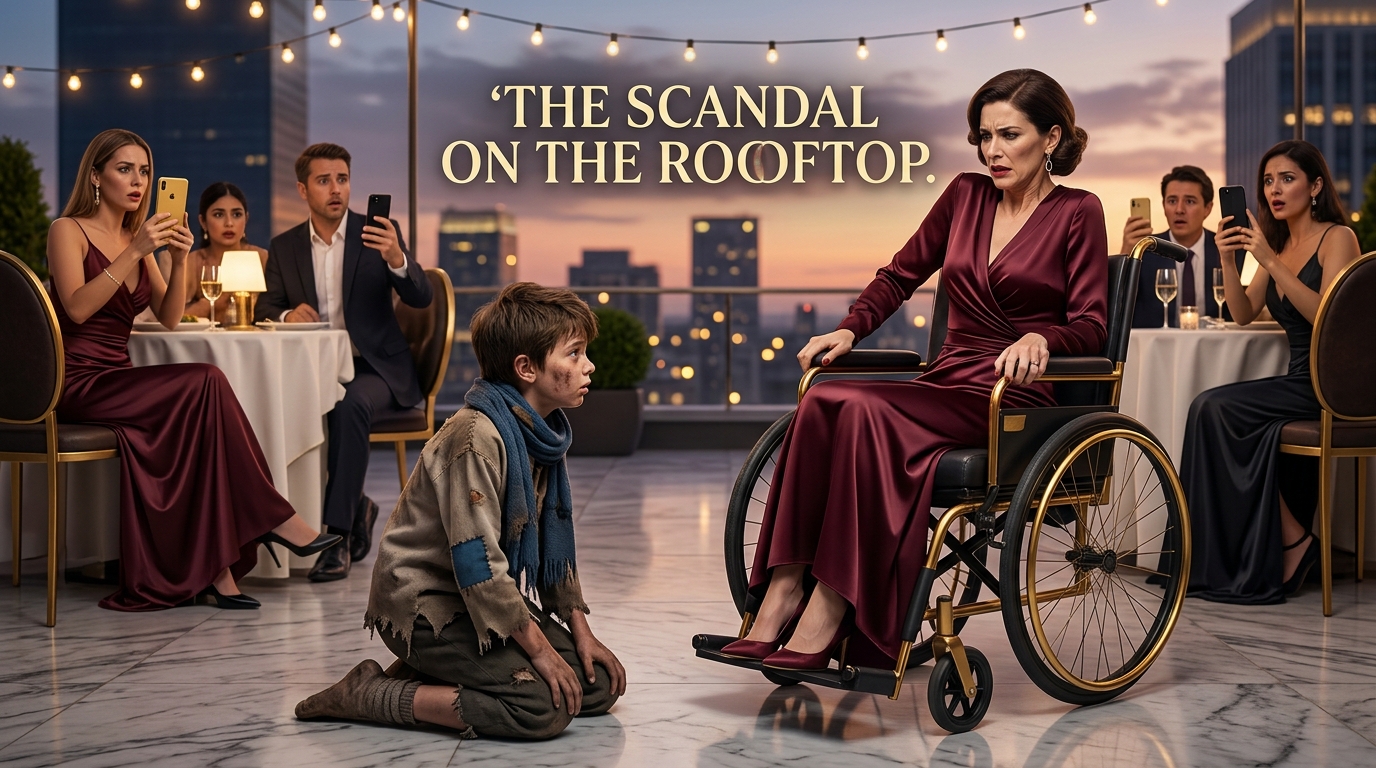
The scream cut through the soft jazz of the rooftop terrace.
For half a second, no one understood what they were seeing.
Then the phones came out.
One by one.
Bright screens rising over linen tables, champagne glasses, gold bracelets, diamond rings, and plates of food arranged too beautifully to look like meals.
The rooftop restaurant sat forty stories above Manhattan, wrapped in glass and money. Candlelight flickered in hurricane lamps. A saxophone player stood near the bar, frozen mid-note. The city glittered below as if nothing ugly could reach this high.
But ugliness had a way of climbing.
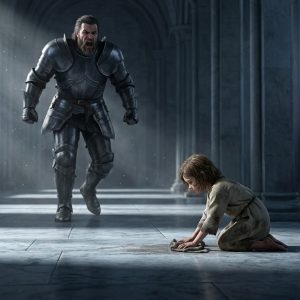
A filthy boy in rags was kneeling on the marble floor.
He could not have been more than nine.
His hoodie was torn at the shoulder. His pants were too short. His hair was damp and tangled. Dirt marked his cheeks, his neck, the backs of his small hands. His sneakers were split at the toes.
He did not belong there.
Not in this world of silk dresses, private elevators, and waiters trained to smile without seeing.
And he certainly should not have been touching her.
Vivian Vale sat in her wheelchair near the terrace railing, draped in ivory silk, her silver-blonde hair pinned perfectly beneath a pearl comb. She was elegant in the way tragedy can become elegant when surrounded by enough money.
For ten years, the city had known her as the paralyzed philanthropist.
The woman who survived the accident.
The woman who turned suffering into charity.
The woman who never stood again.
Now she recoiled as the boy’s small hands reached toward her foot.
“Get away from me!” Vivian snapped.
Security rushed from the glass doors.
Guests leaned back in shock.
Someone whispered, “Is he homeless?”
Another voice said, “Call the police.”
The boy did not flinch.
He did not beg.
He did not look at the phones.
He looked only at Vivian.
“Don’t fight me,” he whispered.
His voice was rough with fear and exhaustion, but beneath it was something stranger.
Certainty.
“Just try.”
Vivian’s face twisted.
“Try what?”
The boy placed one calloused hand around her ankle.
A woman at the next table gasped.
Security was six steps away.
Five.
Four.
Then the boy pressed his thumb against a place beneath Vivian’s foot.
Not hard.
Precise.
Hidden.
Vivian’s breath caught in her throat.
Her whole body jerked.
The terrace went silent.
Her eyes widened.
Not with pain.
With terror.
“Wait,” she choked.
Security stopped.
Vivian stared down at her own foot as if it had betrayed her.
Her lips trembled.
“I felt that.”
The silence that followed was deafening.
The boy looked up.
His eyes were dark and wet.
A haunting, tearful smile moved across his face, too old for his small body.
“My mama said you stood the day you left us.”
Vivian’s face went white.
The wealthy diners no longer looked amused.
Phones stayed raised, but the hands holding them were now still.
The boy pressed again.
This time Vivian’s leg trembled violently beneath the silk blanket covering her lap.
A sound escaped her.
Not quite a scream.
Not quite a sob.
The boy leaned closer.
“My mama said if I ever found you,” he whispered, “I had to touch the place she showed me.”
Vivian shook her head.
“No.”
Her voice was barely air.
“No, no, no.”
The boy reached into his torn hoodie pocket and pulled out a small folded photograph.
He held it up.
The image was creased, stained, nearly worn through from being opened too many times.
Vivian looked at it.
And the last trace of color left her face.
In the photograph, Vivian stood on a beach ten years earlier.
Standing.
Unaided.
Laughing.
One hand on the shoulder of a younger woman beside her.
A woman with tired eyes and a swollen pregnant belly.
On the back, in faded blue ink, were three words:
She remembers everything.
The boy placed the photograph on Vivian’s lap.
Then he said the sentence that shattered the terrace.
“My name is Noah.”
Vivian’s mouth opened.
No sound came.
The boy’s tears finally spilled.
“And my mama’s name was Elena.”
A glass fell from someone’s hand and shattered.
Because every person close to Vivian Vale knew that name.
Elena Ward.
The maid accused of stealing from Vivian ten years ago.
The maid who disappeared after the accident that supposedly left Vivian paralyzed.
The maid everyone said had run away in shame.
Vivian stared at Noah like a grave had opened at her feet.
Then the boy whispered, “She died last week.”
His small hand tightened around the edge of the wheelchair.
“But before she died, she told me you weren’t paralyzed.”
Vivian’s legs trembled again.
And this time, everyone saw.
The Woman Who Turned Suffering Into Power
Vivian Vale had built an empire out of being pitied.
Before the wheelchair, she had been famous for different reasons.
Born into old money.
Married into newer money.
Photographed at galas, charity auctions, museum openings, and summer benefits where people donated enough to feel generous but not enough to alter the world that made generosity necessary.
Her husband, Conrad Vale, owned Vale Meridian Hotels, a luxury hospitality chain with properties across the United States and Europe. Vivian ran the charitable foundation attached to it.
Children’s hospitals.
Disability access campaigns.
Scholarships.
Domestic worker support, ironically.
She understood public image the way some people understand music.
Timing.
Silence.
Lighting.
The right tear at the right podium.
Then came the accident.
At least, that was the official story.
Ten years earlier, Vivian had fallen down the rear staircase of the Vale summer house in Newport during a private staff retreat. There were storms that night. Too much wine. Bad lighting. A doctor’s statement. A spinal injury. Permanent lower-body paralysis.
The story spread quickly.
Beautiful philanthropist loses ability to walk.
City mourns.
Husband stands faithfully beside her.
Foundation expands disability programs.
Vivian became untouchable.
Not because people loved her more after the wheelchair.
Because they questioned her less.
Pity can become armor when worn by someone without shame.
Before the accident, Vivian had been under investigation.
Quietly.
Not by police.
By her husband’s internal auditors.
Elena Ward, a twenty-six-year-old housekeeper assigned to the Newport property, had discovered irregularities in foundation accounts. Medical supply donations billed at triple cost. Shell nonprofits. Missing grant money. Receipts for equipment never delivered.
Elena had not meant to become involved.
She was pregnant, unmarried, and working two jobs.
She cleaned the east wing, folded guest linens, polished silver, and sent money back to her younger sister in Queens. She kept her head down because women like Elena learned early that visibility could be dangerous.
But Elena was smart.
She noticed things.
A receipt in the trash.
A check stub beneath Vivian’s desk.
A locked donation room where boxes labeled pediatric mobility devices were empty.
She told the wrong person.
Vivian.
At first, Vivian smiled.
“Sweetheart, bookkeeping is confusing if you’re not trained.”
Elena apologized.
Then quietly copied documents.
That was her mistake.
Or her courage.
Sometimes the two look the same until consequences arrive.
Elena planned to give the documents to Conrad Vale after the staff dinner.
But that night, Vivian called her to the rear service staircase.
No cameras there.
No guests.
Only rain hitting the windows and the smell of old wood.
Elena later told Noah the details in pieces because some stories are too heavy for a child all at once.
Vivian had been standing at the landing in heels.
Standing.
Angry.
“You don’t understand what you found,” she said.
Elena held the envelope against her chest.
“I understand enough.”
“You’re a maid.”
“I’m a witness.”
Vivian slapped her.
Elena stumbled.
She was eight months pregnant then.
Noah inside her.
Vivian reached for the envelope.
Elena pulled away.
They struggled.
A third person arrived.
Conrad.
Vivian’s husband.
Elena thought he would help.
Instead, he looked at the envelope, then at Vivian, then at Elena’s belly.
And made the first decision that destroyed all of them.
“Give it to me,” he said.
Elena refused.
Vivian lunged again.
Elena slipped on the wet stair tread.
She fell.
Not far.
Four steps.
Enough to strike her hip and shoulder.
Enough to scream from pain and fear.
Enough for Vivian to freeze.
Conrad ran down.
Elena begged him to call an ambulance.
He did.
But not before Vivian turned to him and whispered, “If she talks, everything is over.”
What happened next became the lie of the decade.
By the time paramedics arrived, Vivian was at the bottom of the staircase, crying, claiming she had slipped while trying to help Elena.
Elena, dazed and bleeding, was taken away separately.
The envelope disappeared.
Vivian claimed she could not feel her legs.
Doctors found trauma.
But trauma and truth are not the same.
With enough money, enough specialists, enough carefully framed symptoms, enough private rehabilitation, enough public sympathy, the story became permanent.
Vivian Vale was paralyzed.
Elena Ward was accused of theft, instability, and attempting to extort the Vale Foundation.
She gave birth under a false name three weeks later.
Then disappeared.
Not because she was guilty.
Because Conrad’s men made sure she understood what would happen if she did not.
Noah grew up moving from room to room.
Shelters.
Church basements.
Cash apartments.
Bus stations.
His mother cleaned when she could, sewed when she could, and hid whenever Vale Meridian security came too close.
She never stopped keeping one thing safe.
The photograph.
Vivian standing.
And the nerve trick.
Elena’s mother had been a physical therapist in the Dominican Republic. She had taught Elena simple reflex points, muscle activation tests, and how to tell real loss of sensation from guarded movement.
“She can feel,” Elena told Noah when he was old enough to listen. “She trained the world not to ask.”
Noah did not understand.
Until the cancer came.
Quiet at first.
Then not.
Elena grew thinner.
Weaker.
Her cough worsened.
She could no longer run.
In her last week, she placed the photograph in Noah’s hands and made him practice pressing the nerve beneath her own foot.
“Not hard,” she whispered.
“I don’t want to hurt you.”
“You won’t.”
“What if she screams?”
“Let her.”
“What if they take me?”
“Stay where cameras can see you.”
Noah cried then.
“I can’t do it.”
Elena touched his face.
“You can. Because the truth has been walking on stolen legs for ten years.”
Three days after Elena died in a charity clinic under a name that was not hers, Noah took two buses, followed Vivian’s foundation event calendar from a stolen newspaper, and found the rooftop terrace where she was hosting a donor dinner for disability access awareness.
He waited until security opened the private elevator for a florist.
Then slipped inside behind the carts.
He arrived barefoot because his shoes had split outside the subway station.
And when he saw Vivian Vale in her wheelchair beneath the warm gold lights, smiling as donors praised her courage, something in the boy went still.
His mother had died running.
Vivian had lived sitting on a throne of sympathy.
Noah walked forward.
Then knelt.
The Foot That Betrayed Her
Vivian tried to recover in seconds.
She had survived scandals before anyone knew they were scandals.
The first rule was always the same.
Control the room.
She snatched the photograph from her lap with trembling fingers.
“This child is disturbed,” she said.
Her voice shook.
That was new.
Everyone heard it.
The lead security guard moved again, but now uncertainly.
Noah did not back away.
He pointed to her foot.
“You felt it.”
Vivian lifted her chin.
“Muscle spasms happen.”
Noah shook his head.
“My mama said you would say that.”
A nervous murmur moved through the terrace.
The phones were still recording.
Vivian saw them.
Her eyes flashed.
“Stop filming,” she snapped.
No one stopped.
That was when Conrad Vale arrived.
He had been inside the private dining room speaking to investors when the disturbance began. At sixty-four, Conrad still had the careful handsomeness of a man whose wealth softened every edge before age could show it. His dark suit fit perfectly. His silver hair was combed back. His expression was composed.
Until he saw the photograph in Vivian’s hand.
Then he looked at Noah.
Really looked.
Something moved across his face.
Recognition.
Not of the boy.
Of Elena.
The shape of her eyes.
The set of the jaw.
Noah saw him too.
“My mama said you were there.”
Conrad stopped.
The guests turned toward him.
Vivian’s voice sharpened.
“Conrad, call security.”
Noah stood.
He was small enough that the table beside him was almost shoulder height, but the photograph had changed the room. He no longer seemed like an intruder.
He seemed like evidence.
“My mama said she asked you for help,” Noah said.
Conrad’s mouth tightened.
“Son—”
“I’m not your son.”
The sentence struck harder than it should have.
Conrad looked around at the guests, the cameras, the donors, the board members of Vivian’s foundation. Public pressure pressed against his face.
“Everyone calm down,” he said. “This child has clearly been coached.”
Noah reached into his hoodie again.
Vivian’s eyes widened.
“No.”
He pulled out a folded sheet of paper.
A clinic form.
Wrinkled.
Blood-stained at one corner from Elena’s final IV.
“My mama wrote it before she died.”
Conrad stepped toward him.
Noah stepped back, raising his voice.
“She said read it where people can hear.”
The terrace went silent again.
Noah unfolded the page with shaking hands.
He was not a strong reader.
Elena had known that.
So the letter was short.
My name is Elena Ward. I worked for Vivian Vale ten years ago. I found records proving the Vale Foundation stole money from disabled children’s medical grants. Vivian confronted me. I fell. Conrad helped her blame me. Vivian was never fully paralyzed. She could feel and move enough to stand the day she left the clinic, but she chose the chair because it made no one question her. My son Noah is not lying. I am dead now, but I was not crazy. I was not a thief. Please do not let them make him disappear too.
By the time he reached the final line, Noah’s voice had broken.
A woman near the railing began crying.
A donor whispered, “Oh my God.”
Vivian laughed.
It was the wrong sound.
Too sharp.
Too high.
Too late.
“This is obscene,” she said. “You people are listening to a filthy child reading a deathbed fantasy.”
Noah looked at her.
“My mama said rich people call truth fantasy when the truth has dirty shoes.”
That sentence did something the letter had not.
It cut through the class line in the room.
The diners looked at Noah’s bare feet.
Then at Vivian’s silk blanket.
Then at Conrad’s perfect suit.
The contrast became unbearable.
A man stepped forward from table four.
Dr. Samuel Price.
Neurologist.
Major donor.
Former rehab consultant, though never Vivian’s physician.
His face was grave.
“Mrs. Vale,” he said carefully, “may I ask something?”
Vivian turned to him with fury.
“No.”
He looked at her legs.
“You reacted to a very specific plantar nerve stimulus.”
“Reflexes are not sensation.”
“Your verbal response was.”
Her face flushed.
Conrad snapped, “Doctor, this is neither the time nor the place.”
Dr. Price looked at Noah.
“Apparently, this child tried every private option before the public one.”
Noah shook his head.
“My mom tried.”
The doctor’s expression softened.
“Then your mother tried.”
Vivian’s hand gripped the armrest of her wheelchair.
Conrad leaned toward her.
“Do not move.”
It was a whisper.
But the nearest phone caught it.
Do not move.
Noah heard it.
So did Dr. Price.
So did the security guard standing behind Vivian.
The terrace went very still.
Vivian’s eyes darted to Conrad.
For the first time, fear passed between them in the opposite direction.
Not from exposure.
From each other.
Noah looked at Conrad.
“You knew she could.”
Conrad’s face darkened.
“Enough.”
He grabbed Noah’s arm.
The boy gasped.
Vivian hissed, “Conrad!”
Too late.
The lead security guard stepped in.
So did Dr. Price.
So did a waiter who had been watching with clenched fists from the bar.
Conrad released Noah immediately, but the damage was done.
Three cameras had captured him grabbing a child who had just accused him.
A woman in a navy dress stood from the corner table.
She had not spoken until then.
She held a badge.
Detective Anya Cross, financial crimes division.
“I think,” she said, “this dinner is over.”
Vivian stared at her.
Conrad went pale.
Detective Cross looked at Noah.
“Your mother sent me copies of her documents two weeks ago,” she said gently. “I was trying to find you.”
Noah’s face crumpled.
“You knew her?”
“I spoke to her once.”
“Did she sound scared?”
Detective Cross’s expression tightened.
“She sounded brave.”
Noah began to cry.
And Vivian Vale, still seated in her wheelchair, looked down at her trembling legs as if they had betrayed her more completely than any person in the room.
The Files Beneath The Foundation
Detective Cross did not arrest Vivian that night.
Not immediately.
That frustrated everyone watching online later.
People wanted instant justice.
They wanted the wheelchair rolled away in handcuffs, the wicked woman exposed under flashing lights, the child vindicated before dessert cooled.
Real justice moved slower.
But that night, it started.
Noah was taken to a private room downstairs, where a child advocate, a medic, and Detective Cross stayed with him. He refused food until someone promised the food was not from Vivian’s kitchen.
Then he ate three dinner rolls, soup, and half a chocolate cake slice too quickly and got sick in the bathroom.
The child advocate sat on the floor outside the stall and said, “Take your time.”
Noah asked, “Are they going to put me somewhere?”
“Yes,” she answered honestly. “Somewhere safe tonight. We’ll talk about longer after.”
“Not with them?”
“Not with them.”
That was enough.
Upstairs, the rooftop terrace became an evidence site.
Phones were collected voluntarily from several guests who wanted to help. Others tried to delete recordings and learned quickly that panic makes people bad at technology. Security footage from the private elevator, terrace, and dining room was preserved.
Detective Cross already had Elena’s documents.
Not all.
Enough.
Elena had mailed copies from the clinic when she realized she was dying. She had addressed one envelope to Detective Cross because a nurse told her Cross had investigated financial fraud involving charities before. The package arrived two days after Elena died.
Inside were foundation receipts, old photographs, a copy of the clinic note, and a list of names Elena had memorized for ten years.
Vivian Vale.
Conrad Vale.
Dr. Paul Renner.
Victor Hale, legal counsel.
Marissa Lane, foundation auditor.
And one phrase:
Ask about the empty wheelchairs.
That phrase opened the case.
The Vale Foundation had collected donations for pediatric mobility devices, adaptive chairs, rehabilitation grants, and home accessibility equipment. Many grants were real. Enough to pass surface audits. Enough children received help to make the photographs convincing.
But thousands of devices billed to donors had never been delivered.
The money moved through shell vendors.
Some funds returned to Vale-controlled accounts.
Some paid for private medical consultants.
Some paid legal settlements.
Some paid the staff who helped bury Elena.
When investigators searched the foundation warehouse two days after the rooftop incident, they found rows of empty boxes labeled as specialized wheelchairs, standing frames, pediatric braces, and therapy equipment.
Empty.
Photographed for donors.
Billed as delivered.
Never shipped.
The irony was so ugly even hardened agents grew quiet.
Vivian had built a disability charity on stolen disability aid while performing helplessness so convincingly that no one questioned her.
Dr. Renner, the physician who publicly supported her paralysis diagnosis, became the weak link.
He had signed more than medical reports.
He had helped craft the narrative.
Incomplete spinal injury.
Psychological overlay.
Severe functional loss.
No expectation of independent ambulation.
The language allowed ambiguity. Vivian did have an injury after the staircase incident. She did suffer pain, nerve symptoms, and partial impairment for a time. But by the time she began public life in the wheelchair, medical notes showed she had regained partial strength and sensation.
Private videos confirmed it.
The first came from a nurse who had kept a copy for years out of fear.
Vivian standing briefly at a clinic rail three months after the accident.
Conrad beside her.
Dr. Renner saying, “We can frame this carefully.”
Vivian replying, “Frame it permanently.”
The second video came from a hidden camera in the Vale penthouse gym, recovered from an old server.
Vivian exercising her legs with assistance.
Walking short distances.
Not easily.
Not without pain.
But walking.
The public had not been wrong to believe she suffered.
They had been wrong because she turned suffering into a fraud.
That distinction mattered legally.
And morally.
When Vivian was finally brought in for questioning, she arrived in her wheelchair.
Detective Cross watched her roll into the interview room.
“You can use the chair,” Cross said. “But I wouldn’t build your defense around needing it.”
Vivian’s mouth tightened.
“My medical condition is complex.”
“So is fraud.”
Vivian looked away.
Conrad was arrested first, after financial records tied him to shell vendors and security payments used to monitor Elena after the accident. He claimed he protected his wife from extortion.
Then the rooftop video of him whispering do not move went public.
The court of opinion did not wait for the court of law.
Foundation donors demanded audits.
Families of children denied equipment came forward.
Former staff testified.
A receptionist remembered Elena coming to the office with documents and leaving in tears after meeting Vivian.
A driver admitted he had been paid to follow Elena after she gave birth.
A nurse confirmed Elena begged to file a police report after the staircase fall, but a Vale attorney arrived before officers did.
And Noah, small Noah, became the face of a scandal he never asked to carry.
Detective Cross protected him as much as possible.
Not enough.
No protection could stop the world from wanting the boy who made the fake paralyzed woman feel her foot.
That was how headlines framed it.
Noah hated that.
“My mama did it,” he told the child advocate. “Not me.”
The advocate said, “You finished what she started.”
Noah thought about that.
Then asked, “Does that mean I can stop now?”
No one answered quickly enough.
The Boy With No One Left
Elena had no living parents.
Her younger sister, Rosa, was found three days after the rooftop incident in Newark, working double shifts at a laundromat and crying so hard when told Elena was dead that the detective had to sit with her for an hour before asking questions.
Rosa had searched for Elena for years.
Elena cut contact to protect her.
That was one more wound the Vales had not directly caused but had made necessary.
When Rosa met Noah, she froze outside the child services office.
He sat in a plastic chair, knees tucked up, wearing donated sneakers that did not fit. He looked at her with Elena’s eyes and someone else’s exhaustion.
Rosa covered her mouth.
“Noah?”
He stood slowly.
“My mom said you sing when you cook.”
Rosa broke.
She crossed the room and pulled him into her arms.
He went stiff first.
Then folded.
For the first time since the rooftop, Noah cried like a child instead of a witness.
Rosa took him home under temporary kinship placement.
Her apartment was small.
Too small, according to the social worker.
Clean.
Warm.
Full of plants, old photographs, and neighbors who knocked without making it feel like surveillance.
Noah slept on the couch the first night because he refused the bedroom.
Rosa did not argue.
She placed a blanket over him and sat in the kitchen until dawn, humming badly under her breath because she wanted him to know Elena had told the truth.
He woke once and whispered, “Are you going to send me back?”
Rosa came to the doorway.
“No.”
“Even if people come?”
“Especially then.”
He nodded and closed his eyes.
Healing did not begin as joy.
It began as the absence of immediate running.
Rosa took Noah to identify Elena’s belongings.
A bag from the clinic.
One sweater.
A notebook.
A bus card.
A hair tie.
The photograph.
Noah held the sweater to his face and did not speak for twenty minutes.
Rosa sat beside him.
No hurry.
No performance.
Later, she took him to Elena’s grave.
The city had buried Elena under her assumed name at first. Detective Cross helped correct the records.
Elena Ward.
Mother.
Witness.
Truth-teller.
Noah brought no flowers.
He brought the folded clinic letter.
“I read it,” he told the grave. “Like you said.”
The wind moved through the cemetery.
Rosa stood behind him, crying silently.
Noah continued.
“She felt it.”
A pause.
“Everyone saw.”
Another pause.
“I’m tired now.”
Rosa stepped closer.
“You can be tired.”
He leaned into her side.
Noah’s testimony was handled carefully.
A judge allowed a recorded statement with a child trauma specialist present. He described Elena’s instructions, the photograph, the nerve point, the rooftop, Conrad grabbing him, Vivian’s reaction.
Vivian’s attorney tried to argue that Noah had been coached.
The judge watched the rooftop video.
Then the medical records.
Then Elena’s letter.
Then said dryly, “The child appears to have been instructed to reveal evidence, not fabricate it.”
The line made the news.
Noah did not care.
He cared about whether Rosa bought the cereal he liked.
Whether the donated shoes could be exchanged.
Whether his mother’s sweater still smelled like her.
Whether Vivian could come find him.
She could not.
Vivian and Conrad were indicted on foundation fraud, conspiracy, witness intimidation, obstruction, medical misrepresentation tied to insurance and charitable solicitation, and child-related coercion connected to Elena’s disappearance and Noah’s concealment.
Dr. Renner was indicted too.
So was Victor Hale, the foundation attorney who had drafted threats against Elena and helped classify her as unstable after the fall.
The trial began nearly a year later.
By then Noah had gained weight.
His hair was cut properly.
He attended school.
He still hated rooftop terraces, jazz music, white tablecloths, and anyone touching his feet.
Rosa learned all of that.
She learned not to wake him suddenly.
Not to say “calm down.”
Not to throw away old clothes without asking.
Not to treat bravery as if it erased fear.
When the prosecutor asked if Noah would testify in court, he said no.
Rosa supported him.
Detective Cross supported him.
The prosecutor used his recorded statement instead.
Vivian watched it from the defense table.
She sat in her wheelchair.
Always.
That was her final battlefield.
If she stood, the world would see performance.
If she stayed seated, perhaps someone might still pity her.
Then Dr. Price testified.
He explained sensation, partial injury, reflexes, and functional ability. He explained that using a wheelchair did not itself prove fraud, but misrepresenting one’s condition to solicit funds and conceal evidence did.
The prosecutor played the clinic video.
Vivian standing at the rail.
The courtroom inhaled as one body.
Vivian closed her eyes.
Then came Elena’s letter.
Read aloud by the prosecutor.
Noah was not in the room.
Rosa took him to the park that day instead.
They fed ducks until Noah asked if ducks could choke on bread. Rosa Googled it, panicked, and bought peas from a nearby store. Noah laughed for the first time in days.
In court, the letter did what Elena had hoped.
It made her real.
Not a thief.
Not unstable.
Not a maid who tried to extort a rich woman.
A mother.
A worker.
A witness.
A woman who had died before anyone powerful admitted she had been telling the truth.
Vivian testified against advice.
Like many people who build identities from performance, she could not resist the stage.
She spoke of pain.
Humiliation.
Public misunderstanding.
The complexity of invisible disability.
Some of it was true in isolation.
That made it more dangerous.
Then the prosecutor asked, “Mrs. Vale, why did you tell your husband not to move when the boy pressed your foot?”
Vivian’s face hardened.
“I was startled.”
“Why did your husband tell you, ‘Do not move’?”
“I cannot speak for him.”
“Did you ever walk after the accident?”
Vivian paused.
The courtroom waited.
“With assistance.”
A murmur spread.
The prosecutor continued.
“Did you allow the public to believe you had no functional sensation or voluntary movement in your legs?”
“My condition was private.”
“You built a public charity around it.”
Vivian’s composure cracked.
“I suffered.”
“Yes,” the prosecutor said. “And then you used your suffering to steal from people who suffered more.”
That line ended her.
Not legally.
The evidence did that.
But morally, the room was done.
The jury convicted Vivian and Conrad on most counts. Dr. Renner and Victor Hale reached plea agreements. The foundation was dissolved and restructured under court supervision, with recovered funds directed to the families and children originally denied services.
At sentencing, Rosa gave a statement.
Noah did not.
Rosa stood with Elena’s photograph in one hand.
“My sister cleaned your rooms,” she said to Vivian. “She saw your dirt. You thought that made her low. It made her a witness.”
Vivian looked down.
Rosa continued.
“She died poor because you made truth expensive. Her son walked into your rich dinner with no shoes because you took every safe road from him. I hope that is the image that follows you.”
Vivian received a long sentence.
Conrad too.
But no number felt equal to Elena’s lost years.
Noah asked Rosa afterward, “Is it over?”
Rosa answered honestly.
“The court part is.”
He looked at her.
“What part is next?”
She took his hand.
“The living part.”
The Woman Who Finally Stood
The first time Noah saw Vivian stand publicly, he was seventeen.
Not at a gala.
Not in court.
In a prison medical hearing broadcast only to legal parties.
He was not supposed to watch, but he asked.
Rosa hesitated.
Then said yes, because secrets had already harmed him enough.
Vivian had aged in custody.
Her hair was gray now. Her face was thinner. She still used the wheelchair most of the time, partly because her injury had worsened with age and disuse, partly because bodies remember lies in complicated ways.
During the hearing, a doctor asked her to transfer from chair to exam table.
Vivian placed both hands on the armrests.
Pushed.
Stood.
Slowly.
Painfully.
For three seconds.
Then sat.
Noah watched without satisfaction.
He had expected triumph.
He felt only sadness.
Not pity exactly.
Something heavier.
Rosa sat beside him.
“You okay?”
“She could stand,” he said.
“Yes.”
“But not well.”
“No.”
He stared at the screen after it went black.
“My mom knew that.”
“Yes.”
“Vivian was hurt.”
“Yes.”
“And she still lied.”
“Yes.”
Noah nodded slowly.
“I hate that both things are true.”
Rosa touched his shoulder.
“Most hard stories have more than one truth. That doesn’t make the crime smaller.”
Noah carried that with him.
It shaped the man he became.
He studied physical therapy first because his grandmother had taught Elena, and Elena had taught him. Then he moved into forensic rehabilitation consulting, helping courts evaluate injury claims without dismissing real disability or enabling fraud.
He was careful.
Almost painfully careful.
He refused jokes about fake wheelchair users.
He corrected people who used Vivian’s case to mock disability.
“My mother didn’t expose her because she used a chair,” he would say. “She exposed her because she used a lie to hurt people.”
That distinction became his life’s work.
Rosa said Elena would have been proud.
Noah believed her some days.
Other days, grief made pride feel like a poor trade.
The rooftop restaurant closed after the scandal.
Years later, it reopened under another name. Noah visited once as an adult.
Not for revenge.
For geography.
He stood near the terrace railing where Vivian had sat. The city still glittered below. Jazz still played inside. Wealth still looked polished from far away.
He took off one shoe.
Then the other.
The marble was cool under his feet.
A manager approached nervously.
“Sir?”
Noah smiled faintly.
“I’m all right.”
He stood there barefoot for one minute.
Not the frightened child.
Not the witness.
Just a man feeling the ground beneath him by choice.
Then he put his shoes back on and left.
The Vale Foundation building became something else too.
After restitution, recovered assets helped establish the Elena Ward Mobility Trust, run independently with strict transparency requirements. It provided equipment, home modifications, therapy access, and legal support for patients whose needs were denied, exploited, or used in fraudulent fundraising.
Noah hated the name at first.
Then visited the first family helped by the trust.
A little girl named Amara received a standing frame and customized chair her insurance had denied twice. Her mother cried when the equipment arrived.
Amara looked at Noah and asked, “Did your mom make this?”
He swallowed.
“In a way.”
That night, he went home and took Elena’s sweater from its box.
It no longer smelled like her.
That broke him more than the first year had.
Rosa found him on the floor and sat beside him until morning.
Grief does not leave.
It changes shape, hides in fabric, waits inside questions, and returns when smell fades.
Noah kept going anyway.
Years later, people still told the story of the filthy boy who knelt at a rooftop dinner and pressed a hidden nerve in a rich woman’s paralyzed foot, making her gasp that she felt it.
They remembered the scandal.
The phones.
The trembling leg.
The photograph.
The dead mother’s letter.
The charity fraud.
The woman whose secret literally walked back to haunt her.
But Noah remembered the moment before all that.
His hand hovering above Vivian’s foot.
His mother’s voice in his memory.
Not hard. Precise.
He remembered being afraid that if he pressed and nothing happened, Elena would vanish all over again.
But he pressed.
And Vivian felt it.
The truth entered the room through her own body.
That was the part no lawyer could create.
No witness could soften.
No money could buy away.
On the tenth anniversary of Elena’s death, Noah and Rosa visited her grave with two folding chairs, coffee, and a bag of sweet bread from the bakery Elena used to love.
Noah had brought a pair of small children’s shoes.
Not his original ones.
Those were long gone.
These were new.
Sturdy.
Blue.
Rosa looked at them.
“For who?”
He placed them by the grave.
“For the boy she sent.”
Rosa’s eyes filled.
Noah sat in the grass.
“I used to think she asked too much of me.”
Rosa sat beside him.
“She did.”
He looked at her, surprised.
Rosa continued.
“She had no choice. But yes. It was too much.”
Noah breathed out shakily.
“I needed someone to say that.”
“I know.”
They sat quietly.
Then Noah said, “I’m glad she trusted me.”
“Both can be true.”
He nodded.
Both can be true.
His mother had protected him.
His mother had needed him.
Vivian had been injured.
Vivian had lied.
The world had watched the boy because he made a rich woman tremble.
But Elena had been the one who carried the truth for ten years.
Noah stood before the grave and touched the photograph in his pocket.
The same beach photo.
Vivian standing.
Elena pregnant.
A moment that had once been proof of betrayal and later became proof of a crime.
Now it was proof of something else too.
His mother had been there.
She had seen.
She had remembered.
She had refused to let the powerful decide reality simply because they could afford better lighting.
Noah looked at the stone.
“Elena Ward,” it read.
Mother. Witness. Beloved.
Beneath it, Rosa had insisted on one more line.
She saw the truth and kept walking.
Noah smiled through tears.
That line was not entirely accurate.
Elena had been forced to run, hide, crawl, suffer, and die too early.
But spiritually, maybe it was true.
She kept walking.
Through fear.
Through poverty.
Through sickness.
Through every story told against her.
And when she no longer could, she sent her son forward.
Barefoot.
Hungry.
Terrified.
Carrying a photograph, a letter, and the exact place to press.
Some people thought the rooftop was where Vivian Vale was exposed.
Noah knew better.
Vivian was exposed long before that.
In the staircase.
In the clinic.
In the empty boxes.
In the charity ledgers.
In every moment Elena told the truth and no one with power listened.
The rooftop was simply where the world finally heard the gasp.
And when Vivian’s breath caught, when her leg trembled, when silence fell over all that silk and gold, Noah understood something his mother had died trying to prove.
Truth does not need to look powerful to be powerful.
Sometimes it arrives in rags.
Sometimes it has dirty hands.
Sometimes it kneels.
Sometimes it whispers, Don’t fight me. Just try.
And sometimes, with one small touch, it makes a decade of lies stand on shaking legs.