“KID, GET OUT OF THERE!”
The scream ripped through the dusty air of the rodeo arena.
For one impossible second, every sound seemed to vanish.
The cheering.
The announcer.
The clang of the chute gate.
The stomp of boots on wooden bleachers.
Even the country music crackling from the speakers seemed to cut out beneath the collective horror of twelve thousand people realizing a child had just jumped the fence.
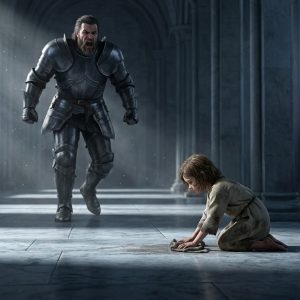
A ten-year-old boy landed hard in the dirt.
He rolled once, coughing as dust swallowed him.
Then he pushed himself up onto his knees.
He did not run.
He did not crawl toward the fence.
He did not freeze like a child who had made a mistake and suddenly understood too late.
He turned toward the bull.
The animal was already loose.
Two tons of black muscle, rage, and scarred hide thundered across the arena. Its horns flashed white through the dust. Its hooves struck the ground with a force that shook the rails. Foam streaked its mouth. Its eyes were wild from light, noise, pain, and years of men calling domination sport.
The announcer’s voice cracked through the speakers.
“Somebody get that kid out of there!”
Rodeo hands sprinted toward the gates.
Clowns waved their hats.
A rider near the west rail climbed down too fast and fell.
But the boy stayed where he was.
Small.
Dusty.
Shaking.
In the direct path of the bull.
In the VIP booth, beneath a shaded canopy decorated with banners and sponsor logos, a wealthy man stood abruptly.
His name was Grant Keller.
Owner of Keller Stock & Rodeo.
Local legend.
Millionaire rancher.
Winner of that year’s Golden Trophy for Lifetime Contribution to Western Sport.
He gripped the brass railing as the boy reached into his pocket.
Grant’s face tightened.
Not with fear for the child.
With recognition.
The boy pulled out a red cloth.
A faded bandana.
Old.
Frayed at the edges.
Hand-stitched with a single letter in black thread.
K.
The crowd fell silent as the bull skidded in the dirt.
Its hooves carved deep lines.
Dust rose around its massive body.
The animal lowered its head.
The boy held out the bandana with both trembling hands.
“Easy,” he whispered.
The bull snorted.
One hot breath moved the cloth.
Then the beast stepped closer.
The arena held its breath.
The bull sniffed the fabric.
Once.
Twice.
Then its whole body changed.
The rage did not vanish.
It folded into something older.
Deeper.
A low moan escaped the animal’s chest.
Not a roar.
Not a threat.
A sound almost like grief.
The boy’s face broke.
Tears carved clean tracks through the dust on his cheeks.
He pressed the bandana against the bull’s nose.
“You remember him,” he whispered.
The bull lowered its head until its massive forehead nearly touched the boy’s chest.
A few people in the front row began crying without understanding why.
The announcer forgot to speak.
Rodeo hands stopped moving.
The boy slowly turned toward the VIP booth.
His eyes locked on Grant Keller.
The wealthy man in the front row went pale.
The boy’s voice rose, cracking through the arena.
“You lied to my dad before he died!”
A murmur rolled through the crowd.
Grant’s wife covered her mouth.
His foreman shifted behind him.
The boy stood in the dust beside the bull, still holding the red bandana.
His small body shook, but he did not look away.
“You said Koda was dead!” he screamed. “You said my dad was crazy!”
The bull lifted its head at the name.
Koda.
Grant Keller’s face changed completely.
Because that was the name he had erased from every record.
The secret he thought was buried in a grave had just stood up in the middle of his arena.
And for the first time that afternoon, everyone understood.
The bull was not the monster.
The monster was the man holding the golden trophy.
The Boy Who Remembered The Barn
The boy’s name was Caleb Reed.
He was ten years old, but grief had made him look smaller and older at the same time.
His father, Mason Reed, had been a bull handler at Keller Stock & Rodeo for nearly fifteen years. Not a famous rider. Not a rich ranch owner. Not the kind of man whose name appeared on sponsor banners.
He was the man behind the scenes.
The man who fed animals before sunrise.
The man who checked hooves, repaired gates, cleaned stalls, calmed terrified bulls after transport, and slept in the barn office during storm season because he said animals knew when people abandoned them.
Mason had a gift with bulls that other men mocked until they needed it.
He did not believe in breaking animals.
He believed in learning them.
Their patterns.
Their fear.
Their anger.
Their memory.
He taught Caleb the same way.
“Never stand in front of rage unless you know what hurt it,” Mason said once, crouching beside a stall while Caleb watched a young bull slam its head against a gate.
“Is he mean?” Caleb asked.
“No.”
“He looks mean.”
“He’s scared. Mean is what people call fear when they don’t want to feel responsible for it.”
That sentence stayed with Caleb.
So did the bull.
Koda.
A massive black bull with a white mark like a torn moon over one eye. He had come to Keller Ranch half-starved and violent after being seized from an illegal fighting operation. Most handlers wanted him put down. Grant Keller wanted him turned into a spectacle.
“Angry bulls sell tickets,” Grant said.
Mason hated that.
“He’s traumatized.”
Grant laughed.
“He’s livestock.”
Mason took Koda anyway.
For months, he worked with the bull quietly.
No cameras.
No shouting.
No prods unless absolutely necessary.
He used voice, rhythm, patience, and one red bandana tied to the gate every morning while feeding. The bandana belonged to Caleb’s mother, Kayla, who died when Caleb was four. She had stitched the K herself in black thread.
Mason carried it after she died.
Then Koda began associating it with calm.
Food.
Safety.
Mason.
Caleb used to sit outside the pen with homework in his lap while his father worked.
“Why do you let him smell Mom’s bandana?” he asked.
Mason smiled.
“Because grief knows grief.”
Caleb did not fully understand then.
He only knew Koda stopped throwing himself at the gate when Mason held up the cloth.
By the second year, Koda was still dangerous, but not wild.
He trusted Mason.
Only Mason.
Sometimes Caleb too, from a distance.
Then everything changed.
Mason found something in the old feed office.
Not drugs.
Not stolen money.
Something uglier for men like Grant Keller.
Records.
Shipment logs.
Veterinary invoices.
Insurance forms.
Photos of injured animals moved between shell ranches.
Keller Stock & Rodeo was not just breeding rodeo bulls.
It was cycling traumatized, abused, and illegally modified animals through events, hiding injuries, falsifying veterinary clearances, and using electric shock devices to make certain bulls appear more aggressive before high-stakes rides.
Koda had been one of the animals.
Grant had been selling him as “the untamable beast,” a marketing legend worth more alive and raging than calm and healthy.
Mason confronted him privately.
That was his mistake.
Or maybe, like Elena in other stories, it was simply the moment courage met power without enough witnesses.
Caleb heard part of the argument from behind the tack room.
“He’s not going in that arena,” Mason said.
Grant’s voice was cold.
“You work for me.”
“Not if you keep torturing him for money.”
“You get sentimental about animals, Mason. That’s why you’ll always shovel for men who own.”
Mason stepped closer.
“I copied the records.”
Silence.
Then Grant said, “Careful.”
“No. You be careful. If Koda enters that ring after what your men did to him, I go public.”
That night, Koda disappeared from the barn.
Grant told everyone the bull had been put down after attacking a handler.
Mason did not believe him.
He searched.
He called contacts.
He drove to satellite ranches.
He came home with red eyes and mud on his boots.
Three weeks later, Mason Reed died in a truck crash on County Road 12.
Brake failure, the report said.
Winter ice, the sheriff said.
Tragic accident, Grant Keller said at the funeral, one hand resting heavily on Caleb’s shoulder.
“Your daddy was a good man,” Grant told him. “Troubled, near the end. But good.”
Caleb remembered wanting to pull away.
But adults were watching.
After Mason died, the records vanished from their trailer.
So did Mason’s laptop.
So did the notebook where he kept animal treatment logs.
Grant paid for the funeral.
People praised his generosity.
Caleb moved in with his aunt Rosa, who worked nights at the grocery store and cried when she thought he slept.
Then, six months later, a poster appeared in town.
Keller Championship Rodeo.
Featuring Midnight Fury.
The Beast No Man Can Ride.
The poster showed a black bull with a white torn-moon mark over one eye.
Koda.
Renamed.
Rebranded.
Not dead.
Caleb stared at the poster until the paper blurred.
Then he went home and opened the old coffee tin beneath his bed.
Inside was the red bandana.
The one item Grant’s men had missed because Mason had hidden it in Caleb’s lunchbox the week before he died.
Behind it was a folded note in Mason’s handwriting.
If anything happens, Koda knows this cloth. And Grant knows why.
Caleb did not tell his aunt.
He did not tell the sheriff.
He had seen the sheriff laughing with Grant after the funeral.
Instead, on the morning of the rodeo, Caleb took the bandana, bought the cheapest ticket with birthday money, and sat in the stands while men praised Grant Keller under bright banners.
Then they opened the chute.
Koda exploded into the arena.
And Caleb understood why his father had written the note.
The truth could not be explained from the bleachers.
It had to be recognized by the animal Grant claimed was dead.
So Caleb climbed the fence.
The Man With The Golden Trophy
Grant Keller had spent fifty-eight years becoming untouchable.
He was born poor enough to resent poverty and rich enough by forty to pretend he had never been shaped by it. He built Keller Stock & Rodeo from inherited scrubland, bank loans, ruthless acquisitions, and a talent for turning Western myth into marketable violence.
He sponsored youth rodeo programs.
Donated to county law enforcement.
Paid hospital bills after public accidents.
Funded church repairs.
Bought jackets for high school teams.
Every act of generosity came with a photograph.
Every photograph became armor.
By the time Mason Reed accused him of animal abuse, fraud, and cover-up, Grant knew the county would believe him before it believed a widowed bull handler with dirt under his nails.
That was the first kind of power.
The second kind sat beside him in the VIP booth.
Sheriff Lang.
Commissioner Doyle.
Two sponsors.
A livestock inspector whose reports always cleared Keller animals.
And Grant’s daughter, Savannah, home from law school, watching the arena with a face that did not yet know which parts of her father were true.
When Caleb screamed from the dirt, “You lied to my dad before he died,” everyone in that booth turned toward Grant.
He felt their eyes.
He hated the boy for that.
Not for exposing him.
For forcing him to perform without preparation.
Grant stood slowly, gripping the railing.
“Somebody get that child out of the arena,” he said into the nearest microphone.
His voice boomed through the speakers.
Calm.
Concerned.
Authoritative.
“This is dangerous.”
Caleb shouted back, “You made him dangerous!”
Koda snorted beside him.
The bull shifted, but did not charge.
Every camera in the arena caught that.
Grant’s jaw tightened.
“Son, whatever you think you know, this isn’t the way.”
Caleb held up the bandana.
“My dad said Koda would remember.”
A murmur moved through the crowd.
Koda.
People began searching programs.
Midnight Fury was the listed bull.
Not Koda.
Grant’s foreman, Roy Briggs, leaned toward him.
“Boss,” he muttered, “we need to end this.”
“Don’t touch the bull,” Grant hissed.
Because he saw the trap now.
If handlers rushed in and Koda stayed calm with the boy, the story grew.
If they startled Koda and the bull hurt Caleb, Grant’s empire ended in blood.
If Grant denied knowing the animal, someone might produce evidence.
He needed control.
Fast.
He looked toward Sheriff Lang.
The sheriff was already pale.
That told Grant something else had shifted.
“Get the kid,” Grant ordered.
Sheriff Lang did not move immediately.
Savannah Keller stood beside her father, staring at Caleb.
“Dad,” she said quietly, “who is Koda?”
Grant did not look at her.
“A name from an old animal.”
“The animal is supposed to be dead?”
“Misidentified, probably.”
Caleb’s voice cracked through the arena again.
“You cut my dad’s brakes!”
The crowd erupted.
Not in cheering.
In shock.
Grant’s face went cold.
That accusation was too much.
Too direct.
Too dangerous.
He forced a laugh.
“Now this is beyond cruel,” he said into the microphone. “This boy is grieving. Mason Reed was a good employee, but he struggled after his wife died. Everyone knew that.”
Caleb trembled.
Koda moved closer.
The bull’s massive body stood between the boy and the VIP booth as if it understood tone if not words.
Grant saw it.
So did the crowd.
Then a woman’s voice rang from the lower railing.
“Let the boy speak.”
It was Aunt Rosa.
Caleb turned.
His aunt stood near the front row, hair coming loose from its clip, work shoes dusty, face white with terror and fury.
She had followed him after finding the ticket stub missing from his drawer.
“Rosa,” Grant called, voice smooth, “get him out before he gets hurt.”
Rosa looked up at him.
“Funny. That’s what Mason said about the bull.”
A ripple moved through the stands.
Grant’s fingers tightened around the golden trophy.
Savannah turned to her father.
“What did Mason find?”
He snapped, “Not now.”
That was the wrong answer.
She stepped back.
The first fracture in Grant Keller’s house appeared not in the arena dirt, but in his daughter’s face.
Down below, Caleb slowly reached into the waistband of his jeans and pulled out a small plastic bag.
Inside was a folded paper.
Mason’s note.
Caleb raised it.
“My dad wrote it.”
The announcer, still stunned, forgot to mute his microphone.
The entire arena heard Caleb read.
If anything happens, Koda knows this cloth. And Grant knows why.
The crowd fell into a different kind of silence.
Not fear.
Witness.
Grant looked at Sheriff Lang.
This time the sheriff understood.
But before anyone could move, a woman in a tan jacket stepped onto the arena floor from the west gate.
She held up a badge.
Detective Anya Cross.
State livestock and financial crimes task force.
Beside her came two federal agents and a veterinarian carrying a tranquilizer rifle lowered safely toward the ground.
Grant Keller’s face drained.
Because Mason Reed had not only hidden a bandana.
He had mailed copies of records to someone outside the county.
And that someone had just walked into the arena.
The Bull That Remembered
Detective Cross did not approach Caleb quickly.
No one with sense moves quickly toward a traumatized bull.
She stopped thirty feet away, lowered her hands, and spoke calmly.
“Caleb Reed?”
The boy looked at her.
“Who are you?”
“My name is Detective Cross. Your father sent me a package before he died.”
Caleb’s face crumpled.
“He did?”
“Yes.”
Koda snorted.
The veterinarian beside Cross spoke softly.
“Animal is agitated but responsive. Don’t crowd him.”
Cross nodded.
She looked at Caleb.
“Can you step away from the bull?”
Caleb shook his head.
“If I move, they’ll take him.”
“No one is taking him back to Keller.”
Grant’s voice boomed from above.
“This is private property. You have no authority—”
Detective Cross looked up.
“We have a warrant, Mr. Keller.”
The crowd roared.
This time not cheering.
Reacting.
Grant slammed the microphone down.
Savannah whispered, “Dad.”
He turned on her.
“Sit down.”
She did not.
That mattered later.
On the arena floor, Caleb stayed beside Koda.
The bull lowered its head again, pressing its nose against the red bandana.
Caleb whispered something no microphone caught.
Rosa climbed over the lower rail despite security trying to stop her.
“Don’t you touch him,” she snapped, and somehow three grown men listened.
She walked slowly toward Caleb, crying openly now.
“Baby, come here.”
“I had to,” he sobbed.
“I know.”
“Dad said—”
“I know.”
“He’s not dead. Koda’s not dead.”
“I see him.”
Caleb looked at Detective Cross.
“Will they hurt him?”
Cross looked at the bull.
“No. We’re going to get him out safely.”
The veterinarian moved closer with a feed bucket instead of the rifle. Koda watched him but did not charge. The red bandana remained in Caleb’s hand.
It took twenty minutes to move the bull into a holding pen.
Twenty minutes during which nobody left.
Not even the sponsors.
Not even the families with children.
The whole arena watched as the so-called monster followed a grieving boy and a faded cloth more calmly than he had ever followed any Keller handler.
That footage went everywhere.
But the real evidence was not emotional.
It was physical.
Once secured, Koda was examined by independent veterinarians.
Old scars.
Improper horn treatment.
Evidence of electric shock injury.
Sedation irregularities.
Untreated joint damage.
Signs consistent with prolonged stress conditioning.
The animal had not been a born killer.
He had been made into a product.
Detective Cross secured Keller Ranch before Grant’s men could destroy records. Mason’s mailed package had given her enough to seek warrants, but Caleb’s public act forced immediate preservation.
At the ranch, investigators found a hidden storage room behind the feed office.
Inside were boxes of old veterinary files.
Modified branding documents.
Insurance policies.
Shock devices.
A ledger of illegal side bets tied to bull performance.
And a second set of accident records.
Mason Reed.
Truck brake inspection.
Photos of cut lines.
Internal message from Roy Briggs to Grant Keller:
Reed won’t stop. Need permanent fix before state hears.
Grant’s reply:
Make it look like winter.
That message became the phrase newspapers repeated later.
Make it look like winter.
Caleb never read that article.
Rosa did and tore it in half.
But he heard adults whispering.
He knew enough.
His father had not lost control on an icy road.
His father had been killed because he refused to let men profit from suffering.
Grant was arrested two days after the rodeo.
Not in the arena.
Not in front of cheering crowds.
At his ranch house, while trying to board a private plane from a neighboring county airstrip.
Sheriff Lang resigned within the week after evidence showed he ignored Mason’s earlier complaint. The livestock inspector was charged with falsifying reports. Roy Briggs took a plea deal. Several sponsors claimed ignorance, then quietly removed Keller’s name from banners that had once made them proud.
Savannah Keller testified before the grand jury.
That surprised everyone.
Especially Grant.
She turned over emails her father had sent from a family server and a recording of him admitting the boy had “ruined timing” by jumping into the arena before the sale of Koda to a larger rodeo circuit.
When reporters asked why she helped prosecutors, Savannah said only, “Because my father taught me that legacy matters. I finally believed him.”
Grant never forgave her.
That was fine.
She had stopped asking.
The Grave With No Applause
Mason Reed’s grave sat on a hill behind the small white church where he and Kayla had married.
For months after the rodeo, Caleb refused to visit.
Rosa did not force him.
Grief is not a chore adults should assign to children.
He went when he was ready.
It was early autumn.
Dry grass.
Soft wind.
A sky too blue for sadness and therefore disrespectful, in Caleb’s opinion.
Rosa drove him.
Detective Cross came too, at Caleb’s request, though she stayed near the fence to give him room.
Caleb brought the red bandana.
It had been returned after evidence processing, sealed in a plastic sleeve first, then carefully washed by Rosa in the sink while both of them cried.
He knelt beside the stone.
Mason Reed
Father. Husband. Keeper of Gentle Things.
Rosa had chosen the last line.
Caleb had hated it at first.
Then liked it more every time he read it.
He placed the bandana on the grass.
“Koda remembered,” he said.
The wind moved over the hill.
No answer came.
Caleb did not expect one.
But he kept talking.
“I jumped the fence.”
Rosa made a soft sound behind him.
He ignored her.
“I know you’d be mad. Aunt Rosa was mad. Detective Cross was mad. Everybody was mad.”
He swallowed.
“But I didn’t know how else to make them see.”
His voice broke.
“You said people don’t look where money tells them not to.”
Detective Cross lowered her head.
Rosa wiped her face.
Caleb touched the stitched K.
“They see now.”
The trial came the following spring.
By then Caleb was eleven.
He wore a borrowed blue shirt and boots a church group bought him. He testified behind a screen so he would not have to look at Grant Keller.
He told the jury about Koda.
The bandana.
His father’s note.
The poster.
The day in the arena.
Grant’s attorney tried to suggest Caleb had been manipulated by grief.
“Caleb,” the attorney said gently, “you loved your father very much, didn’t you?”
“Yes.”
“And when we love someone, we sometimes want someone to blame.”
Caleb looked at the judge, then the attorney.
“My dad blamed Grant before he died.”
The courtroom went still.
The attorney tried again.
“But you don’t know what happened to your father’s truck personally.”
“No.”
“So you cannot say Mr. Keller harmed your father.”
Caleb’s small hands tightened.
“I can say my dad was scared of him. I can say he wrote the note. I can say Koda was alive when Grant said he was dead. I can say dead bulls don’t remember bandanas.”
The jury heard that.
So did Grant.
He looked away first.
Veterinarians testified.
Financial analysts testified.
Roy Briggs testified.
Savannah testified.
Detective Cross walked the jury through shipment records, false veterinary reports, illegal devices, side-betting ledgers, and the brake-line evidence.
Grant Keller’s defense was built on reputation.
He had helped the county.
Funded scholarships.
Supported rodeo culture.
Given jobs to men who needed second chances.
The prosecutor’s closing argument dismantled that politely.
“Generosity funded by cruelty is not generosity. It is camouflage.”
Grant was convicted of conspiracy, animal cruelty violations, fraud, witness intimidation, obstruction, and second-degree murder in Mason Reed’s death through the arranged sabotage of his truck.
When the verdict came, Caleb sat beside Rosa.
He did not cheer.
He did not smile.
He leaned into his aunt and whispered, “Can we go home?”
They did.
Justice, he learned, did not feel like the movies.
It felt exhausting.
Koda was not returned to rodeo.
That had been Caleb’s biggest fear.
Instead, after months of veterinary care and legal custody proceedings, the bull was moved to a sanctuary specializing in rescued livestock. He was still dangerous. He would never be a pet. He did not magically become gentle because the truth came out.
Trauma does not perform redemption on command.
But he was no longer shocked into rage.
No longer transported under false papers.
No longer renamed for ticket sales.
Caleb visited him twice a year.
The first visit, Koda stood behind a reinforced fence, massive and suspicious under the wide Texas sky.
Caleb held up the red bandana.
Koda stared.
Then slowly lowered his head.
Caleb cried quietly.
The sanctuary director, a woman named June Alvarez, stood beside him.
“He remembers,” she said.
Caleb nodded.
“People think animals forget because they can’t testify.”
June looked at him.
“You testify for him.”
Caleb wiped his face.
“He testified for Dad.”
The Trophy That Lost Its Shine
The golden trophy was removed from Keller’s name before the year ended.
The rodeo board held a meeting.
Then another.
Then issued a statement about values, accountability, and commitment to animal welfare.
Rosa read it and snorted.
“They committed to not getting caught.”
Caleb almost smiled.
The trophy itself sat in evidence for months before being released. No one wanted it. Sponsors refused it. The board could not display it without shame. Savannah Keller eventually requested permission to purchase it from the estate sale.
People criticized her for that.
Until she melted it down.
Not publicly.
Quietly.
She used the gold to fund the first year of Mason Reed Memorial Veterinary Reporting Grants, a program that allowed handlers, stable workers, and junior staff to report animal abuse without losing their jobs overnight.
The first plaque did not use Grant’s name.
It used Mason’s.
Caleb attended the ceremony.
He stood beside Rosa in clean jeans and a new jacket, uncomfortable with everyone looking at him.
Savannah approached him afterward.
She looked nervous.
Good, Caleb thought.
Adults should be nervous when they owed children truth.
“I’m sorry,” she said.
He did not answer.
She continued.
“My father killed yours. I didn’t know. But I benefited from not knowing.”
Caleb looked at her then.
That was not an apology he expected.
Rosa crossed her arms.
Savannah held out a small box.
Inside was one corner of the melted trophy, reshaped into a plain brass tag.
On it were stamped the words:
KODA REMEMBERED.
Caleb stared at it.
“I don’t want his gold.”
“I know,” Savannah said. “You can throw it away. I just thought maybe the trophy should stop belonging to him.”
Caleb looked at Rosa.
His aunt’s face said the decision was his.
He took the tag.
Not because he forgave Savannah.
Not because gold meant anything.
Because Mason’s name deserved to outlive Grant’s trophy.
Years passed.
The Keller arena changed ownership.
For a while, people said the rodeo was dead in Millstone County.
Then it returned differently.
Smaller.
Stricter.
Independent animal welfare oversight.
No shock devices.
Transparent veterinary records.
Handlers empowered to pull animals without owner retaliation.
Some old rodeo fans complained that softness had ruined the sport.
June Alvarez responded in a televised interview, “If your sport requires hidden cruelty, it isn’t tradition. It’s evidence.”
Caleb watched that clip a hundred times.
He grew tall.
Quiet.
Strong in the way people become when childhood teaches them to observe before speaking.
He did not become a rider.
People expected that story.
Boy avenges father, grows into rodeo champion.
No.
Caleb became a large-animal veterinarian.
Not quickly.
Not easily.
School was expensive. Grief made concentration difficult. Anger made him reckless at fourteen, withdrawn at sixteen, and nearly impossible at seventeen.
Rosa stayed.
Detective Cross stayed in the background, sending scholarship links and occasionally showing up at school meetings with a look that made administrators sit straighter.
June Alvarez let Caleb volunteer at the sanctuary.
Koda aged there.
Massive.
Scarred.
Still suspicious.
Still alive.
When Caleb was twenty-two, Koda died in a pasture at sunrise.
No spectacle.
No arena.
No crowd holding its breath.
Just June, Caleb, and a vet tech standing nearby as the old bull lowered himself into the grass and did not rise again.
Caleb held the red bandana.
“He’s with Dad now,” the vet tech said softly.
Caleb appreciated the kindness.
But he did not need to make animals into symbols every time they died.
“Koda’s done being used,” he said.
That was enough.
They buried the bull beneath a mesquite tree on the sanctuary hill.
Caleb placed the brass tag from the trophy near the marker.
KODA REMEMBERED.
Then he tied the red bandana around the fence post.
Not forever.
Cloth fades.
Weather takes things.
But for a while.
Long enough.
The Arena Where The Truth Stood
Twenty years after the day he jumped the fence, Caleb Reed returned to the Millstone Championship Arena as a speaker.
He almost refused.
The new rodeo board wanted him for the anniversary of the welfare reforms. They wanted a full-circle moment. People love those because circles look cleaner than scars.
Rosa told him not to go if it felt like being used.
June told him to charge them an uncomfortable speaking fee.
Detective Cross, retired by then, said, “Make them listen.”
So Caleb went.
The arena looked smaller than memory.
That surprised him.
As a child, it had seemed like the whole world.
Now it was wood, steel, dirt, lights, and ghosts.
The VIP booth had been redesigned. No golden trophy. No Keller banners. No private section elevated quite so high above everyone else.
Good.
Caleb stood in the center of the arena before the event began. His boots pressed into the same kind of dirt where he had once knelt with shaking hands.
He could almost hear the announcer.
Kid, get out of there.
He could almost feel Koda’s breath against the bandana.
He could almost see Grant Keller’s face drain of color.
Rosa stood near the rail, older now, hair silver at the temples, still looking ready to fight anyone who spoke wrong.
Caleb smiled at her.
She pointed two fingers at her eyes, then at him.
I’m watching.
He laughed.
When the crowd gathered, Caleb stepped to the microphone.
For a moment, the old fear returned.
Not of bulls.
Of being seen.
Then he unfolded the red bandana.
It was preserved now, fragile and faded, the stitched K still visible.
The crowd quieted.
“My father taught me that animals remember,” Caleb began. “People do too. But people are better at pretending not to.”
No one moved.
“When I was ten, I jumped into this arena because I thought if I didn’t, the truth would die with my father. That was too much for a child to carry. I know that now.”
Rosa wiped her eyes.
Caleb continued.
“I am proud that I was brave. I am angry that I had to be.”
That sentence settled over the stands.
He looked toward the holding pens.
“Koda was called a monster because men made money from his pain. My father was called unstable because men made money from his silence. I was called reckless because a child’s truth embarrassed adults who had ignored evidence.”
He paused.
“The lesson is not that children should jump fences. The lesson is that adults should listen before children have to.”
No one applauded immediately.
That was good.
Some words need silence first.
Then the applause came.
Slow.
Then rising.
Caleb did not enjoy it.
But he accepted it.
Afterward, a boy around twelve approached him near the chutes.
“My dad says bulls don’t feel stuff like dogs do.”
Caleb crouched slightly.
“Your dad ever been a bull?”
The boy blinked.
“No.”
“Then he’s guessing.”
The boy grinned.
Then grew serious.
“Were you scared?”
“Yes.”
“But you did it.”
“Yes.”
“Why?”
Caleb looked at the bandana in his hand.
“Because my dad left me one piece of truth, and I was afraid nobody would believe it unless the bull did.”
The boy thought about that.
“Did the bull believe it?”
Caleb smiled faintly.
“No. Koda remembered it.”
Years later, people still told the story of the ten-year-old boy who jumped into a rodeo arena and stopped a raging bull with a faded red bandana.
They remembered the danger.
The dust.
The crowd holding its breath.
The wealthy man turning pale.
The accusation shouted toward the VIP booth.
The bull lowering its head.
The truth standing in the arena.
Some told it like a miracle.
Some like revenge.
Some like the day a monster became gentle.
Caleb always corrected that last part.
“Koda was never gentle,” he would say. “He was hurt. There’s a difference.”
That difference mattered.
To animals.
To people.
To boys whose fathers were called troubled so powerful men could stay clean.
The real story was not that a child tamed a beast.
It was that an animal recognized the one thing powerful men forgot to destroy.
A red bandana.
A hand-stitched K.
A smell tied to food, patience, safety, and the only man who had treated him like something more than rage with horns.
Mason Reed had not been rich.
He had not held trophies.
He had not owned the arena.
But he left behind proof in the only language Koda could speak.
Memory.
And when Caleb stood in the dust, small enough to be crushed, brave enough to tremble, the bull remembered what people had tried to bury.
That was why Grant Keller lost.
Not because a child was fearless.
Not because a bull became harmless.
Because truth had been placed somewhere no contract, sheriff, sponsor, or trophy could reach.
Inside an animal’s memory.
Inside a son’s grief.
Inside a faded cloth carried into danger by shaking hands.
Caleb kept the bandana in a frame above his office desk.
Not as a relic.
As a warning.
Whenever a ranch worker came to him quietly, worried about an injured animal being forced into an event, or a young handler said, “I don’t know if this matters,” Caleb would look at the red cloth before answering.
“It matters,” he would say. “Start at the beginning.”
Because he knew what happened when people waited too long.
A boy ended up in an arena.
A bull had to testify with silence.
And a dead man’s warning had to rise from the dust before anyone with power finally heard it.
The bull was not the monster that day.
The monster was not even only Grant Keller.
The monster was every system that laughed, paid, cheered, sponsored, ignored, and looked away until a child had to stand in front of two tons of pain to make the truth stop charging.
Caleb spent his life making sure fewer children had to do that.
And every year, on the anniversary of Mason’s death, he visited the hill behind the church, then the mesquite tree at the sanctuary.
Father first.
Bull second.
Both witnesses.
Both gone.
Both remembered.
He would stand in the quiet with the wind moving over the grass and hear his father’s voice again.
Never stand in front of rage unless you know what hurt it.
Caleb understood now.
His father had not only been talking about bulls.
And when the world became loud, cruel, and certain of the wrong story, Caleb held onto the lesson that saved him in the arena.
Find the hurt.
Hold up the truth.
And do not let the men in the VIP booth tell you which one is the monster.