“GET OUT OF HERE BEFORE I CALL THE POLICE!”
Her voice sliced through the polished silence of the bank lobby.
Sharp.
Cold.
Practiced.
The kind of voice people use when they believe the room will agree with them.
The boy flinched.
Only once.
A tiny movement in his shoulders.
Then he slowly raised his head.
He could not have been more than nine.
Maybe ten if hunger had made him look smaller.
His brown jacket was too thin for the weather. One sleeve hung slightly torn near the wrist. His sneakers were scuffed white at the toes, and his dark hair looked as if he had cut it himself with dull scissors in a bathroom mirror.
He stood beneath the chandelier of Blackstone Meridian Bank’s flagship Manhattan branch like a mistake no one wanted to claim.
Marble floors.
Brass rails.
Leather chairs.
Glass offices.
Men in tailored suits.
Women in wool coats and diamond earrings.
Everything in that room had been designed to say wealth belonged here.
The boy did not.
At least, that was what the woman behind the private-client counter had decided.
Her nameplate read: Cassandra Vale, Senior Account Associate.
She looked at him as though he had tracked mud across her personal reputation.
“I said leave,” she snapped. “This is not a shelter.”
A few people laughed quietly.
Not enough to sound cruel.
Enough to be cruel.
The security guard near the entrance shifted forward, one hand resting near his belt.
The boy swallowed.
Then spoke.
“I… I just want to check my account.”
The laughter almost grew.
Then something in his voice stopped it.
Not confidence.
Not fear.
Certainty.
The room shifted.
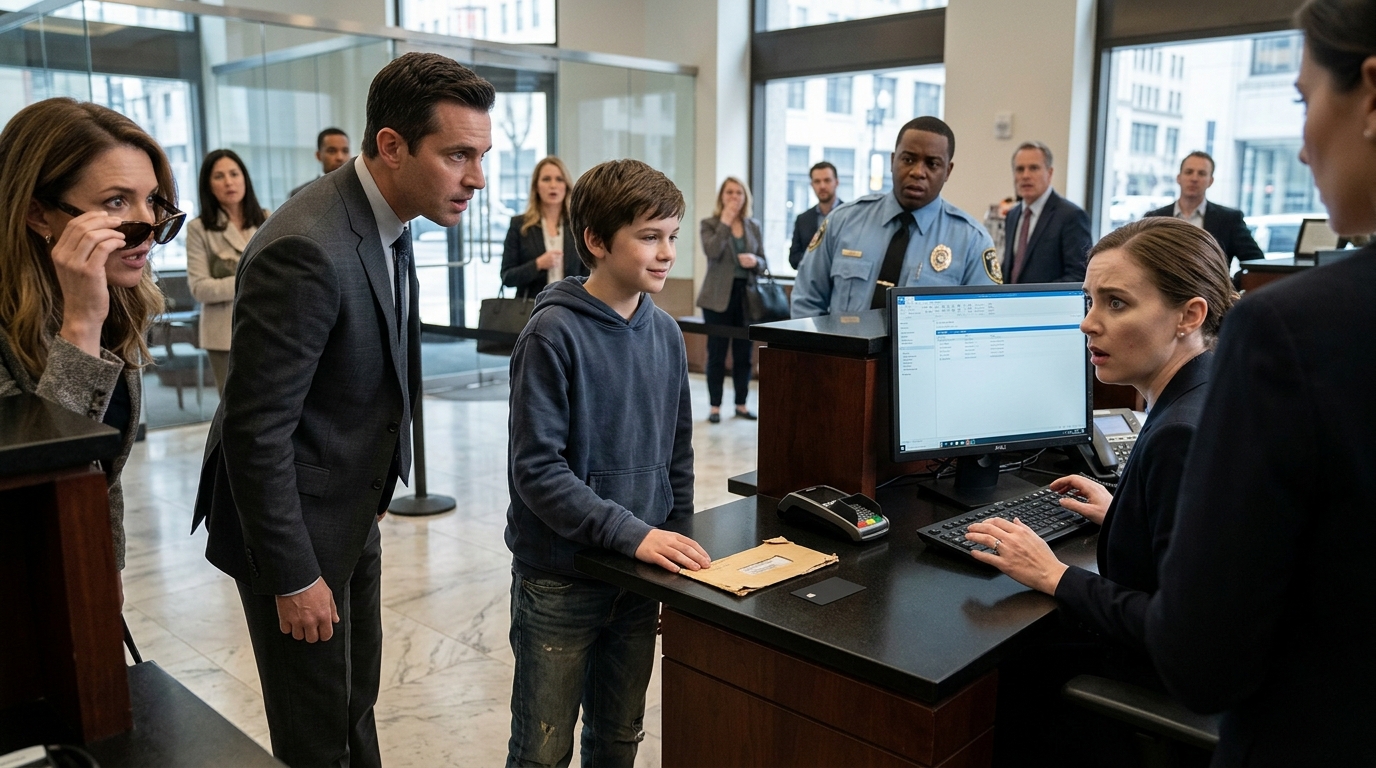
A woman near the waiting area lowered her sunglasses.
A man in a navy suit stepped closer, curiosity pulling him in like gravity.
Cassandra blinked once.
“Your account?”
The boy nodded.
“My mother said I should ask for the balance.”
“Your mother,” Cassandra repeated, almost smiling. “And where is she?”
The boy’s face changed.
Barely.
Enough.
“She’s gone.”
The room quieted further.
Cassandra did not soften.
People like her viewed sadness as suspicious when it arrived in cheap clothing.
“I’m not playing games today,” she said. “This is a private banking branch. Children don’t walk in off the street and ask for account balances.”
“I didn’t walk in off the street,” the boy said.
Cassandra lifted one eyebrow.
“Then where did you walk in from?”
He looked toward the revolving glass doors.
“From the bus station.”
Someone whispered, “Oh my God.”
The guard stepped closer.
“Ma’am, should I escort him out?”
The boy looked at the guard.
Not pleading.
Not challenging.
Just looking.
Then he reached into the pocket of his worn jacket and pulled out an old envelope.
It was creased.
Yellowed.
The flap had been opened and sealed again with tape.
He placed it on the counter.
Then, after a brief hesitation, he reached deeper into his pocket and removed a black card.
The room stilled.
It was not glossy like ordinary credit cards.
It was matte.
Heavy-looking.
The kind of card people noticed even before understanding why.
Cassandra glanced at it.
Her smirk returned.
“This better be fake.”
She picked it up between two fingers, as if it might dirty her manicure.
The boy said nothing.
His blue eyes stayed on her face.
Too blue.
Too calm.
Not the eyes of someone hoping.
The eyes of someone who had already been told exactly how this would end.
Cassandra slid the card into the terminal.
She began typing.
Fast.
Confident.
Unbothered.
At first.
Then her fingers slowed.
Her brow tightened.
She typed again.
Faster now.
The terminal made a soft sound.
Numbers reflected in her glasses.
Long strings.
Codes.
Portfolio designations.
Account tiers.
Internal flags.
Her lips parted.
“What?”
The guard leaned closer.
“Everything okay?”
Cassandra did not answer.
She typed again.
Her hands were no longer steady.
The boy stood perfectly still.
Behind him, clients abandoned their lines. A banker stepped out of a glass office. The branch manager appeared near the staircase, sensing a disturbance before understanding it.
“Just tell me the number,” the boy said quietly.
Cassandra swallowed.
“I need to verify—”
“The number,” he repeated.
His voice did not rise.
That made it worse.
Cassandra looked at the screen.
Then at him.
Then back at the screen.
“No chance,” someone whispered behind her.
The branch manager reached the counter.
“Cassandra, what is going on?”
She slowly removed the card from the terminal.
Her face had drained of all color.
“This account…” she said, barely breathing.
The branch manager frowned.
“What account?”
Cassandra looked up at the boy.
Her lips trembled.
“This account owns the bank.”
For the first time, the boy smiled.
Not wide.
Not happy.
A small, tired smile.
Like the answer had not surprised him.
Like it had only confirmed the last thing his mother had left behind.
Then he pushed the old envelope forward with two fingers.
“My mother said if they laughed at me,” he whispered, “I should give them this.”
The Child At The Private Counter
The branch manager, Preston Hale, did not believe Cassandra at first.
That was reasonable.
No one wants to believe a barefoot-looking child in a torn jacket has just walked into their lobby carrying ownership authority over one of the most powerful private banks in the country.
Preston stepped behind the counter, adjusting his tie with fingers that were suddenly too careful.
“Let me see.”
Cassandra handed him the card.
Her hand shook.
Preston noticed.
So did everyone else.
The boy noticed most of all.
He had spent the last year learning how adults moved when afraid.
Fast when they wanted to hide something.
Slow when they wanted to look innocent.
Preston inserted the card into the senior terminal.
A different screen opened.
His posture changed before his face did.
Cassandra whispered, “I checked three times.”
Preston ignored her.
He typed an override code.
Then another.
Then stood very still.
The account was not a checking account.
It was not a trust account in any ordinary sense.
It was the master controlling interest registry for Blackstone Meridian Holdings, routed through a series of family trusts, private equity vehicles, and voting-share custodial structures.
At the top of the screen was a name.
Noah Ellison Whitmore.
Minor Beneficiary.
Primary Controlling Interest: 61.4 percent.
Voting rights currently dormant pending identity authentication.
Authentication trigger: in-person presentation of legacy black access card.
Preston looked at the child.
The lobby had become so quiet the hum of the air conditioning sounded loud.
“What is your name?” he asked.
The boy’s blue eyes did not move.
“Noah.”
“Noah what?”
“Noah Ellison Whitmore.”
A woman near the waiting chairs gasped.
The Whitmore name still mattered inside that building.
It was carved into the private elevator plaques, written in old annual reports, whispered in executive histories, and buried under legal structures most employees were never meant to understand.
Charles Whitmore had founded Blackstone Meridian with two other men after the financial crash of the late eighties. His only daughter, Anna Whitmore, had been the designated heir before she disappeared seven years ago in what the newspapers called a voluntary breakdown.
Preston had worked here long enough to remember the scandal.
Anna Whitmore.
Brilliant.
Unmarried.
Difficult, according to men who disliked being questioned.
She had vanished after accusing her uncle and several bank executives of hiding losses and misusing client trust assets. Within months, the family announced she had suffered a mental collapse and left the country for treatment.
No body.
No public statement.
No lawsuit.
Only silence.
Preston looked at Noah again.
The blue eyes.
The crease between the brows.
The shape of the mouth.
Anna’s mouth.
He suddenly wished he had retired last year.
Cassandra whispered, “That’s impossible.”
Noah looked at her.
“You said that already.”
Her cheeks flushed.
The branch manager turned sharply.
“Cassandra.”
She lowered her eyes.
But it was too late.
The room had heard enough.
Preston leaned slightly toward the boy.
“Noah, do you have identification?”
Noah reached into his pocket and pulled out a folded paper.
Not a proper ID.
A copy of a birth certificate.
Worn at the creases.
Inside a plastic sandwich bag to protect it from rain.
Name: Noah Ellison Whitmore.
Mother: Anna Grace Whitmore.
Father: not listed.
Attached behind it was a notarized letter with water damage along the edge.
Preston did not touch it immediately.
Some documents feel dangerous before being read.
“Where is your mother?” he asked.
Noah’s smile vanished.
“I told you.”
“She’s gone?”
Noah nodded.
“Gone where?”
He looked down at the envelope on the counter.
“She said not to say until I met the man with the silver watch.”
Preston went cold.
The man with the silver watch.
That was not a public title.
It was an internal identifier used decades ago for Blackstone Meridian’s founding trustee liaison.
Graham Bell.
Retired now.
Nearly eighty.
Former legal guardian of several Whitmore family assets.
The only person outside the family who might understand the oldest trust structure.
Preston looked toward the executive staircase.
“Who told you that phrase?”
“My mom.”
“And where is she now?”
Noah’s voice stayed quiet.
“They took her.”
The security guard shifted.
Cassandra whispered, “This is insane.”
Noah slowly turned toward her.
“My mother said people would say that too.”
That landed harder than anger.
Preston exhaled.
“Noah, I’m going to call someone who can help verify this.”
“No police,” Noah said quickly.
The guard stiffened.
Preston’s eyes narrowed slightly.
“Why?”
Noah glanced toward the glass doors.
Because of that glance, Preston followed his eyes.
Outside, across the street, a black SUV sat by the curb.
Engine running.
A man in a gray coat stood beside it with a phone pressed to his ear.
Watching the bank.
Noah’s hand tightened around the envelope.
“My mom said some police work for my uncle.”
Preston felt a bead of sweat slide beneath his collar.
“What is your uncle’s name?”
Noah looked him straight in the eye.
“Victor Hale.”
Preston almost stepped back.
Victor Hale was not Noah’s uncle by blood.
He was Anna Whitmore’s half-brother.
Interim chairman of Blackstone Meridian Holdings.
Publicly respectable.
Privately feared.
A man who had spent seven years consolidating control over assets that, according to the screen in front of Preston, belonged mostly to the child standing at the counter.
The revolving doors began to turn.
The man from the black SUV entered the lobby.
Noah saw him.
For the first time, his calm cracked.
Preston saw the fear.
Real.
Immediate.
The man in the gray coat walked toward them.
“Noah,” he called softly.
The boy flinched.
Preston stepped between them before he had time to think.
The man smiled.
“Thank you. I’ll take him from here.”
Preston looked at the black card still in his hand.
Then at the boy.
Then at the man whose smile did not reach his eyes.
“No,” Preston said.
The man’s face changed.
Only slightly.
Enough.
Preston pressed the silent alarm beneath the counter.
Then reached for the phone.
“Get Graham Bell here,” he told Cassandra. “Now.”
The Mother Who Hid The Card
Noah’s mother had taught him how to survive in pieces.
Never all at once.
Never in a way that made childhood feel like training.
But looking back later, Noah would understand that everything had been preparation.
Anna Whitmore lived under the name Anna Ellison in a narrow apartment above a shuttered bakery in Queens. The place smelled faintly of old sugar and radiator steam. The floors slanted. The kitchen window stuck in winter. The neighbors knew her as a quiet woman who worked nights doing bookkeeping from home and raised a polite little boy who always said thank you.
Noah thought they were poor.
Not miserable.
Just careful.
Anna counted grocery money at the table. She patched his jackets. She cut his hair herself. She told him libraries were treasure houses and bus rides were adventures if you sat near the window.
She did not tell him he owned a bank.
Not at first.
She did tell him three rules.
“If someone calls me confused, ask what they gain by making me sound that way.”
“If someone says they’re family but scares you, family is not the important word.”
“And if I ever send you to Blackstone Meridian, you go to the private counter, not the regular teller. You show the black card. You say your full name. And you ask for the man with the silver watch.”
Noah hated that rule.
It sounded like a story where something bad happened first.
“Will something happen to you?” he asked once.
Anna smiled.
Not convincingly.
“Not if I’m careful.”
His mother was careful about everything.
She paid cash when possible.
Changed phone numbers often.
Never stood with her back to a door.
Checked hallway mirrors before opening the apartment.
Kept one suitcase packed beneath Noah’s bed and another behind the loose panel in the pantry.
She also kept a locked metal box inside the wall under the kitchen sink.
Noah saw it only once before the night everything changed.
Inside were documents, photographs, a small recorder, a stack of old bank papers, and the black card wrapped in cloth.
“Is it a credit card?” Noah asked.
Anna looked at it for a long time.
“No.”
“What is it?”
“A key people thought I lost.”
“Why don’t you use it?”
“Because using it too early could make us disappear faster.”
That answer gave him nightmares.
Anna saw.
After that, she spoke less about danger and more about courage.
“Being brave is not running into fire,” she told him while folding laundry. “Sometimes brave is remembering the plan when your hands are shaking.”
Noah practiced.
Not because he understood.
Because his mother asked.
Then came the rainy Tuesday.
He woke to voices.
Low.
Angry.
His mother in the kitchen.
A man’s voice he did not know.
Then another voice he did.
Victor.
He had met Victor once when he was five.
A tall man with silver hair and a soft voice who brought expensive chocolate Noah was not allowed to eat until Anna checked the package.
Victor had knelt and said, “You look just like your grandfather.”
Anna had gone white.
After he left, they moved apartments within two days.
Now Victor’s voice was in the kitchen.
“You’re out of time, Anna.”
Noah slipped from bed and crawled to the hallway.
Through the crack in the door, he saw his mother standing near the sink, one hand behind her back.
Victor Hale stood opposite her in a navy overcoat.
Beside him was a woman in a dark suit holding a folder.
“No more hiding,” Victor said. “No more games. The board vote is Friday.”
Anna laughed once.
“You mean the theft becomes permanent Friday.”
Victor’s face hardened.
“You were declared unfit for a reason.”
“Because you paid Dr. Renner.”
“Because you were unstable.”
“Because I found the shadow ledgers.”
The woman in the dark suit stepped forward.
“Ms. Ellison, we have legal authority to escort you for evaluation.”
Anna looked toward the hallway.
Noah froze.
For one second, their eyes met through the crack.
She did not look frightened.
She looked sorry.
Then she dropped something behind the trash bin with a soft clink.
“Run,” she mouthed.
Noah did not move.
He could not.
Two men entered from behind Victor.
Anna shouted then.
Not words.
Just sound.
She threw a mug at the wall, kicked the chair into one man’s path, and lunged toward the sink cabinet. Victor grabbed her wrist. The woman in the suit called for restraint.
Noah ran.
Not out the front.
The plan.
Hands shaking, he pulled the loose vent cover from behind the hallway hamper, crawled through the maintenance gap into the storage room next door, and waited in the dark while his mother screamed once.
Only once.
That was worse.
After the apartment went quiet, Noah waited until the building settled. He counted to three hundred twice, the way Anna had taught him.
Then he returned.
The apartment was destroyed.
Chair overturned.
Cabinet open.
Papers gone.
Anna gone.
Under the trash bin, taped to the bottom, was a small brass key.
Noah used it on the metal box.
Inside, most of the documents were gone.
But the black card remained.
And the envelope.
On the front, Anna had written:
NOAH — IF I AM TAKEN, GO NOW.
Inside were instructions.
Birth certificate.
Bank address.
Three bus routes.
Twenty dollars.
And a letter.
My brave boy,
If you are reading this, I am not with you. That means you must do the hardest thing first: do not look for me alone. Go to Blackstone Meridian. They will try to make you leave. Do not leave. Show the card. Ask for Graham Bell. If they laugh, give them the sealed envelope. If Victor comes, stay where cameras can see you.
Noah had cried then.
Silently.
Because silence was part of the plan too.
He packed the card, the letter, the birth certificate, and the old envelope.
He put on his jacket.
He took the bus in the dark.
And the next morning, with no breakfast and no mother, he walked into a bank that owned more marble than his apartment had square feet.
Cassandra Vale looked at his shoes and called security.
That almost made him leave.
Almost.
Then he heard his mother’s voice inside him.
Being brave is remembering the plan when your hands are shaking.
So he stayed.
The Man With The Silver Watch
Graham Bell arrived in twenty-six minutes.
Preston Hale counted every one of them.
The man in the gray coat, who identified himself as Peter Lang from “family security,” remained in the lobby under the watch of two bank guards and one off-duty NYPD officer who happened to be a client waiting for a meeting.
Lang smiled through all of it.
That worried Preston.
Calm men sent to collect children from banks rarely represented anything harmless.
Noah sat in a private office with glass walls, holding a cup of water he did not drink. Cassandra had been sent away from the counter after Preston heard her whisper that the child was “probably coached.”
The old envelope sat on the desk between Noah and Preston.
Still sealed.
Noah had refused to open it for anyone except Graham Bell.
“Why him?” Preston asked gently.
Noah stared at the envelope.
“My mom said he kept one promise when everyone else broke theirs.”
Preston did not know what that meant.
Then Graham Bell walked in.
He was tall, though age had bent him slightly. His hair was white. His suit was old but immaculate. On his left wrist, beneath the cuff, was a silver pocket-watch chain converted into a wristpiece decades earlier.
Noah saw it immediately.
He stood.
“Mr. Bell?”
Graham stopped in the doorway.
His eyes went first to the boy’s face.
Then to the black card on the desk.
Then to the envelope.
The old man’s expression changed in a way Preston would never forget.
Grief.
Recognition.
Fear.
All passing across his face before discipline locked them away.
“What is your name?” Graham asked.
“Noah Ellison Whitmore.”
Graham closed his eyes briefly.
“Anna’s boy.”
Noah’s lip trembled.
“You know my mom?”
“Yes.”
“Can you find her?”
Graham’s face tightened.
“I will try.”
Noah pushed the envelope toward him.
“She said this is for you.”
Graham sat slowly.
His hands trembled as he picked up the envelope.
The seal was marked with Anna’s initials in blue ink.
A.W.
He opened it carefully.
Inside were three things.
A letter.
A flash drive.
And a photograph.
Graham looked at the photograph first.
Anna, younger and thinner than he remembered, standing beside a hospital bed. In the bed lay an elderly man with tubes in his nose and one hand raised weakly toward the camera.
Charles Whitmore.
Anna’s father.
Officially dead seven years ago.
Graham whispered, “Dear God.”
Preston leaned forward.
“What is it?”
Graham did not answer.
He read the letter.
Mr. Bell,
If Noah is standing in front of you, Victor found us. I am sorry I waited so long. You told me years ago that the black card should only be used when I was ready to reclaim everything publicly. I thought hiding Noah was safer. I was wrong. Victor controls the board through a lie: that my father died and that I was mentally unfit. My father did not die when they said. He was kept alive long enough to transfer emergency control to Noah, then hidden. I found him once. The proof is on the drive. If I am gone, protect my son first. Then burn them with the truth.
Graham read the final line twice.
Burn them with the truth.
His jaw tightened.
Preston, watching him, saw the old man return to a version of himself the bank had forgotten.
Not retired.
Not ceremonial.
Dangerous.
Graham inserted the flash drive into a secure offline laptop Preston provided.
A folder opened.
Video files.
Medical records.
Trust documents.
Internal memos.
Audio recordings.
The first video showed Anna entering a private medical facility at night. The footage was shaky, likely from a concealed camera. She moved down a hallway, opened a door, and whispered, “Dad?”
The man in the bed turned his head.
Charles Whitmore.
Alive.
Weak.
Terrified.
“Anna,” he rasped.
Graham covered his mouth.
Noah stood beside him, looking at the screen.
“Is that Grandpa?”
Graham looked at him.
“Yes.”
“Is he dead now?”
Graham hesitated.
“I don’t know.”
The next file contained scanned trust documents.
Emergency succession structure.
If Anna Whitmore declared incapacitated under disputed conditions, controlling shares were to be held in dormant trust for her biological child, if any, authenticated by black card and genetic confirmation.
Victor Hale had never known the final clause.
Or had known and failed to find the card.
Preston understood then why the account screen said what it said.
Noah did not simply have money.
He was the legal trap Charles Whitmore had left behind before being buried alive inside paperwork.
The glass office door opened without a knock.
Peter Lang stepped in.
“I’m afraid this meeting is over.”
Preston stood.
“You need to leave.”
Lang smiled.
“Mr. Hale has court documents authorizing recovery of the minor.”
Graham turned slowly.
“Victor Hale has no authority over this child.”
Lang’s smile thinned.
“You’ve been retired a long time, Mr. Bell.”
“Yes,” Graham said. “But not dead.”
Lang reached into his coat.
The off-duty officer outside the office reacted first, drawing his weapon and ordering him to freeze.
Lang stopped.
Slowly, he removed his hand.
Not a gun.
A folded legal packet.
But the movement had done what Graham needed.
Every camera in the office had recorded him reaching into his coat in front of a frightened child.
Graham looked at Preston.
“Lock down the branch.”
Preston moved.
Lang’s face hardened.
“You don’t understand who you’re crossing.”
Noah, who had been silent, looked at him.
“My mom said you’d say that.”
Lang’s eyes flicked to the boy.
The old mistake.
Underestimating the child.
Graham closed the laptop and lifted the black card.
“Mr. Lang,” he said, “tell Victor Hale the dormant authority has been triggered.”
Lang went pale.
Graham continued.
“And tell him Anna Whitmore’s son just woke the bank.”
The Bank That Belonged To A Child
By noon, Blackstone Meridian was in controlled chaos.
Not public chaos.
The marble lobby still looked calm from the street. Clients were offered apologies, rescheduled appointments, private exits. Security guards stood at the doors with polite expressions and locked jaws.
But upstairs, in the executive conference room, the bank was shaking.
Graham Bell called three people before he called law enforcement.
First, an independent trust attorney named Evelyn Grant, who had drafted parts of the original Whitmore succession structure and despised Victor Hale.
Second, a forensic accountant named Daniel Price, who had spent five years trying to prove Blackstone Meridian’s client trust assets were being used as private collateral.
Third, Detective Marisol Keene, financial crimes division, not local precinct, not bank-friendly security, not anyone tied to Victor’s network.
Then he called the federal banking regulator.
Preston Hale watched him work and understood that retirement had been an illusion.
Graham had been waiting.
Perhaps for Anna.
Perhaps for the card.
Perhaps for one final chance to fix what he had not stopped years earlier.
Noah sat in the corner of the conference room with a sandwich someone had brought him from the staff kitchen. He ate slowly, eyes tracking every adult movement.
Cassandra had been sent home pending review.
She cried when escorted out.
Noah watched without expression.
Preston felt ashamed of the lobby.
Of the laughter.
Of the way everyone had nearly let a child be dragged away because his shoes were wrong for the room.
The genetic test was arranged immediately using a private court-approved lab. But the trust did not require full paternity to trigger temporary protection. It required the black card, identity documents, and a sworn verification review from Graham Bell.
Graham signed it with a steady hand.
Victor Hale arrived at 1:43 p.m.
He did not come through the lobby.
He entered through the executive garage with two attorneys, three security men, and the calm fury of a man who had discovered a locked door inside a house he thought he owned.
He was sixty-two, silver-haired, broad-shouldered, elegantly dressed. To the public, he was the man who saved Blackstone Meridian after family tragedy. To employees, he was polite until crossed. To those who knew better, he was a blade wrapped in velvet.
He walked into the conference room and looked first at Graham.
Then Preston.
Then Noah.
His eyes lingered on the boy.
Something ugly moved behind them.
Not surprise.
Recognition.
“So,” Victor said softly. “Anna sent you.”
Noah did not answer.
Victor smiled.
“You look like her.”
Graham stepped forward.
“Where is Anna?”
Victor sighed.
“I had hoped age would make you less theatrical.”
“Where is she?”
“She is receiving care.”
Noah stood so fast his chair scraped back.
“That’s what you said when you took her.”
Victor’s expression did not change.
“I did not take your mother. I protected her from herself.”
Noah’s hands curled into fists.
Graham placed one hand gently on the boy’s shoulder.
Not to silence him.
To anchor him.
Evelyn Grant, the trust attorney, opened a folder.
“Victor Hale, effective eleven thirty-seven this morning, the dormant Whitmore controlling trust has been activated pending identity confirmation. You are suspended from exercising discretionary authority over any trust-linked voting shares.”
Victor looked at her as if she were furniture speaking out of turn.
“You have no authority to do that.”
“I have Charles Whitmore’s signature, Graham Bell’s verification, and court-registered trust language your lawyers apparently failed to destroy.”
One of Victor’s attorneys stepped forward.
“We contest the validity of any such activation.”
“Of course you do,” Evelyn said. “That is why regulators are already on their way.”
Victor’s face tightened.
Preston saw it.
So did Graham.
So did Noah.
The first crack.
Victor turned to Preston.
“You are relieved of duty.”
Preston swallowed.
A career can pass before a man in a suit decides whether he has a spine.
Then he looked at Noah.
The boy who had flinched when Cassandra threatened police.
The boy who still stayed.
“No,” Preston said.
Victor’s eyes narrowed.
“No?”
Preston felt his pulse hammering.
“No, sir. I report to the board and regulatory authority under emergency continuity protocol, not to a suspended trust officer.”
The room went silent.
Victor almost smiled.
“You’ll regret that.”
Preston believed him.
He said nothing.
Detective Keene arrived moments later with two federal agents.
Victor’s attorneys tried to stop the meeting.
They failed.
Graham handed over the flash drive, copies of Anna’s letter, the security footage of Lang, and the branch authentication records.
Detective Keene crouched slightly to speak to Noah.
“Noah, I’m going to ask you some questions. You can have Mr. Bell stay with you. No one here is going to let Mr. Hale take you.”
Noah studied her.
“My mom said badges can lie too.”
Keene nodded.
“She’s right. So don’t trust the badge. Trust what I do next.”
That answer seemed to matter.
Noah nodded once.
Victor watched from across the room.
For the first time, he looked less like a chairman and more like an uncle whose story had stopped working.
Detective Keene stood.
“Mr. Hale, where is Anna Whitmore?”
Victor’s mouth curved.
“I will cooperate through counsel.”
Noah whispered, “Coward.”
Everyone heard it.
Victor’s eyes flashed toward him.
There it was.
The truth beneath the polish.
He hated the boy.
Not because Noah had done anything.
Because Noah existed.
Because Anna had hidden him.
Because Charles had protected him.
Because a child in torn shoes had walked into the bank and turned ownership into evidence.
Graham saw Victor’s expression and went cold.
He remembered Anna at twenty-one, standing in his office with red eyes, saying, “If anything happens to me, don’t let him turn me into a diagnosis.”
Graham had promised.
Then failed.
Not this time.
The Woman Declared Unfit
Anna Whitmore was found that night.
Not in a hospital.
Not exactly.
She was being held at Ashford House, a private psychiatric and rehabilitation facility two hours north of the city, hidden behind iron gates and language designed to make confinement sound like care.
Restorative wellness.
Protective observation.
Family-directed intervention.
The paperwork said Anna Ellison had been admitted voluntarily for acute delusional distress and custodial stabilization.
The paperwork was a lie.
The facility director insisted everything was legal until Detective Keene produced a warrant tied to unlawful restraint, fraud, and identity manipulation.
Then staff began forgetting who had signed what.
Anna was in Room 214.
The window had no handle.
Her phone was gone.
Her wrists showed bruises from restraints.
She had been sedated, but not enough to erase the moment Detective Keene entered with a body camera and said, “Anna Whitmore?”
Anna turned her head slowly.
Her lips were cracked.
Her eyes struggled to focus.
Then she whispered one word.
“Noah?”
“He’s safe,” Keene said.
Anna closed her eyes.
Tears slipped down both sides of her face.
Graham brought Noah to the hospital the next morning after doctors cleared Anna for a brief visit.
Noah ran before anyone could stop him.
“Mom!”
Anna, sitting upright in a hospital bed, reached for him with both arms.
He crashed into her carefully and not carefully at all, sobbing into her gown.
“I did the plan,” he cried.
Anna held him so tightly the nurse stepped forward, then stopped.
“I know,” Anna whispered. “I know, baby. You did it.”
“They laughed.”
Her face changed.
“I’m sorry.”
“I stayed.”
“I know.”
“I gave them the envelope.”
“I know.”
“They said the account owns the bank.”
Anna let out a broken laugh against his hair.
“It does.”
Noah pulled back.
“You didn’t tell me.”
“You were nine.”
“I’m ten next month.”
That made her laugh again.
Then cry harder.
Graham stood near the doorway, unable to move.
Anna saw him over Noah’s shoulder.
Her face stilled.
“Mr. Bell.”
“Anna.”
“You got old.”
“So did you.”
She looked down at Noah.
“Not as much as I thought I would.”
Graham’s eyes filled.
“I’m sorry.”
Anna studied him.
“For which part?”
He absorbed the question.
“All of it.”
She nodded slightly.
Not forgiveness.
Inventory.
“You told me the black card was a last resort,” she said.
“Yes.”
“I used it too late.”
“No,” Graham said. “You used it when the child could survive the trip.”
That sentence broke something in her face.
She looked at Noah.
“I should have kept him away from all this.”
Noah frowned.
“You did. Until you couldn’t.”
Anna closed her eyes.
The doctors documented sedation, bruising, malnutrition, and evidence of coercive admission. The facility’s records showed Victor’s office had arranged payment through a shell medical trust. Dr. Paul Renner, the same physician who had declared Anna unstable years earlier, had signed the new evaluation without examining her in person.
That signature became the thread.
Detective Keene pulled it.
Everything began to unravel.
Seven years earlier, after Anna accused Victor and Blackstone executives of hiding catastrophic losses in client-linked investment vehicles, Dr. Renner diagnosed her with paranoid delusional disorder. Victor used the diagnosis to remove her from the board, seize interim control, and bury her allegations as symptoms.
Anna fled before they could confine her permanently.
She went underground.
Not because she was guilty.
Because the people hunting her controlled the language of sanity, family, and finance.
During that time, Charles Whitmore—her father—had not been dead, at least not when the world was told he was.
He had suffered a stroke during a confrontation with Victor. Instead of public disclosure, Victor moved him through private care facilities, using medical proxies to extract signatures and delay succession triggers.
Charles regained enough lucidity once to contact Graham Bell.
That was when the black card structure was finalized secretly.
But Charles disappeared again before Graham could reach Anna.
Then the official death announcement came.
Closed casket.
Private burial.
No independent medical review.
Everyone with questions was paid, threatened, or diagnosed.
But Charles had left one weapon Victor never found.
Noah.
Not as a pawn.
As heir.
As living proof Anna had future rights Victor could not legally absorb.
That was why Victor searched for them.
That was why Anna hid.
That was why the black card mattered.
Once Noah triggered the account, Blackstone Meridian’s ownership structure froze.
Victor could no longer move the final assets.
The theft had stopped with a child at a counter.
The Trial Of The Bank
The first hearing happened six days later.
Noah wore a navy sweater Graham bought him and sneakers Anna insisted he pick himself. He sat beside his mother in the courtroom, swinging his feet slightly because even children carrying empires are still children.
Victor Hale sat across the aisle with four attorneys.
He looked calm.
That was his greatest skill.
Cassandra Vale testified early.
She had requested to apologize to Noah before the hearing. Anna refused.
“Apologies can wait until after testimony,” she said.
On the stand, Cassandra admitted she had threatened to call police before checking the card. She admitted she assumed the boy was homeless. She admitted she had never seen a black card but handled it dismissively. She cried halfway through.
Victor’s attorney tried to make her seem incompetent.
Evelyn Grant redirected.
“Ms. Vale, did anyone train you on how to respond if a minor presented legacy trust credentials?”
“No.”
“Did anyone inform branch staff that a dormant controlling beneficiary might appear?”
“No.”
“Who controlled that information?”
Cassandra looked toward Victor.
“Executive trust office.”
Victor’s face did not move.
Preston testified next.
Then Graham.
Then Anna.
When Anna took the stand, the courtroom changed.
She was still thin.
Still recovering.
But her voice held.
She described finding the shadow ledgers. Challenging Victor. Being declared unstable. Running. Hiding. Giving birth to Noah under an assumed name. Finding Charles alive. Building the black card plan. Being taken from her apartment.
Victor’s attorney stood.
“Ms. Whitmore, you have a documented psychiatric diagnosis, correct?”
Anna looked at him.
“I have a purchased diagnosis.”
A murmur moved through the room.
The judge called for order.
The attorney continued.
“You believe your brother, respected chairman Victor Hale, conspired to imprison you, hide your father, falsify medical documents, and steal control of a bank?”
Anna’s eyes moved to the evidence table.
“To be precise, I don’t believe it. I documented it.”
That line appeared in every article by evening.
Noah testified privately in chambers to avoid public exposure.
The judge, attorneys, a child advocate, and a court reporter were present. Anna waited outside with hands clasped so tightly Graham gently told her to breathe.
Noah told the judge about the apartment.
The voices.
His mother mouthing run.
The vent.
The black card.
The bus.
Cassandra.
The man in the gray coat.
The judge asked, “Were you scared?”
Noah thought about it.
“Yes.”
“What helped you keep going?”
“My mom made plans for scary things.”
The judge paused.
“And did the plan work?”
Noah nodded.
“But people laughed first.”
That sentence carried into the public order issued later that week.
The court confirmed temporary control of Blackstone Meridian’s voting trust under independent guardianship for Noah’s benefit, suspended Victor Hale’s authority, froze related accounts, and ordered full forensic review.
Victor was arrested three weeks later.
Not in a dramatic lobby scene.
In his penthouse, at breakfast, wearing a robe worth more than the rent Anna had once struggled to pay.
Charges included fraud, unlawful restraint, financial exploitation, falsification of medical records, obstruction, conspiracy, and securities violations.
Dr. Renner was arrested too.
Peter Lang took a plea.
So did the Ashford House director.
The trial lasted months.
Documents did what outrage could not.
They showed the structure.
The false diagnoses.
The hidden facilities.
The altered succession records.
The client assets used as collateral.
The board votes manipulated through incapacitation claims.
The payments.
The threats.
The long effort to turn Anna Whitmore from heir into patient, from whistleblower into ghost.
Victor’s defense argued he had protected the bank during a family mental health crisis.
Then prosecutors played Anna’s hidden video of Charles Whitmore.
Charles, frail and frightened, saying:
Victor is not protecting the bank. He is eating it.
The jury needed less time than expected.
Guilty.
On nearly every count.
Anna did not smile when the verdict came.
Noah did.
Just a little.
Then he looked at his mother to see if smiling was allowed.
Anna pulled him close.
“It’s okay,” she whispered.
Only then did he let himself breathe.
The Boy Who Changed The Lobby
Owning a bank did not make Noah’s life simple.
That disappointed people who liked dramatic endings.
The boy with the black card did not move into a mansion overnight. Anna did not suddenly become a glamorous heiress reclaiming marble halls with perfect hair and revenge dresses.
Real repair was less cinematic.
It involved court-appointed guardians, trust protectors, trauma therapists, school enrollment, regulatory hearings, asset reviews, and long meetings where adults said “fiduciary responsibility” until Noah fell asleep on Anna’s lap.
Anna did not want operational control of Blackstone Meridian.
Not immediately.
Maybe not ever.
“I spent seven years surviving that building,” she told Graham. “Do not ask me to love it because it finally obeys the law.”
Instead, an independent board was appointed. Client assets were restored where possible. Executives tied to Victor resigned or were removed. Ashford House closed after more families came forward. Dr. Renner’s other cases were reopened.
Preston Hale remained at the bank after review.
Cassandra did not.
Her dismissal became a minor online debate, which Anna refused to engage.
Noah asked about her once.
“Is the lady who yelled at me in jail?”
“No,” Anna said.
“Did she help Victor?”
“Not directly.”
“Then why did she lose her job?”
Anna thought carefully.
“Because cruelty can make dangerous people’s work easier, even when it doesn’t plan to.”
Noah considered that.
“She could have made me leave.”
“Yes.”
“Then I’d be gone.”
Anna touched his hair.
“Yes.”
He nodded.
“Okay.”
That was enough for him.
The flagship branch changed first.
Not the marble.
Not the chandelier.
Those stayed.
But the private-client entrance was redesigned. Staff were trained to handle minor beneficiaries, distressed visitors, and legacy documents without assumptions based on appearance. Security protocols were rewritten so “remove this person” could not happen before proper assessment.
At Anna’s insistence, a public plaque was installed near the counter.
Not with Noah’s name.
He hated that idea.
The plaque read:
DIGNITY IS PART OF VERIFICATION.
Preston thought it sounded unusual for a bank.
Anna said that was the point.
Graham Bell formally retired again, though everyone knew he still answered Anna’s calls faster than legally required. He became Noah’s unofficial grandfather in the way old men sometimes become family after arriving at the exact moment a child needs one adult to know the code.
Noah called him Mr. Bell for almost a year.
Then one afternoon, while Graham taught him chess, Noah said, “Grandpa Graham, that move is illegal.”
Graham froze.
Anna, reading nearby, looked up.
Noah did not notice the emotional damage he had caused.
Graham cleared his throat.
“First, it is not illegal. Second, repeat what you just said.”
Noah looked suspicious.
“That move is illegal?”
“No. Before that.”
Noah rolled his eyes.
“Grandpa Graham.”
Graham nodded solemnly.
“Correct. Continue losing.”
Anna cried quietly into her book.
Years later, when Noah was fifteen, he asked to visit the lobby again.
Not through the executive entrance.
Through the front doors.
Anna hesitated.
Then agreed.
They arrived on a rainy afternoon. The chandelier still shone. The floors still gleamed. The counter still looked too tall for a child.
Noah stood where he had stood years earlier.
He was taller now.
Still serious.
Still blue-eyed.
But not hungry.
Not shaking.
At the counter, a young employee smiled warmly.
“Good afternoon. How can I help you?”
Noah looked at Anna.
She nodded.
He turned back.
“I’d like to check my account.”
The employee did not laugh.
Did not sneer.
Did not look at his shoes.
“Of course,” she said. “May I see your identification?”
Noah smiled.
Not because he owned the bank.
Because the question was fair.
Anna watched from a few steps away.
Her son placed his ID on the counter.
No black card this time.
No old envelope.
No fear.
Just a boy being treated as a person before being verified as important.
That was the victory.
Not the money.
Not the verdict.
Not Victor in prison.
This.
The ordinary decency that should never have needed a scandal to exist.
Noah eventually chose not to run Blackstone Meridian.
At least, not the way people expected.
He studied law and financial ethics, then built a foundation inside the bank’s charitable trust to help families challenge coercive guardianships, medical exploitation, financial abuse, and institutional dismissal.
He named it The Anna Whitmore Center for Verification and Dignity.
Anna objected.
Noah ignored her.
“You named me Noah Ellison Whitmore without asking,” he said. “We’re even.”
She laughed.
He kept the black card in a glass case in his office.
Beside it sat the old envelope.
And a photograph of Anna the year she finally stopped hiding.
When visitors asked about the card, Noah told the story carefully.
Not as a fantasy about secret wealth.
Not as revenge against a rude bank employee.
Not as a child owning a marble palace.
He told it as a warning.
“Systems don’t only fail when powerful people corrupt them,” he would say. “They fail earlier, when ordinary people decide someone looks too poor, too young, too unstable, or too inconvenient to be telling the truth.”
Then he would point to the plaque downstairs.
DIGNITY IS PART OF VERIFICATION.
“That was my mother’s line,” he said once.
Anna corrected him.
“No, it was yours.”
He smiled.
Maybe it was both.
Years after the morning Cassandra threatened to call police, Noah walked into the same lobby for a ceremony honoring Graham Bell. The old man was ninety-one and furious about being celebrated.
“I am not dead,” Graham announced.
“That’s why we’re doing it now,” Anna said.
Preston laughed.
Graham scowled.
The bank dedicated a legal aid fund in Graham’s name for whistleblowers and hidden beneficiaries. He pretended to hate it until Noah placed the framed dedication in his hands.
Then he cried.
Openly.
Badly.
“No one mention this,” Graham warned.
Everyone mentioned it forever.
During the ceremony, Noah stood at the private counter and looked across the lobby.
He could still remember the exact feeling.
The hunger.
The polished floor under his worn shoes.
Cassandra’s voice.
This is not a shelter.
The laughter.
The card sliding into the terminal.
The numbers reflected in her glasses.
The moment the room realized the poor-looking child had not come to beg.
He had come to unlock the truth.
Anna stood beside him.
“Do you ever wish I had told you sooner?” she asked.
Noah thought about it.
“That I owned the bank?”
“That you were in danger.”
He looked at her.
“I think I knew.”
Her face tightened.
He added, “But I also knew you were trying.”
She closed her eyes briefly.
“I was.”
“I know.”
He took her hand.
For a while, they stood quietly in the lobby that had once nearly swallowed him.
Then the front doors opened.
A woman entered with a little girl.
The woman’s coat was worn. The girl held a folder against her chest. They looked nervous enough that the old lobby might once have rejected them without paperwork.
A teller stepped forward.
“Welcome to Blackstone Meridian. How can we help?”
Noah watched the woman’s shoulders loosen slightly.
Anna squeezed his hand.
“See?” she said.
He nodded.
Not fixed.
Never fully.
But changed.
That mattered.
People still told the story of the boy with the black card.
They liked the impossible twist.
The poor child at the counter.
The cruel employee.
The account that owned the bank.
The villainous uncle.
The mother hidden away.
The numbers too large to believe.
But Noah remembered what happened before the twist.
He remembered almost leaving.
He remembered the guard’s shoes stepping closer.
He remembered wondering if brave people felt less afraid than he did.
They do not.
He learned that later.
Brave people are often terrified.
They just move carefully toward the plan anyway.
His mother had given him the card.
But she had also given him something more important.
The knowledge that truth can survive inside a sealed envelope.
Inside a hidden file.
Inside a child who listens.
Inside a mother who refuses to let a stolen name become the end of the story.
And when Cassandra looked up from the terminal with all the color drained from her face and whispered that the account owned the bank, Noah smiled for the first time not because he understood wealth.
He did not.
He smiled because he understood his mother had been right.
They could laugh.
They could threaten.
They could call him fake.
They could call her unstable.
They could polish the floors and lock the offices and hide behind words like policy, family, and care.
But the truth still had a key.
And that morning, with shaking hands and worn-out shoes, Noah had carried it through the front door.