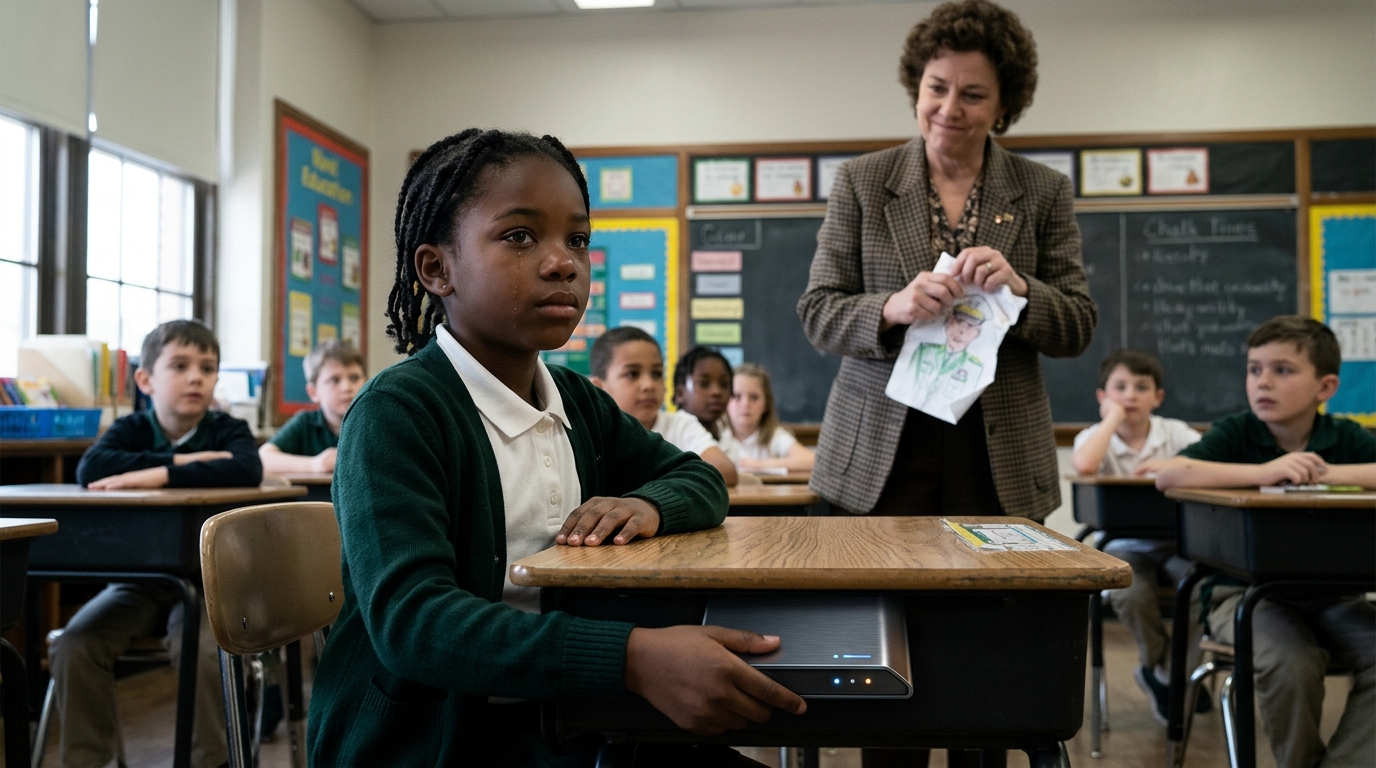
“HONEY, YOUR MOTHER CLEANS HOUSES.”
The words landed harder than the teacher intended.
Not because they were loud.
Because they were said softly enough for everyone to hear and sharply enough for a child to understand exactly what was being taken from her.
The classroom went silent.
Twenty-six third graders turned in their seats.
Colored pencils stopped moving.
A pair of scissors froze midair.
At the front of the room, taped to the whiteboard beneath a sign that read WHEN I GROW UP, stood a little girl’s drawing.
It showed a woman in a dark green military uniform.
Four stars on each shoulder.
A flag behind her.
A little girl beside her, saluting with one hand and holding a lunchbox in the other.
At the top, in careful purple marker, the girl had written:
MY MOM WILL BE A GENERAL SOMEDAY. AND SO WILL I.
The girl’s name was Ava Cole.
Eight years old.
Small for her age.
Dark curls tied back with a red ribbon.
A sweater with one missing button.
She sat in the second row, hands folded on her desk, staring at the drawing as if staring hard enough could protect it.
Her teacher, Mrs. Delaney, stood beside the board with a smug little smile.
“Honey,” she said again, “your mother cleans houses.”
A few children giggled.
Not many.
Enough.
Ava swallowed.
“It’s true,” she whispered.
Mrs. Delaney tilted her head.
“What is true?”
Ava’s voice trembled.
“My mom cleans houses.”
The teacher’s smile widened.
“Then perhaps your picture should be more realistic.”
Ava looked down.
A tear slipped over her cheek.
“She told me to dream accurately,” the teacher continued, turning toward the class. “Ambition is wonderful, children. But we must also understand where we come from.”
A boy near the window laughed.
“My dad says generals don’t scrub toilets.”
The room tittered.
Ava’s hands tightened in her lap.
Mrs. Delaney reached up, peeled the drawing from the board, and held it between two fingers like it had dirt on it.
“This is not appropriate for our career wall.”
Then she crumpled it.
Slowly.
Deliberately.
Purple marker folded into wrinkles.
The little saluting girl disappeared inside the crushed paper.
Ava did not move.
The class watched, waiting for her to cry harder.
But something changed in her eyes.
Not anger exactly.
Not defeat.
Something deeper.
A remembered instruction.
A promise.
Ava reached slowly under her desk.
Her small hand found the hidden pocket sewn beneath her backpack strap. Her fingers closed around something hard and cold.
Metal.
Mrs. Delaney turned back toward her desk, still smirking.
She did not see the glint.
Did not see Ava slide the object into her palm.
It was a small brass challenge coin.
Heavy for a child’s hand.
On one side was an eagle.
On the other, four stars surrounding a number Ava had memorized before she could spell it.
Her mother had given it to her that morning.
“If anything goes wrong today,” her mother had said, kneeling in front of her, “you hold this and remember who you are.”
Ava had asked, “Can I tell them?”
Her mother’s expression had changed.
“Not yet.”
“But Mrs. Delaney says—”
“I know what she says.”
“She thinks you’re just a cleaner.”
Her mother had smiled faintly.
“Then let her.”
Now, inside the classroom, Ava pressed the coin against her palm.
The floor beneath them began to tremble.
At first, it felt like a truck passing outside.
A deep vibration.
Low.
Building.
The windows rattled.
Pencils rolled across desks.
Mrs. Delaney’s smirk faltered.
“What is that?”
The children turned toward the windows.
The sound grew louder.
A resonant hum that filled the walls, the ceiling, the air in their chests.
A boy shouted, “Helicopters!”
Ava stood.
Mrs. Delaney snapped, “Sit down.”
Ava did not.
Outside, beyond the playground, two black military helicopters descended toward the school’s athletic field. Dust rose in spirals. Grass flattened beneath the rotor wash. Teachers ran to classroom windows. Children screamed, not in fear exactly, but in the wild excitement of something impossible arriving before lunch.
Mrs. Delaney’s face drained of color.
Ava walked to the front of the room.
She picked up the crumpled drawing from the floor.
Then she looked at her teacher.
“My mother cleans houses,” she said quietly.
The classroom shook as the helicopters landed.
Ava smoothed the wrinkled paper against her chest.
“But that’s not her job.”
The intercom crackled.
The principal’s voice came through, thin and frightened.
“Mrs. Delaney, please send Ava Cole to the office immediately.”
A pause.
Then, lower, as if he had forgotten the microphone was still on:
“Her mother is here.”
The Woman Everyone Underestimated
Ava’s mother had cleaned houses for eleven months.
At least, that was what people in Millbrook believed.
Her name was Mara Cole.
She arrived in town quietly, renting a small yellow house at the end of Sycamore Lane, paying in cash, enrolling Ava at Millbrook Elementary, and taking work under the name Mara Ellis through a local domestic cleaning service.
She wore simple clothes.
Jeans.
Work shoes.
Plain shirts.
Hair tied low.
No jewelry except a thin black cord around her neck with a metal tag tucked beneath her collar.
She cleaned the homes of bankers, school board members, retired judges, business owners, and one state senator who visited town twice a month and tipped badly.
People liked Mara when she stayed invisible.
They praised her efficiency.
Her silence.
Her punctuality.
“She’s wonderful,” one woman told another at church. “Never talks too much. Knows her place.”
That was the phrase.
Knows her place.
Mara heard it more than once.
She would smile politely, fold fresh towels, and file the words away like evidence.
Because cleaning houses was not her life.
It was her cover.
Before Millbrook, before the yellow rental, before Ava’s thrift-store sweaters and the fake last name, Mara Cole had been Colonel Mara Voss, United States Army Intelligence, deputy director of an interagency investigation into a private defense procurement network suspected of bribery, data theft, and classified equipment diversion.
The case was sensitive.
Political.
Dangerous.
The kind of case where the enemy wore suits, donated to schools, sat on foundation boards, smiled beside governors, and made sure working people were always the first to be blamed when something disappeared.
The network had a node in Millbrook.
Not a warehouse.
Not a base.
A cluster of private homes.
Hard drives in studies.
Cash ledgers in safes.
Burn phones hidden in laundry rooms.
Meetings disguised as charity dinners.
Mara’s team needed access no warrant could safely reveal yet.
They needed someone who could enter houses without making powerful people nervous.
Someone they would not see.
A cleaner.
Mara volunteered.
Her commanding officer objected.
“You have a child.”
“I know.”
“That makes you vulnerable.”
“No,” Mara said. “It makes me careful.”
Ava knew pieces.
Not all.
Children should not carry full secrets.
But Ava knew her mother had once worn a uniform. She knew there were medals in a locked case inside the closet. She knew sometimes men and women came to the house late at night and spoke in low voices over maps and laptops while Ava pretended to sleep.
She knew her mother cleaned houses because bad people were hiding things in rooms they assumed no cleaner understood.
She also knew not to tell.
That was the hard part.
Because Millbrook Elementary had rules of its own.
The children of important families sat together at lunch.
Their parents donated to classroom renovations.
Their names appeared on plaques outside the gym.
Ava arrived with used pencils and packed lunches, wearing clothes that had been washed too many times.
Mrs. Delaney noticed immediately.
Some teachers have a gift for seeing which children are safe to wound.
Mrs. Delaney taught kindness during morning circle and practiced cruelty in small, deniable ways.
She corrected Ava more sharply than others.
She said, “We don’t grab,” when Ava reached for crayons that were meant for the whole table.
She said, “Ask your mother to sign this properly,” when Ava brought back forms in Mara’s careful handwriting.
She once told another teacher in the hallway, not quietly enough, “That cleaning woman’s daughter is very intense.”
Ava heard.
At home, she asked, “Is intense bad?”
Mara looked up from polishing her boots, then realized Ava was watching.
“Intense means you notice things other people wish you didn’t.”
Ava thought about that.
“Then Mrs. Delaney doesn’t like intense.”
“No,” Mara said softly. “People like that rarely do.”
The career wall assignment came on a Monday.
Draw what your parent does, or what you dream of becoming.
Ava sat at the kitchen table that night with markers spread around her.
At first, she drew a mop.
Then stopped.
Her face tightened.
Mara watched from across the room.
“What’s wrong?”
Ava pushed the paper away.
“If I draw cleaning, they’ll laugh.”
Mara sat beside her.
“And if you draw what you really want?”
“They’ll laugh more.”
“Maybe.”
Ava looked at her.
“Why do people laugh at things they don’t understand?”
Mara’s face softened.
“Because it is easier than admitting they don’t understand.”
Ava picked up the purple marker.
“Can I draw you in uniform?”
Mara was quiet.
Too long.
Then she said, “You can draw the truth as you know it.”
“But I can’t tell the truth?”
“Not yet.”
“That’s not fair.”
“No,” Mara said. “It isn’t.”
Ava drew the general anyway.
Four stars.
Flag.
A little girl saluting.
Mara looked at the picture for a long time.
“I’m not a general,” she said gently.
Ava shrugged.
“Someday.”
Mara smiled.
The kind of smile that hurt.
“Dream accurately,” she told her.
“I am.”
That morning, before school, Mara put the brass challenge coin in Ava’s hand.
It had belonged to General Evelyn Hart, the officer leading the investigation and Mara’s mentor. Four stars. Eagle. Unit number. A reminder that rank was not fantasy in their world. It was earned, carried, protected.
“If someone is cruel,” Mara told her, “you do not have to prove anything. You only have to remember.”
Ava slipped the coin into her backpack.
Neither of them knew that by noon, remembering would not be enough.
Because Mrs. Delaney would not just mock the drawing.
She would crumple the one piece of truth Ava had been allowed to carry into school.
And across town, at that exact hour, Mara’s cover would finally break.
The Drawing That Exposed The Wrong Person
When the intercom ordered Ava to the office, Mrs. Delaney tried to regain control.
“Class,” she said, voice tight, “remain seated.”
No one listened.
The helicopters outside had turned the entire school into a hive of whispers. Children pressed against windows. Teachers stood in doorways. The principal’s assistant ran past the room carrying a folder and looking as if she might cry.
Ava stood at the front, still holding her crumpled drawing.
Mrs. Delaney reached for it.
“I’ll keep that.”
Ava stepped back.
“No.”
The teacher’s eyes narrowed.
“Ava.”
“No,” Ava said again.
This time, the word did not tremble.
Before Mrs. Delaney could respond, the classroom door opened.
Principal Howard stepped in.
He was a thin man with nervous hands, usually fond of cheerful ties and morning announcements. Now his face was pale.
“Ava,” he said carefully, “please come with me.”
Mrs. Delaney lifted her chin.
“Mr. Howard, I don’t appreciate military theatrics interrupting my class.”
Principal Howard looked at her.
Then at the crumpled drawing in Ava’s hands.
“What happened here?”
“Nothing,” Mrs. Delaney said quickly. “Ava became emotional during a lesson about realistic goals.”
Ava’s cheeks burned.
Principal Howard frowned.
“Realistic goals?”
Mrs. Delaney gestured toward the drawing.
“She drew her mother as a four-star general. I was explaining that while ambition is admirable, children should not be encouraged to misrepresent—”
The principal’s eyes dropped to the brass coin in Ava’s hand.
His expression changed.
He recognized enough to become afraid.
“Ava,” he said softly, “bring your things.”
Mrs. Delaney looked annoyed.
“I’m not finished.”
The principal’s voice hardened.
“You are.”
The class went still.
Ava gathered her backpack slowly.
As she walked past Mrs. Delaney, the teacher whispered, “This little performance won’t change what your mother is.”
Ava stopped.
Then turned.
“My mother is who she says she is.”
Mrs. Delaney smiled thinly.
“And who is that?”
Before Ava could answer, another voice came from the doorway.
“Someone you should have treated with respect before you knew.”
Everyone turned.
A woman stood behind Principal Howard.
She wore Army Dress Blues.
Dark fabric.
Gold buttons.
Ribbons across her chest.
Silver eagles at her shoulders.
Her hair was pulled into a neat bun. Her face was calm, but her eyes moved with a sharpness that made the room feel inspected, not watched.
Colonel Mara Cole.
Ava’s mother.
Not in jeans.
Not with a cleaning bucket.
Not invisible.
The classroom forgot to breathe.
Mrs. Delaney’s face went slack.
“Mara?”
Colonel Cole stepped into the room.
“Ava.”
Ava ran to her.
Not dramatically.
Just fast enough that Mara had to bend and catch her with one arm.
For one second, the soldier disappeared.
Only the mother remained.
She touched Ava’s wet eyelashes.
“What happened?”
Ava looked down at the drawing.
Mara saw it.
The wrinkles.
The torn corner.
The little saluting girl crushed through the middle.
Her expression did not change much.
That was worse.
She looked at Mrs. Delaney.
“You crumpled my daughter’s work?”
Mrs. Delaney recovered badly.
“I was correcting a misunderstanding.”
Mara held out her hand.
“Ava.”
Ava gave her the drawing.
Mara smoothed it carefully against a desk.
The purple marker lines were warped, but visible.
A woman in uniform.
A girl saluting.
A dream folded and unfolded.
Mara looked at it for a long moment.
Then she turned it toward the class.
“My daughter drew a future.”
No one spoke.
“She did not owe anyone proof before being allowed to dream.”
Mrs. Delaney’s face flushed.
“Colonel, I had no idea—”
“That I outranked your assumptions?”
The sentence landed cleanly.
A few children stared at their desks.
Principal Howard cleared his throat.
“Colonel Cole, perhaps we should move to the office. General Hart is waiting.”
Mrs. Delaney’s eyes widened.
“General?”
Mara looked at her.
“The woman my daughter drew is based on General Evelyn Hart. She is outside with federal agents, military police, and a warrant connected to an investigation that includes this school district’s procurement accounts.”
The room went cold.
Mrs. Delaney blinked.
“This school?”
Mara’s gaze sharpened.
“Yes.”
Principal Howard looked as if he might faint.
That was when Mrs. Delaney made the mistake that ended any sympathy she might have earned.
She said, “I don’t know anything about that. My husband handles district contracts.”
Mara’s eyes moved slightly.
Not surprise.
Confirmation.
“Your husband is Paul Delaney?”
Mrs. Delaney’s mouth opened.
The classroom door filled with two Military Police officers.
Mara folded Ava’s drawing and placed it carefully into her own jacket pocket.
“Mrs. Delaney,” she said, “I suggest you come to the office.”
The teacher’s face lost all color.
Because the woman she had mocked as a house cleaner had not come to defend a drawing.
She had come to close a case.
The Houses She Cleaned
Paul Delaney did not look like a criminal in the photos.
That was one of the reasons the case had taken so long.
He looked like a suburban father.
Kind smile.
Golf shirts.
Charity 5K medals.
A hand resting proudly on Mrs. Delaney’s shoulder at school fundraisers.
He owned Delaney Facilities Solutions, a company contracted to supply cleaning products, maintenance equipment, and facility upgrades to schools across three counties.
On paper, his business was ordinary.
In reality, it was one of the quiet tunnels through which money, data, and stolen equipment moved.
Mara had entered Millbrook under cover because Delaney’s company had ties to a defense contractor suspected of diverting restricted surveillance components. The school district contracts were the respectable front. Cleaning products and maintenance supplies created perfect shipping cover. Boxes moved in and out of schools, offices, and private homes without anyone asking many questions.
Who worries about a mop bucket?
Who checks a vacuum cleaner bag?
Who looks at the woman scrubbing baseboards and wonders what she hears?
Mara cleaned five houses tied to the network.
The senator’s townhouse.
A procurement officer’s lake home.
Paul Delaney’s guesthouse.
A school board member’s vacation property.
And, twice, Mrs. Delaney’s own home.
The teacher had not recognized her.
That told Mara everything.
People like Mrs. Delaney did not look at workers long enough to remember their faces.
Inside those houses, Mara found fragments.
A shipping label photographed beneath a trash bag.
A burner phone hidden behind cleaning supplies.
A ledger page tucked into a desk drawer.
Serial numbers written on the back of a receipt.
Whispers over wine.
The case moved slowly because powerful people know how to scatter guilt across paperwork. No one signature told the whole story. No one shipment looked suspicious alone.
Then, two weeks before the career wall assignment, Ava came home and mentioned something strange.
“Mrs. Delaney told Mr. Price that her husband was angry about the blue lockers.”
Mara looked up.
“What blue lockers?”
“The new ones for the gym. She said the shipment got delayed because the army people were nosy.”
Mara stayed very still.
“Exact words?”
Ava thought hard.
“She said, ‘Paul says if the Army keeps poking around the storage contract, the blue lockers will never get here.’ Then Mr. Price said, ‘Tell Paul not to keep things in school shipments.’ Then they laughed.”
Children hear everything adults believe is too boring to matter.
The blue lockers led to a district storage facility.
The district storage facility led to Delaney’s shipment manifests.
The manifests led to crates marked athletic equipment.
Inside one crate, agents found restricted signal processors missing from a defense contractor inventory report.
The warrant operation was scheduled for that Thursday.
The same day Mrs. Delaney decided to humiliate Ava’s drawing.
Mara had not planned to reveal herself at school.
Her team planned simultaneous actions: Delaney Facilities offices, the storage facility, two private residences, and Millbrook Elementary’s administrative wing, where records had been moved after someone tipped Paul off.
Mara was supposed to remain in a command vehicle.
Then Principal Howard called her cover phone.
At first, she ignored it.
Then he called again.
And again.
Finally, Mara answered.
His voice shook.
“Mrs. Ellis? Or… Colonel Cole? There’s been an incident with Ava.”
Every other sound vanished.
“What incident?”
“She’s physically unharmed, but her teacher—”
Mara heard enough.
General Hart was beside her in the vehicle, reviewing the final warrant packet.
“Mara,” Hart said, “we move in seven minutes.”
“My daughter needs me.”
Hart looked at her.
Not as a superior.
As a woman who understood the cost of duty when motherhood was involved.
“Then we move in three.”
That was why the helicopters landed near the school.
Not for drama.
For coordination, evidence preservation, and the rapid seizure of district servers before Paul Delaney’s people could wipe procurement records.
But drama came anyway.
Because the people who had built their lives on underestimating cleaners, children, and quiet women were about to discover all three had been listening.
The Office Where Politeness Failed
Mrs. Delaney refused to sit in the principal’s office.
That seemed important to her.
She stood near the bookshelf, arms crossed tightly, while Ava sat beside Mara on the leather couch, holding a cup of water with both hands.
General Evelyn Hart stood by the window.
Ava recognized her immediately from Mara’s old photo.
Four stars.
Silver hair.
Face calm enough to make adults nervous.
She was shorter than Ava expected.
That somehow made her more impressive.
The office was crowded.
Principal Howard.
Mrs. Delaney.
Mara.
General Hart.
Two Military Police officers.
A federal agent named Lawson.
And soon, Paul Delaney, who arrived sweating through his collar and pretending irritation was innocence.
“What is going on?” he demanded. “Why are there helicopters on school property?”
General Hart turned from the window.
“Paul Delaney?”
He hesitated.
“Yes.”
Agent Lawson stepped forward.
“We have a federal warrant for records and electronic devices related to Delaney Facilities Solutions, Millbrook District procurement accounts, and associated storage contracts.”
Paul laughed once.
“That’s absurd.”
Mrs. Delaney seized his arm.
“Paul, they’re saying—”
He looked at Mara.
Recognition did not come at first.
Then slowly.
His eyes narrowed.
“You.”
Mara nodded.
“Yes.”
“You clean the senator’s place.”
“Among others.”
His face tightened.
Mrs. Delaney stared at him.
“You know her?”
Paul did not answer.
General Hart looked at Ava.
“Miss Cole, would you like to wait outside?”
Ava looked at her mother.
Mara said softly, “Your choice.”
That was new.
Adults usually told Ava where to go.
Ava looked at Mrs. Delaney.
At the teacher who had crumpled her drawing because she believed a cleaner’s child had no right to imagine command.
“No,” Ava said. “I want to stay.”
Mrs. Delaney scoffed.
“This is wildly inappropriate.”
General Hart looked at her.
“You humiliated a child in front of a classroom. Your concern for appropriateness is late.”
Mrs. Delaney flushed.
Paul stepped forward.
“I don’t know what this woman has told you, but this is harassment. My company provides janitorial supplies. That’s all.”
Agent Lawson opened a folder.
“Then you will have no concern about the restricted components found in crates billed as gym lockers.”
Paul’s face changed.
Barely.
But Mara saw it.
So did General Hart.
Mrs. Delaney whispered, “Paul?”
He ignored her.
“Anyone could have tampered with shipments.”
“Indeed,” Lawson said. “Which is why we are reviewing your communications with Senator Mills, defense procurement officer Grant Bell, and district procurement staff.”
Paul’s mouth shut.
Principal Howard looked ill.
“I didn’t know,” he said.
General Hart turned to him.
“We will determine who knew what.”
That did nothing to comfort him.
Mrs. Delaney suddenly pointed at Mara.
“She planted something. She had access to homes. She pretended to be staff.”
Mara looked at her.
“I was staff.”
“You lied.”
“Yes.”
The honesty disarmed her.
Mara continued.
“I lied about my name and purpose under lawful authorization. You lied to a child about the limits of her future because you thought her mother cleaned your bathroom.”
Mrs. Delaney’s face twisted.
“This has nothing to do with Ava.”
Mara’s voice cooled.
“It has everything to do with Ava. You saw a child you believed had no power and chose cruelty. That is not separate from the world your husband built. It is the same belief at a smaller scale.”
The office went silent.
Paul snapped, “Enough moral theater. I want my attorney.”
“You’ll have one,” Agent Lawson said.
An MP entered with a tablet and handed it to General Hart.
She read, then looked up.
“Paul Delaney, you are being detained pending execution of the warrant and review of evidence recovered from the district storage facility.”
Mrs. Delaney gasped.
Paul stepped back.
“You can’t arrest me at my wife’s school.”
General Hart’s expression did not move.
“Watch us.”
The MPs moved in.
Paul’s composure broke.
He looked at Mrs. Delaney.
“Call Reese. Tell him to wipe the office server.”
Agent Lawson smiled faintly.
“Thank you.”
Paul realized what he had said.
Too late.
Mrs. Delaney backed away from him, pale.
Mara covered Ava’s ears half a second too late.
Ava looked up.
“I know what wipe means.”
Mara sighed.
“I know you do.”
Paul was taken out through the side hall, not the front office, but enough staff saw. News traveled faster than rules. By the time the last server was seized, half the district knew Delaney Facilities was under federal investigation.
Mrs. Delaney remained in the office.
Small now.
Not sorry.
Afraid.
Principal Howard looked at Mara.
“Colonel Cole, I cannot apologize enough—”
“No,” Mara said. “You cannot.”
He stopped.
She stood.
“Ava and I are leaving.”
Mrs. Delaney finally spoke, voice thin.
“What about my class?”
Mara turned at the door.
“You should have thought about your class before teaching them contempt.”
The Coin On The Desk
The news broke that evening.
Federal agents had arrested Paul Delaney and three others in connection with a procurement fraud and defense component diversion scheme. Search warrants were executed at multiple locations. Restricted equipment was recovered. Several public officials were under review.
The articles did not mention Mara by name at first.
They called her an undercover officer.
A military intelligence operative.
A source close to the investigation.
Millbrook filled in the rest within hours.
The cleaning woman was Army Intelligence.
The quiet mother was a colonel.
Ava’s drawing was not a fantasy.
Mrs. Delaney had crumpled it in front of twenty-six children.
By morning, parents were calling the school.
Some about the investigation.
More about the teacher.
One mother posted that her son came home crying because he had laughed at Ava and now understood he had done something cruel.
Another parent asked why a teacher had used a child’s parent’s job to humiliate her.
A third wrote, “Even if her mother really did clean houses, what exactly would have made that shameful?”
That was the question that finally mattered.
Because Mara had no interest in becoming a feel-good story about hidden rank.
She hated that version.
Woman mocked as cleaner revealed to be military hero.
It was satisfying.
It was also too small.
The point was not that Mrs. Delaney should have respected Mara because she was a colonel.
The point was that she should have respected her when she believed she was a cleaner.
Mara said that at the school board meeting three days later.
She stood at the podium in plain clothes.
No uniform.
No medals.
No visible rank.
Ava sat in the front row holding the brass coin.
Mrs. Delaney had been suspended pending investigation. Principal Howard had issued an apology so carefully worded that General Hart called it “linguistic fog.” Mara had declined a private meeting.
She wanted the record public.
“My daughter drew a future,” Mara told the board. “Her teacher destroyed it because she believed my current cover job defined the ceiling of Ava’s life.”
The room was silent.
“I am not here to argue that my daughter deserved respect because I am secretly important. I am here to say she deserved respect before anyone knew I was.”
Several parents lowered their eyes.
Mara continued.
“House cleaners deserve respect. Cafeteria workers deserve respect. Custodians. Drivers. Aides. Parents working two jobs. Children wearing secondhand clothes. No child’s dream should be mocked because an adult has decided dignity is income-based.”
Ava looked down at the coin in her lap.
Mara turned slightly toward the board.
“You have a problem larger than one teacher. You have a culture where status entered the classroom disguised as realism.”
Mrs. Delaney’s union representative shifted uncomfortably.
Mara did not soften.
“Realism tells a child the road may be hard. Contempt tells her not to start walking.”
That sentence appeared in the local paper the next day.
Mrs. Delaney resigned before the disciplinary hearing concluded.
Paul Delaney’s case expanded.
Senator Mills stepped down from two committees.
Grant Bell, the procurement officer, pled guilty.
The district superintendent retired early after emails showed repeated concerns about Delaney contracts had been ignored because the company was “politically useful.”
Millbrook Elementary changed too, though not perfectly.
Schools rarely transform because one scandal forces them to hang better posters.
But the career wall came down.
In its place, each classroom began a new project.
People Who Work, People Who Serve.
Students interviewed parents, relatives, neighbors, school staff, and local workers. House cleaners came in to speak about running small businesses. Mechanics explained engines. Nurses explained night shifts. A custodian showed how building systems worked. A retired judge talked about fairness. General Hart visited once and let students ask questions until someone asked if generals ever got scared.
“Yes,” she said.
The room was shocked.
Ava smiled.
Mrs. Delaney’s old classroom got a new teacher, Ms. Rivera, who found Ava’s crumpled drawing in Mara’s folder and asked permission to display it.
Ava hesitated.
“It’s wrinkled.”
Ms. Rivera nodded.
“Some important things are.”
They framed it exactly as it was.
Wrinkles visible.
Torn corner showing.
Beneath it, Ava wrote a new caption:
MY MOM CLEANS HOUSES. MY MOM PROTECTS PEOPLE. MY MOM IS MY MOM.
Mara cried when she saw it.
Then denied it.
Ava let her.
The Future She Drew Again
Years later, Ava would remember the hum more than anything.
Not the insult.
Not even the helicopters.
The hum.
That low vibration through the classroom floor when everyone who had laughed began to realize the world was larger than Mrs. Delaney’s opinion of it.
But Mara remembered something else.
Ava’s face when the drawing was crumpled.
That was the image that stayed.
Not Paul Delaney in cuffs.
Not seized servers.
Not news cameras.
Her child standing still while an adult folded her dream into a ball and called it a lesson.
Mara had faced armed men with steadier hands than she had that night, trying to explain to Ava why people were suddenly calling her brave.
“I didn’t feel brave,” Ava said, sitting cross-legged on her bed.
“Most brave people don’t at the time.”
“I wanted to cry.”
“You did cry.”
Ava frowned.
“Then I wasn’t brave.”
Mara sat beside her.
“Crying and bravery are allowed in the same room.”
Ava considered that.
“Were you scared cleaning those houses?”
“Yes.”
“But you did it.”
“Yes.”
“So I was scared in class.”
“Yes.”
“And I still said no.”
Mara smiled.
“Yes.”
Ava touched the brass coin on her nightstand.
“Can I keep this forever?”
“It belongs to General Hart.”
Ava’s face fell.
Mara added, “But she told me to tell you she knows a good officer when she sees one.”
The next week, General Hart came to their house for dinner.
Not an official visit.
No uniform.
She brought pie and corrected Ava’s salute at the kitchen table.
“Wrist straight,” she said.
Ava adjusted immediately.
Mara rolled her eyes.
“Don’t recruit my child before dessert.”
General Hart smiled.
“She recruited herself.”
Ava looked between them.
“Can house cleaners become generals?”
Mara answered before Hart could.
“Yes.”
Ava nodded.
“Good.”
Then, after a pause, “Can generals clean houses?”
General Hart laughed.
“If they are visiting Colonel Cole and she refuses to let anyone leave without helping.”
After dinner, Ava showed Hart the framed drawing.
The general studied it seriously.
“I see one problem.”
Ava stiffened.
“What?”
Hart pointed to the stars Ava had drawn.
“You gave me four on both shoulders. Excellent. But if you’re standing beside me as a future officer, you need your own rank.”
Ava ran to get a marker.
Mara watched from the doorway as her daughter drew a tiny silver bar on the little saluting girl’s shoulder.
Not four stars.
Not yet.
A beginning.
The investigation closed over the next year with convictions, plea deals, and reforms that made headlines briefly before the world moved on. Mara’s role remained partly classified, though enough became public that no one in Millbrook ever called her “the cleaning woman” with contempt again.
That bothered her.
Not because she missed contempt.
Because she knew the respect had arrived for the wrong reason in too many mouths.
So she kept cleaning one house.
Mrs. Alvarez’s.
An elderly widow who paid fairly, made strong coffee, and had known from the beginning that Mara was more than she appeared but never asked.
“You don’t have to keep coming,” Mrs. Alvarez said.
Mara folded a towel.
“I like your coffee.”
“You’re an Army colonel.”
“I’m also good at windows.”
Mrs. Alvarez smiled.
“People are going to be confused.”
“Good.”
Ava sometimes went with her on Saturdays.
Not because Mara needed help.
Because Ava liked Mrs. Alvarez’s cookies and because Mara wanted her daughter to understand work without shame.
One morning, while Ava dusted a shelf of old photographs, she asked, “Mom, if people know who you are now, why still do this?”
Mara looked at her reflection in the clean window.
“Because if I stop the moment people respect me, then I teach them cleaning was only honorable when it was fake.”
Ava thought about that.
Then nodded.
“Mrs. Delaney would hate that.”
“Yes,” Mara said. “Which is a bonus.”
They both laughed.
By middle school, Ava no longer introduced herself carefully.
She was not loud.
Not exactly.
But she did not shrink.
When students made classist jokes, she challenged them with a directness that made teachers nervous and proud in equal measure. When a boy mocked the cafeteria worker’s accent, Ava asked him how many languages he spoke. When a girl said her nanny was “basically family” but did not know her last name, Ava stared until the girl looked it up.
Mara watched her daughter become intense.
Unapologetically.
At sixteen, Ava joined Junior ROTC.
At eighteen, she received an appointment to West Point.
At her send-off dinner, General Hart, now retired, gave her the brass challenge coin permanently.
“I believe you’ve earned custody,” Hart said.
Ava turned it over in her hand.
The eagle.
The four stars.
The number.
The weight of that classroom.
The vibration under her feet.
The drawing in Mara’s pocket.
“Thank you, ma’am,” Ava said.
Hart smiled.
“Don’t thank me. Outrank me someday.”
Mara groaned.
“Please stop encouraging her.”
Ava grinned.
“No promises.”
Mara raised an eyebrow.
Ava corrected herself.
“One promise.”
Years later, people still told the story of the little girl whose teacher mocked her because her mother cleaned houses, only for helicopters to land and reveal that the mother was a military intelligence colonel.
They liked the twist.
They liked the teacher’s face.
They liked the powerful reveal.
Ava understood why.
She liked those parts too, sometimes.
But when she told the story, she began earlier.
With the drawing.
With the crumpling.
With the children laughing because an adult gave them permission.
With the truth that her mother had taught her long before helicopters arrived:
A job can be cover.
A uniform can be hidden.
Money can be quiet.
Power can wear work shoes.
But dignity should never depend on any of that.
On the day Ava graduated from West Point, Mara stood in the crowd wearing a simple navy dress. General Hart sat beside her, older now, cane across her lap, eyes bright with pride.
Ava crossed the stage.
Not as a four-star general.
Not yet.
As a second lieutenant.
A beginning.
Afterward, she found Mara beneath a tree and handed her a folded paper.
Mara opened it.
A new drawing.
Not childish now.
Careful.
Detailed.
A woman in work clothes holding a mop in one hand and a folded flag in the other. Behind her, a young officer stood saluting.
At the top, Ava had written:
MY MOTHER TAUGHT ME THAT SERVICE HAS MANY UNIFORMS.
Mara pressed the paper to her chest.
“You still draw me too dramatically.”
Ava smiled.
“Dream accurately.”
Mara laughed, then pulled her daughter into her arms.
Across the lawn, families celebrated. Cameras flashed. Cadets shouted. The world moved loudly around them.
But for a moment, Ava heard the old classroom.
Honey, your mother cleans houses.
She remembered the sting.
The laughter.
The crumpled paper.
Then she looked at her mother’s hands.
Hands that had scrubbed floors, gathered evidence, held a rifle, packed lunches, braided hair, and unfolded a child’s dream after someone tried to crush it.
“Yes,” Ava whispered to herself.
Her mother cleaned houses.
Her mother protected people.
Her mother kept her cover.
Her mother kept her promise.
And because of that, Ava learned the lesson Mrs. Delaney never meant to teach.
Never let someone who cannot see your future be the person who names it.