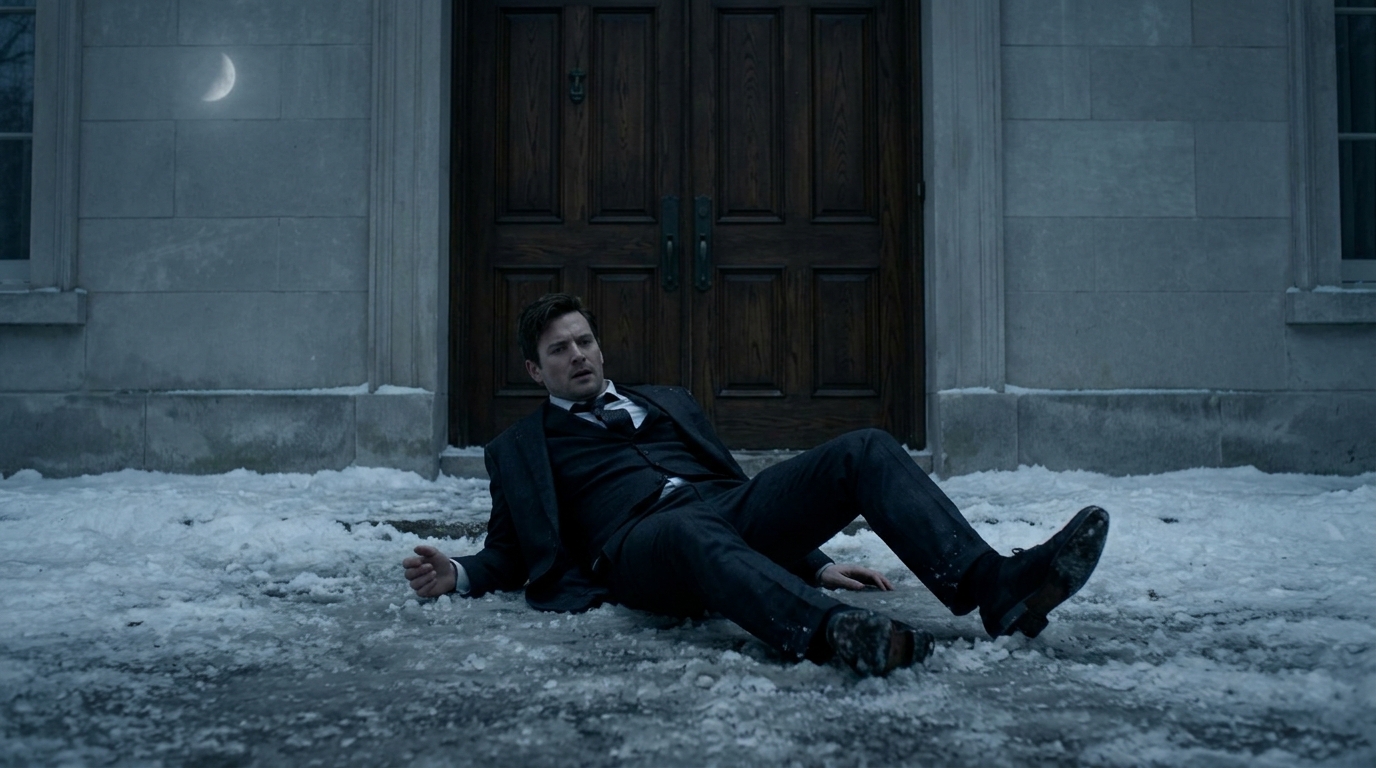
“GET OUT! YOU OWE NOTHING!”
The heavy oak doors of the Sterling estate slammed shut with a force that seemed to shake the frozen night itself.
Damien Sterling hit the slush hard.
One knee first.
Then both hands.
Gray snow soaked through the sleeves of his tailored suit. The bitter cold bit into his palms, but he did not move for several seconds. He stayed there on the stone drive, breath forming jagged white clouds in front of his face, staring at the place where the doors had closed.
Behind those doors was the house he had grown up in.
The house his mother had filled with music.
The house his father had built into a monument of old money, private deals, and carefully polished lies.
From the balcony above, laughter cut through the night.
Sharp.
Cruel.
Triumphant.
His brother leaned over the black iron railing with a glass of whiskey in one hand and their father’s signet on the other.
Adrian Sterling.
Older by seven minutes.
Golden son by birthright.
Monster by choice.
“You’re a nobody now, Damien!” Adrian shouted. “Go rot in the streets!”
More laughter followed from inside.
Cousins.
Lawyers.
Board members.
People who had toasted Damien at dinner three hours earlier, smiling into crystal glasses while knowing the paperwork had already been prepared.
Damien did not scream.
He did not beg.
He did not pound on the doors and demand justice from people who had spent years confusing inheritance with permission.
He only looked down when something slipped from his coat pocket.
A small iron ring.
Dull.
Plain.
Almost ugly.
It struck the frozen step with a faint metallic click and rolled toward the dark teeth of the sewer grate at the edge of the drive.
Damien’s breath hitched.
For the first time that night, panic broke through his face.
He lunged.
His fingers scraped against ice and stone. His shoulder slammed into the ground. The ring spun once, tilted, and nearly vanished between the iron bars.
He caught it at the last second.
His fist closed around it.
And then the dull iron changed.
It did not shine exactly.
It pulsed.
A deep crimson glow bled through Damien’s fingers, staining the white snow beneath his hand red.
On the balcony, Adrian’s laughter faltered.
“What the hell is that?”
Damien slowly lifted his head.
The ring warmed in his palm.
Not magic.
Not miracle.
A signal.
Old technology hidden in older metal.
The last failsafe his father had built before fear and illness made him easier to control.
The low rhythmic thrum of engines rolled through the frozen suburb.
Not one.
Not two.
A convoy.
Twelve black SUVs rounded the corner in perfect formation, headlights cutting across the Sterling estate like searchlights. They moved without hesitation, tires hissing through slush, engines idling with disciplined menace as they stopped along the curb and across the drive.
The balcony went silent.
Doors opened in unison.
Men and women in dark tactical coats stepped out.
Not police.
Not private security hired by Adrian.
Not anyone his brother could command with money.
They ignored the mansion entirely.
They turned toward Damien.
The lead operative was a tall man with silver at his temples and a scar running from his left ear to his jaw. He walked through the slush, stopped two feet from Damien, and knelt.
Knee in the mud.
Head lowered.
In both hands, he held out a black case.
His voice trembled, but not from cold.
“The iron ring has called, Young Master.”
The balcony above seemed to stop breathing.
The man lifted his eyes.
“Your exile is over.”
Damien rose slowly.
The crimson light faded inside his fist, leaving only the dull iron ring pressed into his palm.
His suit was soaked.
His cheek was cut.
Snow clung to his hair.
But his eyes had changed.
Not because power had arrived.
Because the act was finished.
The humiliation.
The expulsion.
The broken inheritance.
The brother laughing above him.
All of it had been allowed to happen for one reason.
Adrian needed to believe he had won.
Damien looked up at the balcony.
For the first time all night, he smiled.
Not kindly.
“Thank you, Marcus,” he said to the kneeling man.
Marcus Vale opened the black case.
Inside lay a sealed folder, a slim encrypted drive, and an old silver key stamped with the Sterling crest.
Damien took the key first.
Adrian’s face drained of color.
Because he recognized it.
Their father’s vault key.
The one Adrian had sworn was lost.
Damien slid the iron ring onto his finger and looked at his brother.
“The plan worked perfectly.”
Then he turned toward the mansion.
“And now,” he said, “we begin with the truth.”
The Brother Who Needed Him Gone
The Sterling family had never believed in love without conditions.
Not openly.
They used better words.
Legacy.
Duty.
Discipline.
Bloodline.
Stewardship.
But underneath all of it lived the same old rule: whoever controlled the money got to define the family.
Damien and Adrian Sterling were born into a world of quiet servants, private tutors, seasonal houses, old portraits, and dinner conversations where children learned early that silence was safer than honesty.
Their father, Malcolm Sterling, owned Sterling Dominion Group, a private holding company built across shipping, defense logistics, infrastructure, energy, and discreet political investments no one discussed near outsiders.
Their mother, Elise, had been the only warm thing in the estate.
She played piano badly but enthusiastically.
She slipped food to staff children during formal parties.
She told Damien and Adrian stories in the greenhouse when storms rolled over the hills.
When the twins were nine, she died in a riding accident.
At least, that was what the family said.
After that, the house changed.
Or perhaps it became what it had always been without her standing between the boys and the cold.
Adrian learned fastest.
He understood that their father respected dominance. He learned to interrupt, to flatter, to punish servants indirectly, to turn mistakes into weapons. He smiled in public and collected resentment in private.
Damien was different.
Quieter.
More observant.
More like Elise.
That was what the old housekeeper, Mrs. Kline, whispered once when she thought no one heard.
Adrian heard.
He never forgave it.
Their rivalry was not dramatic at first.
It was made of small thefts.
A broken watch blamed on Damien.
A tutor’s report altered.
A horse frightened before a riding lesson.
A scholarship application Damien had filled out for a staff member’s son mysteriously disappearing.
Adrian did not want to beat Damien.
He wanted the family to agree Damien deserved losing.
By the time they were adults, the lines were clear.
Adrian was the heir.
Damien was the useful second son.
The one sent to clean up problems in companies where executives were stealing, projects were failing, or regulators had begun asking questions.
Damien became good at it.
Too good.
He found missing money in subsidiary accounts.
He discovered that a port authority contract had been won through illegal payments.
He stopped a defense shipment from moving through a sanctioned intermediary.
He saved Sterling Dominion from three scandals no one outside the board ever heard about.
His father noticed.
That was the beginning of Adrian’s fear.
Malcolm Sterling was not affectionate, but he was not blind. In his final years, illness thinned him and removed some of the arrogance that had once kept him loyal to his oldest assumptions.
One night, six months before the exile, Malcolm called Damien into the old library.
No staff.
No lawyers.
No Adrian.
Only his father sitting beneath the portrait of Elise, one hand resting on a cane he did not want anyone to know he needed.
“You think I don’t know what your brother is?” Malcolm said.
Damien did not answer.
That was safest.
Malcolm gave a humorless smile.
“He thinks cruelty is strength. I let him believe that because it was easier than correcting him.”
The honesty startled Damien more than kindness would have.
His father opened a drawer and removed a small iron ring.
Plain.
Dull.
Heavy.
“This belonged to your mother’s side,” Malcolm said. “The Vale line.”
Damien looked at it.
“I’ve never seen it.”
“No. I hid everything of hers after she died.”
“Why?”
Malcolm looked toward the portrait.
“Because grief made me selfish. And because her family knew things about mine I did not want remembered.”
The ring contained a dormant biometric transmitter tied to an independent security and intelligence network Elise’s family had built generations earlier. The Vale Trust had operated quietly for decades, protecting family assets from hostile capture, blackmail, internal betrayal, and political seizure. It did not answer to Sterling Dominion.
It answered to the ring.
More precisely, to the bloodline confirmed through the ring.
Malcolm placed it in Damien’s hand.
“If I die before I can change the company publicly, Adrian will move fast.”
Damien stared at him.
“Change what?”
Malcolm’s mouth tightened.
“My will. The voting trust. Everything.”
The room seemed to shrink.
“I thought Adrian inherited control.”
“He would have. Once.”
Damien looked down at the ring.
His father continued.
“I opened old files after your mother died. Then closed them because I was a coward. I opened them again when I found what Adrian and Victor were doing.”
“Victor?”
“Victor Hale. Our general counsel.”
Damien knew Victor.
Everyone did.
Gray-haired, calm, lethal in boardrooms.
A man whose loyalty seemed so complete it had always felt artificial.
Malcolm’s voice lowered.
“Adrian has been moving assets through Victor for years. Not only theft. Something worse. Shell procurement. Private armed contractors. Political leverage. Records tied to your mother’s death.”
Damien went still.
“My mother’s death?”
Malcolm closed his eyes.
“I no longer believe it was an accident.”
The words entered Damien like cold water.
Before he could respond, Malcolm gripped his wrist.
“Listen. If I confront them and fail, they will destroy you legally before physically. They will paint you unstable. Disloyal. Addicted. Dangerous. They will strip you, humiliate you, force you out, and make the world believe you earned it.”
Damien looked at the ring.
“And this?”
“If they exile you publicly and you survive long enough to activate it, Marcus Vale will come. He has the files I should have released years ago.”
“Why not now?”
“Because I need them to reveal themselves. Adrian controls more of the board than I realized. If I move too soon, Victor buries everything. If they believe you are powerless, they will stop hiding.”
Damien understood then.
Not fully.
But enough.
His father was asking him to become bait.
Malcolm’s face softened in a way Damien had never seen.
“I failed you and your mother. I cannot undo that. But I can give you the weapon she left behind.”
Two weeks later, Malcolm Sterling died.
Heart failure, according to the official statement.
A private funeral.
Closed medical review.
Adrian weeping beautifully for cameras.
Victor Hale standing behind him like a shadow with legal authority.
Then the documents appeared.
Damien accused of misappropriating company funds.
Damien removed from all posts.
Damien disinherited under a revised family agreement.
Damien escorted from the boardroom.
Damien locked out of accounts.
Damien called unstable.
Damien invited to one final family dinner at the estate so Adrian could perform mercy before the kill.
He went.
Because that was the plan.
He sat through the meal while Adrian smiled, cousins laughed, and Victor placed documents beside his plate.
He signed nothing.
He said almost nothing.
At midnight, Adrian ordered him thrown out.
And Damien let them.
He let the staff see.
Let the cousins laugh.
Let Adrian shout from the balcony.
Let the ring fall.
Let the wolves believe the lamb had reached the snow alone.
The Men Who Answered The Ring
Marcus Vale had waited twenty-six years for the iron ring to call.
That was what he told Damien later.
Not in the snow.
Not at the estate.
Later, when the first wave of arrests had begun and the Sterling house no longer belonged to lies.
In the moment, Marcus was all action.
He stood from the slush, closed the black case, and turned to the operatives behind him.
“Perimeter.”
They moved instantly.
Two teams secured the gate.
One swept the east drive.
One blocked the rear exit road.
A drone lifted silently from the second SUV, disappearing into the black sky above the estate.
On the balcony, Adrian finally found his voice.
“What is this? Damien, what the hell is this?”
Damien brushed slush from his sleeve.
“You wanted witnesses.”
Adrian’s face twisted.
“You think hired thugs impress me?”
Marcus looked up.
His expression did not change.
“Mr. Sterling, no one here is hired by your brother.”
Victor Hale appeared behind Adrian on the balcony.
Even from below, Damien saw the flicker of recognition.
Victor knew Marcus.
That mattered.
Victor placed a hand on Adrian’s arm.
“We should go inside.”
Adrian yanked away.
“No. This is my house.”
Damien looked toward the sealed folder in his hand.
“Not tonight.”
The front doors opened again.
This time, not to throw anyone out.
But because Victor had sent security.
Six armed estate guards stepped onto the portico.
They stopped when they saw the convoy, the tactical formation, the drone overhead, and the way Marcus’s people did not reach for weapons because they had already calculated the room.
Marcus raised his voice.
“Private security personnel, you are currently standing inside an active federal evidence preservation action.”
Adrian laughed.
“Federal? You’re insane.”
Then headlights appeared beyond the convoy.
More vehicles.
Not black SUVs.
Government plates.
Three federal agents stepped out with Detective Elena Cross from the financial crimes task force Damien had contacted indirectly two months earlier through Marcus.
Adrian’s laughter died.
Victor’s face hardened.
Detective Cross walked through the gate carrying a warrant folder wrapped against the snow.
“Sterling estate is now subject to search and evidence preservation under sealed order 47-B,” she said. “No one destroys documents, accesses servers, or leaves without authorization.”
Adrian looked at Damien.
For the first time in his life, he seemed genuinely confused.
“You did this?”
Damien said nothing.
Victor leaned close to Adrian, whispering urgently.
Adrian’s eyes widened.
Then narrowed.
“You set me up.”
Damien looked up at him.
“No. I let you continue.”
The difference hung in the frozen air.
Federal agents entered the house.
Victor tried to block them.
Detective Cross read the warrant aloud.
Sterling Dominion Group.
Estate offices.
Private servers.
Family vault.
Medical records related to Malcolm Sterling.
Historical files related to Elise Vale Sterling.
Procurement contracts tied to private security operations.
Adrian went pale at his mother’s name.
Not because he grieved her.
Because he did not know her death was on the paper.
Damien saw it.
That ignorance was important.
Maybe Adrian was guilty of many things.
But perhaps not everything.
Victor knew.
Victor’s face had gone still in the way guilty men become when their mind begins shredding paper that investigators have already copied.
Marcus stepped beside Damien.
“You should go inside.”
Damien looked at the mansion.
The windows glowed warm against the winter.
For the first time, the house looked less like home than evidence.
He walked up the steps.
No one stopped him.
Inside, the grand foyer smelled of candle wax, old wood, expensive perfume, and panic.
Guests from the dinner stood frozen near the staircase. Some clutched drinks. Others whispered into phones until agents ordered them to stop. The household staff gathered near the service hall, eyes wide.
Mrs. Kline, older now, stood with one hand over her mouth.
When she saw Damien, her eyes filled.
“You came back,” she whispered.
Damien paused.
The boy inside him wanted to collapse into that kindness.
The man could not.
“Not yet,” he said softly.
Because coming back required more than crossing a threshold.
It required surviving what waited in the walls.
The family vault lay beneath the west wing, behind a steel door disguised by mahogany panels and portraits of dead Sterlings who had made fortunes in industries polite history softened.
Adrian reached the vault before them.
He stood there with Victor, two attorneys, and one cousin who kept saying, “This is a misunderstanding,” as if repetition could build reality.
Damien held up the silver key.
Adrian stared.
“Where did you get that?”
“Father.”
“Impossible.”
Victor said, “That key was reported missing.”
Damien looked at him.
“By you?”
Victor’s jaw tightened.
Marcus opened the black case and removed a document sealed with red wax.
“Malcolm Sterling executed emergency authority transfer fourteen days before his death,” Marcus said. “Upon activation of the Vale ring by Damien Sterling, access to the family vault and emergency trust files transfers to the designated heir under the Elise Vale Sterling Protection Clause.”
Adrian’s face flushed.
“Protection clause? There is no—”
Victor grabbed his arm.
This time Adrian noticed.
He looked at Victor.
“What is he talking about?”
Victor did not answer.
Damien inserted the silver key into the vault lock.
For a moment, nothing happened.
Then the iron ring on his finger warmed.
The vault scanned both.
Key.
Ring.
Blood.
The steel door unlocked with a deep mechanical groan.
Adrian whispered, “No.”
Damien pushed the door open.
Inside were shelves of old ledgers, sealed boxes, fireproof cases, art crates, and one black cabinet bearing his mother’s maiden crest.
A raven over an iron circle.
Marcus stepped to the cabinet.
He bowed his head once before opening it.
Inside was a video recorder, an encrypted drive, paper files, and a letter addressed in Malcolm Sterling’s hand.
To my sons, if either of you is still capable of hearing the truth.
The Mother They Buried Twice
Elise Vale Sterling did not die in a riding accident.
That truth was the first thing the vault revealed.
The second was worse.
Her death had been investigated.
Then buried.
Not by strangers.
By family.
The video was twenty-six years old, grainy and slightly damaged, recorded in what looked like a hospital room. Elise sat upright in bed, pale but alive, one side of her face bruised, hair loose over her shoulders.
Damien’s hand tightened when he saw her.
He had almost forgotten the way she moved.
Almost.
On-screen, Elise looked into the camera.
“If this recording reaches my sons, then Malcolm failed to protect the truth while I was alive.”
In the vault room, no one spoke.
Adrian stood near the door, face drained.
Victor stood behind him, eyes fixed on the exits.
Elise continued.
“My accident was not an accident. I discovered Sterling Dominion was moving restricted equipment through humanitarian logistics contracts and using Vale Trust channels to hide payments. I confronted Malcolm first. He denied knowing the full scope. I believed him then. I do not know if I should have.”
Damien looked at the letter in his hand.
His father’s face on the night in the library returned.
I failed you and your mother.
Elise coughed in the recording, then continued.
“Victor Hale came to me afterward. He said old families survive by knowing which truths to starve. I refused.”
Victor’s expression did not change.
But Adrian turned slowly toward him.
The recording went on.
“I was thrown from the horse after the saddle was cut. I survived the fall. I was taken to a private clinic instead of a hospital. Malcolm was told I died before he arrived. If he believed that, he is weaker than I hoped. If he helped them, he is worse than I feared.”
Damien closed his eyes.
The room seemed to tilt.
For twenty-six years, his mother had been not only dead.
She had been misremembered.
Turned into tragedy.
Reduced to a portrait.
Elise leaned closer to the camera.
“My sons, if you are watching this, understand: the fight is not for inheritance. It is for the truth of what men hid inside inheritance. Do not become them.”
The video ended.
A silence followed so heavy even Adrian did not break it.
Then Damien opened Malcolm’s letter.
His father’s handwriting, weaker near the end, filled six pages.
He admitted he had suspected Victor’s involvement but lacked proof. Admitted he accepted the private clinic’s report too quickly because grief and fear made him obedient. Admitted that years later, he found evidence Elise had survived three days after the fall. By then, the clinic was closed, records missing, staff dead or gone.
He had spent the final year of his life reconstructing the crime.
Victor Hale had orchestrated the disposal of restricted shipment records.
Elise found out.
Victor arranged the riding “accident.”
Several Sterling board members participated in the cover-up.
Malcolm did not order Elise’s death.
But he protected the company afterward.
That was his crime.
Not murder.
Cowardice.
Legacy preserved through silence.
Adrian sat down on a crate as if his body had stopped supporting him.
“She was alive?” he whispered.
Damien looked at him.
“For three days.”
Adrian’s face twisted.
“Father knew?”
“Eventually.”
“And said nothing?”
Damien looked at Victor.
“He planned something.”
Victor smiled faintly.
“Malcolm grew sentimental in illness.”
The words snapped something in the room.
Adrian stood.
“You knew?”
Victor adjusted his cuffs.
“I knew many things your father lacked the courage to handle.”
Adrian moved toward him.
Marcus stepped in, blocking both brothers from doing something useful only to Victor’s lawyers.
Detective Cross entered the vault then, holding a tablet.
“We found the server room.”
Victor’s eyes flicked toward her.
“Encrypted?”
“Not anymore.”
Marcus looked almost amused.
Cross continued.
“Sterling Dominion has been moving restricted surveillance hardware through disaster relief subsidiaries. We have records tied to Victor Hale, Adrian Sterling, and multiple board members.”
Adrian’s head jerked up.
“I didn’t know about restricted hardware.”
Detective Cross looked at him.
“You signed approvals.”
“Victor told me they were medical logistics contracts.”
Damien looked at his brother.
For the first time that night, Adrian did not look arrogant.
He looked young.
Not innocent.
Never that.
But used.
Then Detective Cross turned to Damien.
“There’s more.”
The tablet showed an account ledger.
Offshore transfers.
Shell companies.
Payments to estate staff.
Medical purchase orders.
Security contracts.
And one file labeled:
D.S. Destabilization Protocol.
Damien knew before she opened it.
Victor had built the case against him long before Malcolm died.
False transfers.
Fabricated addiction records.
Therapist notes from a doctor Damien had never seen.
Photographs staged to suggest bribery.
Witness statements drafted but unsigned.
Everything needed to destroy him if he became a threat.
Adrian stared at the file.
His lips parted.
“I thought you actually took money.”
Damien laughed once.
Not because it was funny.
Because if he did not laugh, the anger would make him careless.
“Of course you did.”
Adrian looked ashamed.
The expression did not fit him well.
Victor’s phone buzzed.
He glanced down.
That was the mistake.
Marcus saw it.
“Take him.”
Victor moved fast for a man his age.
He threw the phone into the vault lights, plunging half the room into darkness, then lunged toward the rear archive door.
He knew the vault better than anyone should.
But Damien had grown up hiding from tutors in this house.
He knew it too.
Victor reached the archive corridor.
Damien intercepted him at the old wine passage, slamming him against the stone wall.
Victor grunted.
The iron ring pressed into his throat as Damien held him there.
For one second, Damien wanted to crush the man.
For his mother.
His father.
His own public ruin.
For every year the Sterling house had fed on secrets.
Victor smiled through shallow breaths.
“There he is,” he whispered. “A Sterling after all.”
That stopped Damien.
Not because it softened him.
Because it disgusted him.
He released Victor and stepped back.
Detective Cross’s agents seized him immediately.
Damien looked at the old man in cuffs.
“No,” he said. “That’s why you lose.”
The Brother Who Finally Saw The Cage
Adrian Sterling spent the first night after the raid in the east sitting room, guarded by federal agents, drinking nothing, saying little, and staring at his bare hand where he had removed their father’s signet.
Damien found him there just before dawn.
Snow still fell outside.
The estate had been searched through the night. Servers removed. Files boxed. Board members detained or summoned. Staff interviewed. Guests released after statements.
The mansion looked less like a palace now.
More like a crime scene wearing antiques.
Adrian did not look up when Damien entered.
“If you came to enjoy this, go ahead.”
Damien stood near the fireplace.
“I have other things to do.”
That made Adrian laugh bitterly.
“Of course. You’re the heir now.”
“I was never fighting for that.”
“Everyone fights for that.”
“You do.”
Adrian’s jaw tightened.
For a moment, the old anger rose between them.
Familiar.
Easy.
Then he looked exhausted instead.
“I thought Father chose you because you were better.”
Damien said nothing.
Adrian continued.
“Do you know what that does? Being told without words your whole life that you are the first son, the heir, the future, and still feeling him watching you like he expects disappointment?”
Damien looked at him.
“Do you know what it does being used as the spare conscience of a family that ignores you until disaster needs cleaning?”
Adrian looked up then.
A real look.
No smirk.
No performance.
“Maybe he ruined both of us differently.”
Damien hated that the sentence was true.
“He gave you the company,” Damien said. “You used it.”
“Victor used me.”
“You let him because he told you what you wanted to hear.”
Adrian flinched.
That was new too.
Flinching from truth instead of twisting it.
“He told me you were unstable,” Adrian said quietly. “He showed me reports. Transfers. Photos.”
“And you believed him.”
“Yes.”
“Because you wanted to.”
Adrian closed his eyes.
“Yes.”
The honesty did not repair anything.
It changed the air slightly.
That was all.
Damien looked toward the portrait of Elise over the mantel.
Their mother smiling faintly, forever younger than both her sons were now.
“Did you know about Mom?”
Adrian’s voice broke.
“No.”
Damien believed him.
He did not know what to do with that.
Adrian opened his eyes.
“What happens to me?”
“You signed documents tied to the logistics shell.”
“I didn’t know what they were.”
“That may reduce guilt. It doesn’t erase responsibility.”
Adrian stared at him.
“You sound like Father.”
Damien’s mouth tightened.
“Then I’ll say it differently. You were arrogant enough to let criminals use your name because you thought details were beneath you.”
Adrian absorbed that.
Then nodded once.
“Better.”
Damien almost smiled.
Almost.
Adrian looked at his brother’s hand.
“The ring should have been mine too.”
“No.”
“You don’t hesitate.”
“Mother left it to the son who would use it to expose the truth, not protect a throne.”
Adrian looked back at the fire.
“I laughed at you in the snow.”
“Yes.”
“I wanted you broken.”
“I know.”
“I don’t know how to apologize for that.”
Damien turned toward the door.
“Then don’t start with words.”
He left Adrian there.
Not forgiven.
Not abandoned.
Something harder.
Accountable.
Over the following weeks, Sterling Dominion collapsed publicly.
The restricted hardware scandal triggered federal charges. Defense contracts were suspended. Board members resigned. Victor Hale’s network unraveled under pressure from seized communications and the files Marcus Vale had preserved.
Victor tried to trade information for leniency.
He offered everyone.
Politicians.
Executives.
Foreign buyers.
Dead men.
Living cowards.
It helped prosecutors.
Not him enough.
The investigation into Elise’s death reopened officially.
Several clinic records were recovered from a shuttered archive after a former nurse, now terminally ill, came forward. She remembered Elise.
“Mrs. Sterling kept asking for her boys,” the nurse said in deposition. “They told us the husband didn’t want the children traumatized.”
Damien read that line alone.
Then again.
Then put the paper down before grief could become something that broke furniture.
Elise had asked for them.
That mattered.
It hurt.
It mattered.
Malcolm Sterling’s role became public too.
Not as murderer.
As man who suspected, discovered, delayed, and tried too late to correct through strategy instead of confession.
The newspapers called him complicated.
Damien hated that word.
Complicated often means powerful people did wrong in ways that require footnotes.
Adrian cooperated.
At first on advice of counsel.
Then, slowly, because the evidence forced him to see the size of what he had helped by refusing to look. His testimony against Victor and the procurement network reduced his charges but did not spare him consequences. He lost board authority, equity control, and the estate claim he had tried so hard to weaponize.
He also did something Damien did not expect.
He gave a public statement.
Not polished.
Not lawyerly.
Almost painful.
“I believed lies because they benefited me,” Adrian said. “I mistook inheritance for proof of worth. I helped humiliate my brother based on documents I did not verify and a jealousy I did not control. My ignorance was not innocence.”
Damien watched from a private room.
Marcus stood beside him.
“Do you believe him?” Marcus asked.
Damien considered.
“I believe he hates being seen clearly.”
“That’s a start.”
“Not enough.”
“No,” Marcus said. “Starts rarely are.”
The House That Changed Owners
The Sterling estate did not remain a family home.
Damien could not sleep there.
Not after the vault.
Not after Elise’s video.
Not after learning the walls had heard more truth than any person inside them.
He transferred ownership into the Elise Vale Sterling Foundation, an independent trust dedicated to whistleblower protection, investigative journalism grants, support for families harmed by corporate retaliation, and legal aid for employees pressured into silence.
The west wing became an archive.
The family portraits stayed, but each received a plaque with documented history.
Not the flattering version.
The full one.
One plaque beneath Malcolm Sterling’s portrait read:
Built power. Preserved silence. Tried to repair too late.
Adrian objected.
Damien ignored him.
Elise’s portrait was moved to the entrance hall.
Beneath it:
She saw the truth. They buried it. Her ring brought it back.
Mrs. Kline cried when the plaque was installed.
“She would have hated the fuss,” she said.
Damien looked at his mother’s painted face.
“Good.”
The foundation’s first public event took place six months after the raid.
Former employees testified about intimidation inside Sterling Dominion subsidiaries. Families of workers injured in illegal shipments came forward. Investigators explained how respectable companies bury crime under compliance language.
Damien spoke last.
He hated public speaking.
Adrian had always loved rooms.
Damien preferred documents.
But this room needed him.
He stood at the podium wearing a simple dark suit. The iron ring rested on his finger, dull now, no crimson pulse, no theatrical glow. Just metal.
“My mother once said old houses remember what families try to forget,” he began.
The room quieted.
“I used to think the Sterling estate was a home. Then a fortress. Then a crime scene. Now I hope it becomes something more useful.”
He looked toward the front row where Marcus Vale sat, expression unreadable.
“My exile was real. The humiliation was real. My brother’s cruelty was real. But the ring was never about rescuing me from snow. It was about forcing hidden systems into the open.”
He paused.
“Power kept secret becomes rot. Power made accountable can become repair.”
Reporters wrote that line down.
Damien wished they would also write down the names of the workers in the third row who lost pensions, the families still fighting health claims, the staff whose warnings had been ignored.
So he read them aloud.
All of them.
It took eleven minutes.
Long enough that cameras grew restless.
Good.
Truth should inconvenience attention spans.
Adrian attended the event from the back.
No press statement.
No dramatic reconciliation.
Afterward, he approached Damien near the old library doors.
“I’m leaving the country for a while,” Adrian said.
“Vacation?”
“Court-approved work with the restitution board in London.”
Damien raised an eyebrow.
“Actual work?”
Adrian almost smiled.
“Apparently, yes.”
The silence between them was not warm.
But it was not war.
Adrian looked at the iron ring.
“Did it really glow red?”
Damien looked at him.
“Biometric activation. Old Vale tech. Light under corroded iron.”
“So not magic.”
“No.”
Adrian nodded.
“Felt like it.”
Damien did not disagree.
Sometimes truth arriving on time feels supernatural to people who have lived too long inside lies.
Adrian hesitated.
“I am sorry.”
Damien waited.
“For the snow,” Adrian said. “For the balcony. For believing what made me feel superior. For wanting you erased.”
There it was.
Not perfect.
Not enough.
But specific.
Damien looked toward Elise’s portrait.
“I’m not ready to forgive you.”
Adrian nodded.
“I know.”
“But I heard you.”
Adrian swallowed.
“That’s more than I deserve.”
“Yes.”
For once, Adrian did not argue.
Years passed.
Victor Hale died in prison after giving enough testimony to ruin half the men he once served. The restricted shipment network became a case study in corporate crime courses. Sterling Dominion was broken apart, sold, restructured, and monitored. The foundation grew stronger than the company that birthed it.
Damien never became the kind of heir people expected.
He refused the old title.
Young Master, Marcus called him only once.
That night in the snow.
Never again.
Damien asked him why.
Marcus said, “Because you became something better than what the title meant.”
Damien accepted that as close to affection as Marcus Vale offered.
The iron ring remained with him, but he stopped wearing it daily. He placed it in a glass case inside the archive beside the black case Marcus carried that night and a photograph of Elise from before marriage, standing on a cliff in a windbreaker, hair loose, laughing at someone outside the frame.
The caption below the ring read:
ACTIVATED AFTER EXILE. FUNCTION: EMERGENCY TRUTH RELEASE.
School groups came through the archive sometimes.
University researchers.
Journalists.
Families of whistleblowers.
Once, a boy around twelve stared at the ring for a long time and asked, “Did it make him powerful?”
The guide looked at Damien, who happened to be standing nearby.
Damien answered himself.
“No.”
The boy looked disappointed.
Damien smiled faintly.
“It made him responsible.”
The boy thought about that.
“Is that better?”
“Harder.”
“Is harder better?”
“Not always.”
Damien looked at the ring.
“But sometimes necessary.”
The Snow Where Mercy Ended
Ten years after the night Adrian threw him out, Damien returned to the estate alone during the first snow of winter.
The foundation was closed for the evening.
The staff had gone home.
The iron gate was open now, fixed permanently after Damien ordered the old locking mechanism removed.
He stood on the same stone drive where he had fallen.
The same sewer grate remained near the edge.
The same balcony above the doors.
The same cold air.
But the house no longer looked like judgment.
Just stone.
Wood.
History.
Dangerous only when people agreed not to question what happened inside.
Damien crouched near the grate.
He could still see the moment clearly.
The ring rolling.
His fingers scraping ice.
Adrian laughing.
The red glow bleeding through snow.
Marcus kneeling.
Your exile is over.
At the time, Damien had thought that meant return.
Now he knew better.
Exile does not end when people let you back into the house.
It ends when the house no longer defines whether you belong.
He heard footsteps behind him.
Adrian.
Older now.
Less golden.
More human in ways that made him both better and sadder.
“I thought I’d find you here,” Adrian said.
Damien stood.
“You’re back.”
“Restitution board finished the London review.”
“And?”
“Ugly.”
“Good.”
Adrian smiled slightly.
“Yes. Good.”
For a while, they stood in silence as snow gathered on the drive.
Then Adrian looked up at the balcony.
“I replay that night a lot.”
“I know.”
“I used to replay it because I was angry you won.”
“And now?”
Adrian’s breath clouded.
“Because I can’t believe I laughed.”
Damien looked at him.
The apology had been years ago.
Forgiveness had not arrived as a single moment.
It had come grudgingly.
Through testimony.
Work.
Restitution.
Adrian showing up when no cameras were present.
Adrian listening to families he had harmed by signature and neglect.
Adrian learning that shame was not fatal, only deserved.
Damien did not trust him completely.
He might never.
But he no longer hated him cleanly.
That was inconvenient.
Real family often is.
Adrian reached into his coat pocket and removed something.
A ring box.
Damien stiffened.
Adrian opened it.
Inside was their father’s signet.
“I don’t want it,” Adrian said.
Damien stared at the gold crest.
“You wore it like a crown.”
“I know.”
“Now?”
“Now it feels like evidence.”
Damien almost laughed.
Adrian held it out.
“I thought it should go in the archive. Next to the iron ring.”
Damien did not take it immediately.
“What would the plaque say?”
Adrian looked at the balcony.
Then at his brother.
“Inherited without wisdom. Surrendered after consequence.”
Damien studied him.
Then took the box.
“That’s not bad.”
“I’ve been practicing accountability sentences.”
“Awful hobby.”
“Runs in the family now.”
Damien smiled despite himself.
The snow fell thicker.
Adrian turned toward the open gate.
“I still don’t understand why Mother’s ring chose you.”
Damien looked at the estate.
“I don’t think it chose the better son.”
“No?”
“No. It chose the one willing to be thrown out and still hold onto the evidence.”
Adrian nodded slowly.
“That sounds like her.”
“You barely remember her.”
“I remember enough.”
Damien wanted to challenge that.
Then did not.
Memory did not need to be equal to be real.
They walked toward the house together.
Not close.
Not touching.
But through the same door.
Inside, Elise’s portrait watched from the entrance hall.
The gold signet was placed in the archive that night.
Beside the iron ring.
Not as equal objects.
As opposites.
One had represented inherited power.
The other hidden accountability.
One had been worn openly while lies grew.
The other had waited in a pocket until truth had no safer road.
Years later, people still told the story of Damien Sterling being thrown into the snow by his brother, only for an iron ring to glow red and summon twelve black SUVs to kneel before him.
They liked the image.
The slush.
The balcony.
The glowing ring.
The convoy.
The line about exile ending.
Those parts sounded like legend.
But Damien always corrected the ones who made it too clean.
“The ring did not save me,” he would say. “It exposed the men who thought I was already defeated.”
That was less glamorous.
More useful.
The real story was not about a hidden prince returning for revenge.
It was about a family that mistook secrecy for legacy.
A brother who mistook cruelty for strength.
A father who mistook late strategy for courage.
A mother who saw the truth and paid for it.
And a son who let himself be humiliated in the snow because evidence sometimes needs the guilty to feel safe enough to show their hands.
Damien never forgot the cold.
He never forgot the sewer grate.
Never forgot the ring nearly disappearing forever.
That part mattered.
Truth can be lost that easily.
One slip.
One second.
One frightened hand failing to close in time.
So he built his life around not letting truth roll away again.
Every file copied.
Every witness protected.
Every old story reopened.
Every elegant lie forced into plain language.
The iron ring stayed in the archive.
Dull.
Silent.
No longer glowing.
It did not need to.
The call had been answered.
The exile was over.
The war had been real.
And mercy, Damien learned, did not mean leaving the powerful unpunished.
Sometimes mercy meant making sure they could never again bury another person in snow and call it inheritance.