“I ALWAYS KEEP MY PROMISES.”
Her voice was small.
Almost too small to survive the sterile hum of the grocery store lights, the squeak of cart wheels, the low beep of checkout scanners, and the murmurs rising around aisle seven.
But somehow, everyone heard her.
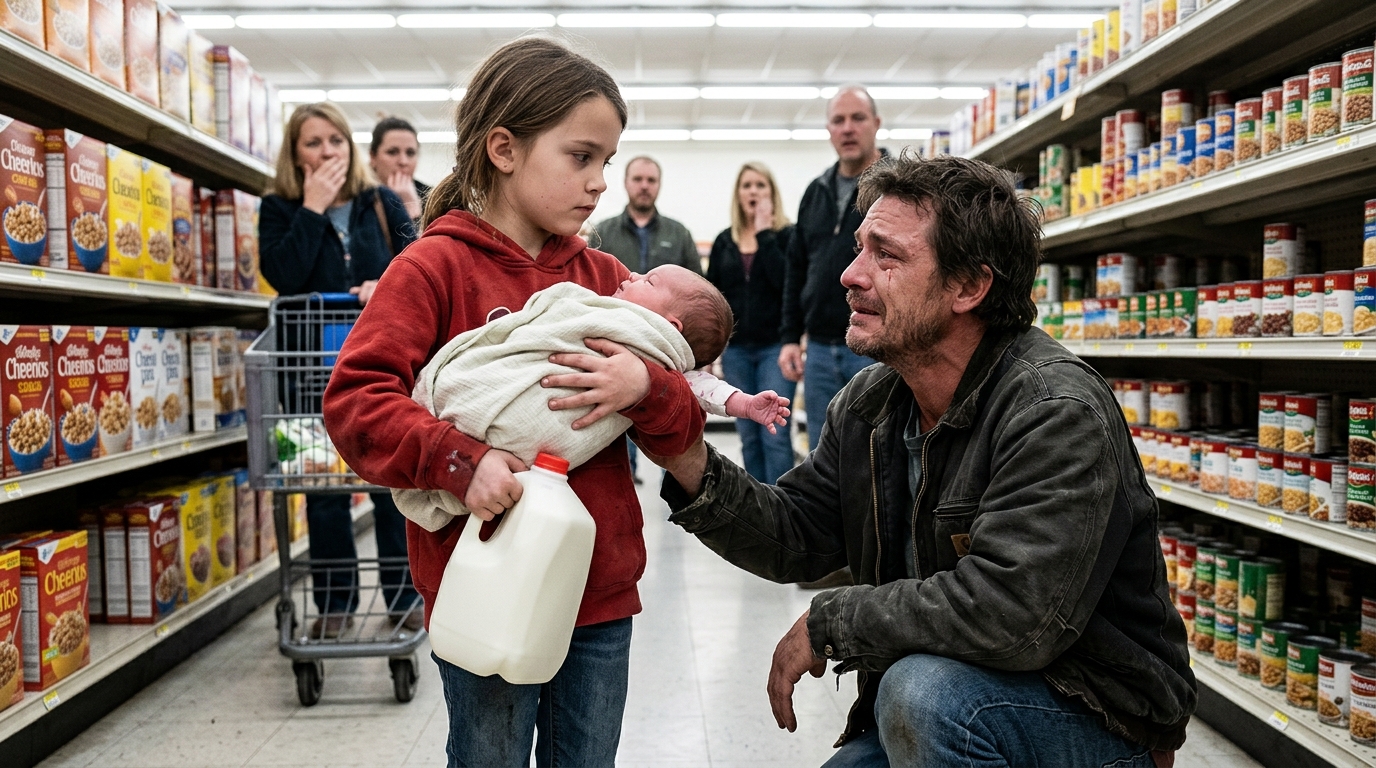
A little girl stood beside the dairy cooler with a newborn cradled awkwardly against her chest and a gallon of milk gripped in her other arm like it weighed more than she did.
She could not have been more than eight.
Her brown hair was tangled beneath a faded purple hood. Her sneakers were too big, the laces knotted twice and still loose. One knee of her leggings had a tear. The baby in her arms was wrapped in a thin blue blanket, its tiny face pressed against her shoulder, eyes squeezed shut against the cold air.
The man kneeling in front of her looked as though the floor had vanished beneath him.
His name was Daniel Mercer.
Thirty-eight years old.
Former paramedic.
Former husband.
Former father, depending on which version of his life he allowed himself to remember.
He had come into the grocery store for coffee, bread, and the kind of errands lonely men invented so their apartments would not feel too quiet. He did not expect to kneel in the dairy aisle, one hand braced against the cold tile, staring at a child who had just spoken words he had heard once before.
I always keep my promises.
The exact words.
The exact rhythm.
The exact impossible ache.
Around them, shoppers had stopped moving.
An older woman clutched a loaf of bread to her chest.
A teenage cashier stood frozen near the endcap.
A man in a business coat whispered, “Where’s the mother?”
Someone else muttered, “Call child services.”
Another voice said, “That baby can’t be more than a week old.”
The judgment spread faster than concern.
Phones were coming out.
Not high yet.
Just ready.
The girl saw them.
Her jaw tightened.
She pulled the newborn closer.
“I’m not stealing,” she said.
The gallon of milk trembled in her hand.
“I have money.”
She opened her small palm.
Three crumpled bills.
A handful of coins.
Not enough.
Everyone could see that.
The store manager, a broad man with a clipped beard and a name tag that said RON, stepped forward carefully.
“Honey,” he said, using the voice adults use when they are already deciding what happens next, “where is your mom?”
The girl did not answer him.
She looked only at Daniel.
Her eyes were dark.
Tired.
Too old in a child’s face.
Daniel could not speak.
The baby shifted inside the blanket. One tiny hand slipped free, pink and fragile, fingers curling and uncurling in the cold grocery air.
Then the baby’s hand brushed Daniel’s coat sleeve.
Barely.
A soft touch.
Nothing.
Everything.
Daniel’s forced smile broke.
A tear slipped down his cheek before he could stop it.
The girl watched the tear fall.
She did not look surprised.
She looked as if she had expected it.
As if she had walked into that store knowing that if she could only find this man, something locked would finally open.
Daniel swallowed.
His voice came out raw.
“I know.”
The whispers stopped.
The manager frowned.
“You know her?”
Daniel looked at the girl.
Then at the baby.
Then at the small silver bracelet tied around the newborn’s wrist with blue thread.
A bracelet he had not seen in nine years.
His wife’s bracelet.
His dead daughter’s bracelet.
His world tilted.
The little girl took one step closer.
“My mom said if anything happened, I had to find you.”
Daniel’s chest tightened so hard he could barely breathe.
“What’s your name?”
She lifted her chin.
“Grace.”
The name struck him like a hand around the heart.
Daniel whispered, “Who is your mother?”
The girl’s eyes filled, but she did not cry.
Not yet.
“Lena Mercer.”
The gallon of milk slipped from Daniel’s hand and rolled gently against the cooler door.
The onlookers froze.
Because Daniel Mercer had buried Lena Mercer nine years ago.
Or at least, that was what everyone had told him he had done.
The Man Who Lost His Family Twice
Before aisle seven, before the murmurs, before the baby’s hand brushed his sleeve, Daniel Mercer had spent nine years living beside a grave that never answered him.
His daughter, Lena, had been fourteen when she disappeared.
Bright.
Stubborn.
Messy-haired.
Always writing stories in spiral notebooks and leaving half-finished drawings on the kitchen table.
She loved storms, stray cats, and making promises so solemnly that Daniel used to tease her.
“You don’t have to swear an oath over taking out the trash.”
Lena would lift her chin.
“I always keep my promises.”
His wife, Mara, would laugh from the stove.
“That’s your fault. You made honor sound dramatic.”
Daniel had been a paramedic then, working long shifts, saving strangers with a calmness that made people trust him instantly. Mara taught third grade. Their house was small, loud, warm, and full of things Daniel later could not bear to touch.
Then came the night everything changed.
A winter storm.
A flooded road.
A call from Lena saying she had missed the late bus after theater rehearsal.
Daniel was on shift across town, pinned at a multi-car accident. Mara drove to pick Lena up.
Neither came home.
Mara’s car was found near Mill Creek Bridge the next morning, half-submerged, crushed against the guardrail.
Mara was dead.
Lena was missing.
There was blood in the passenger seat.
A torn piece of Lena’s coat.
No body.
Police searched the creek for days.
Then woods.
Then abandoned buildings.
Then nothing.
The official theory shifted.
At first: swept away.
Then: possible abduction.
Then, quietly, because small towns prefer closure, presumed dead.
Daniel never accepted it fully.
He searched until people began looking at him with pity sharpened by impatience.
He posted flyers until the ink faded.
He followed tips that led nowhere.
He called shelters, hospitals, churches, police departments, runaway hotlines, morgues.
After six months, his brother-in-law, Eric Voss, sat across from him at the kitchen table and said what everyone else had been hinting.
“Danny, she’s gone.”
Daniel hated him for saying it.
Then hated himself for wondering if he was right.
Eric had been Mara’s older brother. Practical. Organized. Polished in the way grief counselors and funeral directors appreciated. He handled insurance documents when Daniel could not. He met with police. He arranged the memorial service after the search was suspended.
There was no body for Lena.
Only a framed photograph beside Mara’s urn.
At the service, Eric placed a hand on Daniel’s shoulder and said, “You have to let them rest.”
Daniel tried.
He quit the paramedic service two years later after freezing at the scene of an accident involving a teenage girl in a blue coat. No one died that day. But Daniel went home, sat on the bathroom floor, and understood his hands were no longer steady enough to do the work.
Since then, he had lived quietly.
Too quietly.
A maintenance job at a retirement community.
An apartment with one bedroom he never decorated.
Coffee black.
Television low.
Birthdays ignored.
Christmas survived, not celebrated.
He visited Mara’s grave every Sunday.
And beside it, the small memorial stone Eric had insisted on placing for Lena.
Beloved Daughter. Forever Fourteen.
Daniel used to stand before that stone and feel something in him reject it.
Forever fourteen.
No.
Lena would have been twenty-three now.
Twenty-three.
Old enough to drive too fast, argue about politics, forget to call, maybe fall in love with someone Daniel would pretend not to judge.
Sometimes he imagined her alive.
He punished himself for it.
Hope can become cruelty when it has nowhere to land.
Then, on an ordinary Thursday morning, Daniel walked into a grocery store and saw a little girl with his daughter’s eyes holding a newborn with Mara’s bracelet around his wrist.
And the dead did not feel dead anymore.
They felt hidden.
The Child With The Silver Bracelet
The manager wanted to call the police.
Daniel did not stop him.
He stopped him from taking Grace.
That distinction mattered.
Grace stood behind Daniel now, close enough that the damp edge of her sleeve brushed his coat. The newborn had begun to fuss, a thin hungry sound that made every adult in the aisle look suddenly less confident.
Daniel turned to Ron, the manager.
“Get formula.”
Ron blinked.
“What?”
“Newborn formula. Warm water if you have it. A clean towel. And call emergency services, but you tell them this is a welfare check, not a theft report.”
The authority in Daniel’s voice surprised even him.
Old training returning through grief.
Ron nodded and moved.
The older woman with the bread stepped forward.
“I can help with the baby.”
Grace immediately recoiled.
Daniel lifted one hand.
“Ask her first.”
The woman’s face changed.
Shame, maybe.
“May I?” she asked softly.
Grace looked at Daniel.
He nodded once.
Not permission.
Assurance.
Grace allowed the woman to adjust the baby’s blanket, but did not let go.
Daniel crouched again.
“Grace, where is your mother?”
Her mouth tightened.
“She told me not to say until I gave you the letter.”
“What letter?”
Grace looked around at the people watching.
Then at the cameras still half-raised.
Daniel turned his head.
“Phones away.”
No one moved fast enough.
His voice sharpened.
“Now.”
This time, they obeyed.
Grace slowly unzipped the front pocket of her backpack. Inside were baby wipes, a half-empty bottle, a small pack of crackers, and a folded envelope sealed with tape.
The envelope was dirty at the edges.
Handled many times.
On the front, in handwriting Daniel recognized instantly, was his name.
Dad.
The aisle blurred.
Daniel took the envelope like it might break.
His fingers shook so badly he could barely peel back the tape.
Inside was a letter.
Three pages.
The first line almost dropped him to the floor.
Dad, if Grace found you, then I am out of time.
Daniel pressed one hand against the cooler door.
He heard Grace whisper, “She said you’d know her writing.”
He did.
The loops on the D.
The sharp little hook on the y.
The way Lena pressed too hard with a pen when she was upset.
Daniel read.
I am alive. I know what you were told. I know you think Mom and I died that night. Mom did die. I was taken from the crash before the police arrived.
Daniel stopped breathing.
A sound moved through the aisle.
The older woman covered her mouth.
He kept reading.
Uncle Eric found us first. I thought he was saving me. He told me you were dead too. He said the crash killed Mom and that you died at the hospital. He said I had no one left but him.
Daniel looked up.
The grocery store seemed to tilt.
Eric.
Mara’s brother.
The man who arranged the memorial stone.
The man who told him to let them rest.
Grace watched his face carefully.
“My mom said the bad man was family.”
Daniel’s hand tightened around the letter.
He read on.
He kept me hidden. At first he said it was for my safety. Later, when I got older and started asking questions, he moved us. He changed my name. He told people I was unstable. He said if I went to police, they would send me away because I had been declared dead.
Daniel’s jaw clenched so hard it hurt.
I had Grace when I was fifteen. I know that hurts to read. I cannot explain everything in this letter. Not here. But she is good. She is brave. She is mine. The baby’s name is Noah. He is mine too.
Daniel looked at the newborn.
Noah.
His grandson.
My son.
His knees almost failed.
Grace whispered, “Mom said you might cry.”
Daniel gave a broken laugh that sounded nothing like laughter.
The final page was shorter.
Eric knows I found your old address. He knows I was trying to reach you. He took my phone yesterday. I think he is moving us again. If I can’t get away, I am sending Grace with Noah to the grocery store near your apartment because I found a receipt with your name and loyalty number. I told her to buy milk so people would see her before he did.
Daniel looked up sharply.
“She sent you here today?”
Grace nodded.
“She said bright places have cameras.”
Smart girl.
His daughter.
His Lena.
The last lines blurred through his tears.
Dad, I always kept my promise. I stayed alive. I kept Grace alive. I kept Noah alive. Please find us before he makes us disappear again.
Love,
Lena
Daniel folded the letter slowly.
His hands no longer shook.
That frightened Grace more than the tears had.
“Mr. Daniel?”
He looked at her.
“I’m your grandfather.”
Grace’s face changed.
She knew, probably.
But hearing it made something inside her small body loosen.
She whispered, “Then you’re really him.”
“Yes.”
“Mom said you would come.”
Daniel glanced toward the front windows, toward the parking lot baking under pale winter sun.
A dark SUV sat near the far curb.
Engine running.
A man in sunglasses stood beside it, phone pressed to his ear.
Daniel knew the shape of him before the face turned.
Older.
Heavier.
But familiar.
Eric Voss.
Grace saw him too.
Her grip tightened around Noah.
“He found us,” she whispered.
Daniel stood.
The old paramedic inside him counted exits.
Cameras.
Bystanders.
Manager returning with formula.
Police not yet here.
Eric started walking toward the automatic doors.
Daniel handed the letter to the older woman.
“Ma’am, I need you to keep this safe and give it to the police if anything happens.”
Her eyes widened.
“What’s happening?”
Daniel looked at Grace.
Then at the man entering the store.
“My daughter’s kidnapper just walked in.”
The Uncle Who Called It Rescue
Eric Voss entered the grocery store wearing concern like a tailored coat.
That was the first thing Daniel noticed.
Not panic.
Not rage.
Concern.
Calculated.
Public.
He moved quickly, but not too quickly. His eyes swept the registers, the customers, the manager, the security cameras, and then landed on Grace.
His face softened immediately.
“There you are.”
Grace stepped behind Daniel.
Eric stopped.
Only then did he truly look at him.
For one second, the mask cracked.
Daniel saw recognition.
Shock.
Then something colder.
“Daniel,” Eric said.
His voice was almost gentle.
As if they had run into each other at a funeral.
Which, in a way, they had.
Daniel kept himself between Eric and the children.
“Where is Lena?”
Eric’s eyes flicked to the letter in the older woman’s hand.
Then back to Daniel.
“I don’t know what you’ve been told.”
“That she’s alive.”
The air tightened around them.
Ron the manager returned with formula and stopped dead.
Eric sighed sadly, loud enough for nearby shoppers to hear.
“Grace has been through a difficult time. Her mother struggles with delusions. I’m her legal guardian.”
Grace whispered, “No.”
Eric’s eyes sharpened, but his voice stayed soft.
“It’s okay, sweetheart. You’re safe now.”
Daniel almost stepped forward.
He did not.
Not yet.
Men like Eric counted on anger making others look unstable.
Daniel had spent years responding to emergencies where the calmest person in the room was sometimes the most dangerous.
He lowered his voice.
“If you are her legal guardian, show the documents.”
Eric smiled faintly.
“I don’t carry court files to the grocery store.”
“But you carry lies everywhere.”
The smile vanished.
Only for a heartbeat.
Eric looked around.
“Daniel, you’re grieving. You’ve been grieving for years. This is cruel, and I’m sorry you were dragged into it.”
“You told me Lena was dead.”
“She was presumed dead.”
“You arranged a memorial.”
“For your peace.”
Daniel’s laugh was sharp.
“My peace?”
Eric stepped closer.
“Your mind was breaking. You were chasing shadows. Someone had to help you let go.”
Grace was shaking now.
Noah began crying.
The sound cut through the store.
Eric’s gaze moved to the baby.
There it was again.
Not love.
Possession.
“Give him to me, Grace.”
She shook her head.
“Mom said no.”
Eric’s face hardened.
“Your mother is not well.”
“My mother kept us alive.”
Daniel felt those words strike the room.
The onlookers were listening differently now.
Not as spectators.
As witnesses.
The automatic doors opened again.
Two police officers entered.
Ron must have called quickly.
Eric’s expression shifted back into concern.
“Officers,” he said, stepping toward them, “thank God. I need assistance. My niece has taken an infant from a protected residence.”
Grace whimpered.
Daniel lifted one hand, careful, visible.
“My name is Daniel Mercer. This child brought me a letter from my daughter, Lena Mercer, who was declared dead nine years ago. This man is Eric Voss. He is her maternal uncle. She states in writing that he abducted her after the crash that killed my wife.”
The officers looked from Daniel to Eric.
Eric smiled with pity.
“This is exactly what I meant. Daniel has never recovered from the accident.”
One officer, a woman with tired eyes and a steady posture, asked, “Sir, do you have identification?”
Daniel handed over his license.
Eric did too.
Grace clutched Noah tighter.
The older woman stepped forward.
“I have the letter.”
Eric’s head turned.
“Do not hand over private family documents.”
The officer looked at him.
“Sir, step back.”
Eric did not.
“Officer, that child is under my care.”
The officer’s voice cooled.
“Step back.”
He did.
Barely.
The second officer took the letter and began reading. His expression changed halfway down the first page.
“Radio this in,” he said quietly to his partner.
Eric heard the tone.
He moved.
Fast.
Not toward Daniel.
Toward Grace.
His hand shot out, grabbing the strap of her backpack.
Grace screamed.
Daniel reacted without thinking.
He stepped in, caught Eric’s wrist, and twisted just enough to break his grip without breaking bone. Old field training. Not military. Paramedic self-defense from too many violent calls.
Eric cursed and swung.
The officers moved then.
One grabbed Eric from behind. The other pulled Grace and the baby behind her.
Eric fought for three seconds.
Then realized the cameras were watching.
He stopped.
Breathing hard.
Face flushed.
“This is a mistake,” he said.
Daniel looked at him.
“No. The mistake was letting you comfort me at my daughter’s memorial.”
Eric’s eyes went dark.
And in that brief flash, Daniel saw the truth of nine years.
Eric had not hidden Lena because of love.
He had hidden her because some people discover that control feels close enough to love if no one stops them.
The House Behind The Blue Fence
The address came from Grace.
Not immediately.
She would not speak until Daniel bought warm formula, until Noah stopped crying, until the paramedics checked them both, until the police placed Eric in a separate room near the front of the store and assured her he could not hear.
Even then, she looked at Daniel carefully.
“My mom said adults can say safe and still lie.”
Daniel nodded.
“She’s right.”
The female officer, Sergeant Marisol Keene, crouched nearby.
“Grace, we want to help your mom. But we need to know where she is.”
Grace looked at the automatic doors.
Then at the security cameras.
Then at Daniel.
“She said if I found Grandpa, I could tell him.”
Daniel’s throat tightened.
“I’m here.”
Grace whispered the address.
A rental house on the edge of town.
White paint.
Blue fence.
Basement door around back.
Sergeant Keene moved fast after that.
Police units.
Child protective emergency response.
A warrant request.
An ambulance staged two blocks away.
Daniel was told to stay at the grocery store.
He refused.
Then Sergeant Keene looked him straight in the eye and said, “If we find her alive, she needs a father who hasn’t been arrested for interfering.”
That stopped him.
Barely.
He stayed in the back of an ambulance with Grace and Noah while officers went to the house.
Grace sat wrapped in a blanket, sipping juice through a straw. Noah slept in a warmed carrier beside her.
Daniel watched her profile.
His granddaughter.
Eight years old.
A child who had carried a newborn through winter streets to find a man she had never met because her mother believed in a promise older than her fear.
“What promise?” he asked softly.
Grace looked up.
“What?”
“You said you always keep your promises.”
She stared at her juice.
“Mom made me promise if anything happened, I wouldn’t let him take Noah.”
Daniel closed his eyes.
“And before that?”
Grace hesitated.
“She promised me she’d find you.”
He looked at her.
“She said every night, when I was scared, we’d say it. She would say, ‘I’m going to find my dad.’ And I would say, ‘I’ll help.’”
Daniel’s heart broke in a new place.
Lena had not forgotten him.
She had been trying to come home the whole time.
An hour passed.
Then two.
Grace fell asleep sitting up. Daniel adjusted the blanket around her shoulders with hands that still wanted to be doing something else, anything else.
Finally, Sergeant Keene returned.
Her face told him before her words did.
Not everything.
Enough.
“We found her.”
Daniel stood too fast.
“Alive?”
“Yes.”
The word nearly dropped him.
“She’s alive. She’s being transported to Mercy General. She’s weak, dehydrated, and there are signs of prolonged confinement, but she is conscious.”
Daniel covered his face with both hands.
For a moment, he was not in a grocery store parking lot.
He was back at the creek.
Back at the memorial.
Back at every unanswered Sunday.
Then Grace woke.
“Mom?”
Daniel knelt in front of her.
“They found her.”
“Alive?”
His voice broke.
“Yes.”
Grace began crying silently.
Noah slept through it.
Mercy General looked the same as every hospital Daniel had ever worked in.
Too bright.
Too clean.
Too full of machines pretending they could make fear orderly.
They would not let him see Lena immediately.
Doctors first.
Police.
Evidence photographs.
A trauma advocate.
Daniel understood procedure.
He hated every second of it.
Finally, Sergeant Keene came to the waiting room.
“She’s asking for you.”
Daniel stood.
His legs felt unsteady.
The officer walked him down the hall to a private room.
At the door, Daniel stopped.
Through the small window, he saw her.
Lena.
Not fourteen.
Not the frozen school photo from the memorial.
A woman.
Thin.
Pale.
Dark hair cut unevenly at her shoulders.
A bruise fading along one cheekbone.
An IV taped to her hand.
But her eyes—
His daughter’s eyes.
Mara’s eyes.
Daniel opened the door.
Lena turned her head.
For one second, neither moved.
Then she whispered, “Dad?”
Daniel made it two steps before his knees almost failed.
He reached the bed and took her hand like it was something sacred.
“I’m here.”
Her face crumpled.
“I kept my promise.”
He bent over her hand, sobbing now, no strength left to hide anything.
“I know, baby.”
She cried too.
Not loudly.
Not like a child.
Like someone who had been holding a door shut for nine years and finally heard help on the other side.
“I tried to come home,” she whispered.
“I know.”
“He told me you died.”
“I know.”
“He told me nobody was looking.”
Daniel lifted his head.
His voice broke around every word.
“I never stopped.”
Lena closed her eyes.
A tear slipped into her hair.
“I wanted to believe that.”
He touched her forehead gently.
“Believe it now.”
She looked toward the door.
“Grace?”
“She’s safe. Noah’s safe.”
A sound left Lena that was half sob, half prayer.
Daniel leaned close.
“Eric is in custody.”
Fear flashed across her face.
“He’ll lie.”
“Let him.”
“He has papers.”
“We have your letter. Grace. Cameras. The house. Doctors. Police.”
Lena gripped his hand.
“He always made it sound like truth wouldn’t matter if he had the right documents.”
Daniel thought of the memorial stone.
The death certificate.
The reports.
The years.
“Then we’ll make it matter louder.”
The Papers That Buried Her
Eric’s story fell apart in layers.
Not quickly enough for Daniel.
But steadily.
At first, Eric claimed he had rescued Lena from the crash and hidden her because Daniel was unstable after Mara’s death. He said Lena had suffered a psychological break, refused medical care, and begged not to return to her father.
Then investigators found the old accident file.
The first responding officer had noted tire marks from a second vehicle near the creek.
That note disappeared from the final report.
The officer was retired now, living in Florida, but when contacted, he remembered Eric Voss vividly.
“Mara’s brother,” he said. “Kept pushing to close the case. Said the husband couldn’t handle uncertainty.”
Then came hospital records.
Lena had been treated under a false name at a private clinic three towns over two days after the crash. Broken wrist. Concussion. Lacerations. The bill paid by Eric Voss.
Then came school records.
A girl named Grace Allen born seven years later to “Lena Allen,” with Eric listed as emergency contact and guardian.
Then medical records for Noah’s birth, three weeks before the grocery store.
Eric had signed documents claiming Lena was cognitively impaired and unable to make independent decisions.
The doctor who signed off had never met Daniel.
Never contacted police.
Never questioned why a woman declared dead was using a false identity controlled by her uncle.
Papers.
So many papers.
Daniel had once trusted paperwork because emergencies taught him that documentation saved lives.
Now he saw how documentation could bury them too.
Eric had built a legal fog around Lena.
False names.
Guardianship language.
Mental health claims.
Address changes.
Controlled phones.
Controlled bank cards.
Controlled transportation.
Every time Lena tried to reach outside, he moved them.
Every time she resisted, he called it instability.
When she became pregnant with Grace at fifteen, Eric used it as proof she could not make choices.
Lena told investigators the father was a local boy she had trusted briefly, someone Eric drove away by threatening to report him. She did not want him found. The trauma advocate respected that.
Daniel did too.
It was not the story people online would want.
It was messier.
Sad.
Human.
Grace had grown up believing Eric was “Uncle,” not grandfather, not guardian, not safe. She knew never to open doors. Never to speak to police. Never to say her mother’s real name in public.
But Lena taught her one thing in secret.
Daniel Mercer.
She wrote his name with Grace again and again.
On scraps.
In dust.
On the underside of a drawer.
If anything happens, find him.
The trial took nearly two years.
Eric’s defense was polished.
He presented himself as a grieving uncle who made difficult decisions. He described Daniel as unstable after the accident. He suggested Lena was manipulated by trauma and that Grace had been coached.
Then Grace testified.
Eight years old.
Small behind the microphone.
A child advocate beside her.
The prosecutor asked, “Why did you go to the grocery store?”
Grace looked at Lena, then Daniel.
“Because bright places have cameras.”
A murmur went through the courtroom.
“And why did you carry your brother?”
“Because I promised Mom he wouldn’t be left.”
“What did your mother tell you about Daniel Mercer?”
Grace’s eyes filled.
“That he was her dad. That he would come if he knew.”
Eric stared at the table.
Lena testified for three days.
She did not make the story dramatic.
She did not need to.
She told the court about waking after the crash in Eric’s house, asking for her father, being told he had died. She told them about the first time she saw Daniel alive on an old news clipping and realized Eric had lied. She told them about trying to run at sixteen and being returned by police because Eric had paperwork saying she was unstable.
That part made Daniel leave the courtroom for five minutes.
He stood in the hallway, hands pressed against the wall, trying not to become the kind of anger his daughter would have to worry about.
Sergeant Keene found him.
“She’s doing well,” she said.
“She shouldn’t have to.”
“No.”
Daniel nodded.
Then went back in.
Because leaving had already cost enough.
Eric was convicted of kidnapping, unlawful confinement, fraud, child endangerment, falsifying guardianship documents, obstruction, and identity-related crimes. Additional charges tied to the original crash investigation remained disputed, but evidence showed he had removed Lena from the scene before emergency responders arrived and concealed her survival.
At sentencing, Eric finally looked at Daniel.
“You were falling apart,” he said. “I did what I thought was best.”
Daniel stood, though he had not planned to speak.
“No,” he said. “You did what kept you necessary.”
Eric’s face changed.
Daniel continued.
“You took my daughter from me. But worse, you made her believe no one was coming. That is the part I hope follows you.”
The judge sentenced Eric to forty-one years.
Lena did not cry when the sentence was read.
Grace did.
Daniel held them both.
Noah, now toddling between chairs, clapped because everyone else had gone quiet and toddlers do not respect courtroom gravity.
For the first time in years, Lena laughed.
The Promise That Survived
Healing did not look like reunion videos.
It did not look like instant joy.
It looked like Lena sleeping with lights on for months.
Grace hiding food in her backpack even after Daniel filled the pantry.
Noah crying whenever someone shut a door too firmly.
Daniel waking at 3 a.m. to check that everyone was still in the house and then standing in the hallway ashamed of his own fear.
They moved slowly.
Lena did not move into Daniel’s apartment immediately.
She chose a small rental two blocks away with locks she controlled and windows that faced the street. Daniel paid the deposit only after she agreed, and even then, he wrote it as a loan on paper because Lena needed help that did not feel like ownership.
Grace started school.
Not easily.
She mistrusted teachers.
She corrected adults who called Noah her cousin.
“He’s my brother,” she would say, chin lifted.
Daniel bought her a purple backpack because the one from the grocery store had been taken into evidence.
She cried when he gave it to her.
Then got angry that she cried.
Then allowed him to sit beside her while she opened every pocket.
Lena began therapy.
Medical care.
Legal name restoration.
GED classes.
Then community college.
She was twenty-three and beginning again in ways that made people call her brave until she asked them to stop.
“I’m tired of brave,” she told Daniel one night while Noah slept on the couch and Grace did homework at the kitchen table.
Daniel nodded.
“What would you rather be?”
She thought about it.
“Ordinary.”
So they practiced ordinary.
Grocery trips without panic.
Pancakes on Sundays.
Library cards.
Dentist appointments.
Birthday parties.
Arguments about bedtime.
Grace learning to ride a bike in the parking lot while Daniel jogged beside her, one hand hovering near the seat.
“You can let go,” she snapped.
He did.
She rode six feet and crashed into a bush.
Then laughed.
Daniel nearly cried.
Lena returned to the grocery store once a year.
Not for drama.
For proof.
The first time, she stood in aisle seven and touched the cooler door.
Grace stood beside her, holding Noah’s hand.
Daniel kept a respectful distance.
Ron the manager still worked there. He had preserved the security footage immediately after the incident and later testified. He approached quietly.
“Good to see you,” he said.
Lena smiled.
“You too.”
The older woman with the bread, whose name turned out to be Judith Bell, became part of their lives in the strange way crisis can create chosen family. She had kept the letter safe. She had stayed with Grace until police arrived. She had sent cards on birthdays ever since.
Grace called her Bread Lady for a year before finally switching to Miss Judith.
Judith did not mind either.
Mara’s grave changed too.
For years, Daniel had visited one grave and one false stone.
After the trial, Lena went with him.
She stood before her mother’s grave for a long time, then knelt and pressed her hand to the earth.
“I don’t remember her voice,” she whispered.
Daniel knelt beside her.
“I do.”
So he told her.
Not the saint version people make from the dead.
The real Mara.
How she sang off-key.
How she burned rice.
How she cried at commercials but argued with insurance companies like a lawyer.
How she would have adored Grace’s stubbornness and Noah’s habit of throwing socks into the bathtub.
Lena laughed and cried at the same time.
The false memorial stone for Lena was removed.
Daniel worried that would feel strange.
It did.
But when the workers lifted it, Grace watched solemnly and said, “Good. Mom’s not forever fourteen. She’s twenty-three and bossy.”
Lena gasped.
Daniel laughed so hard he had to sit on the grass.
Years later, people still told the story of the little girl in the grocery store who carried a newborn and a gallon of milk, insisting she always kept her promises.
Some told it like a miracle.
Some like a crime story.
Some focused on the tear Daniel shed when the baby touched his sleeve.
Some on the silver bracelet.
Some on the sentence that stopped everyone from calling the authorities too soon.
But Daniel remembered smaller things.
The smell of bleach and dairy coolers.
Grace’s oversized sneakers.
The letter addressed Dad.
The baby’s tiny hand.
The way Grace looked at every adult as if safety had to be proven, not promised.
And the moment Lena, pale in a hospital bed, said, I kept my promise.
She had.
Against terror.
Against paperwork.
Against a man who made lies sound official.
Against years of being told no one was coming.
She stayed alive.
She kept her children alive.
She sent Grace into a bright store with cameras, coins, milk, and a name.
Daniel spent the rest of his life understanding that love had not failed because it was absent.
It had failed because it was cut off.
Hidden.
Intercepted.
Buried under false certainty.
So he built his new life around access.
Phones answered.
Doors open.
Documents shared.
Questions welcomed.
Grace once asked him, years later, “Did you really never stop looking?”
They were in the kitchen. She was twelve by then, all elbows and attitude, making Noah a sandwich because he insisted no one else cut triangles correctly.
Daniel looked at Lena, who stood by the sink.
Then back at Grace.
“I slowed down,” he said honestly. “I got tired. I believed things I wish I hadn’t. But no. Some part of me never stopped.”
Grace considered that.
“Mom said you were stubborn.”
“She was right.”
“She’s stubborn too.”
“Very.”
From the sink, Lena said, “I can hear you both.”
Grace grinned.
Noah held up his sandwich.
“This triangle is wrong.”
Life went on.
Not perfectly.
Not cleanly.
But truly.
Daniel eventually returned to emergency work, not as a paramedic in the field, but as an instructor teaching responders how to recognize coercive control, family abduction signs, and the danger of assuming paperwork tells the whole story.
He told them, “A calm adult with documents can still be the emergency.”
He never used Lena’s story without her permission.
When she did give it, she added her own line.
“If a child says she made a promise, ask who trusted her with something no child should have to carry.”
Grace grew tall.
Noah grew loud.
Lena grew into herself slowly, then suddenly, then slowly again.
Some days the past still reached for them.
But it no longer held the only key.
On Grace’s sixteenth birthday, Daniel gave her a small silver necklace. Not the bracelet. That belonged to Noah now, preserved in a box until he was old enough to understand. The necklace had a tiny engraved word on the back.
Promise.
Grace touched it and rolled her eyes.
“This is emotionally manipulative.”
Daniel smiled.
“Yes.”
She hugged him anyway.
Across the room, Lena watched with tears in her eyes and peace in her face.
Not perfect peace.
Earned peace.
The kind that knows what it survived.
That night, after the cake, after Noah complained that sixteen candles were a fire hazard, after Judith Bell went home with leftover frosting in a jar, Daniel found Lena on the porch.
She was looking at the stars.
“You okay?” he asked.
She nodded.
“Just thinking.”
“About?”
“The grocery store.”
He stood beside her.
“I used to hate that Grace had to do that,” Lena said. “Carry him. Find you. Be braver than any child should be.”
Daniel nodded.
“I still hate it.”
“Me too.”
She wiped one tear with the back of her hand.
“But she did it.”
“Yes.”
“She kept the promise when I couldn’t carry it anymore.”
Daniel’s throat tightened.
“And you kept yours until she could.”
Lena leaned her head against his shoulder.
For a long time, they stood there quietly.
No dramatic reunion.
No courtroom.
No flashing cameras.
Just a father and daughter on a porch, both older than they should have been, both still here.
Inside, Grace laughed at something Noah shouted.
The sound moved through the open window.
Lena closed her eyes.
“Dad?”
“Yeah?”
“I’m glad you were buying coffee that day.”
He smiled faintly.
“I didn’t even buy it.”
She laughed softly.
After all those years, that laugh still felt like something returned from the dead.
Daniel looked toward the warm kitchen light, the messy table, the half-eaten cake, the children arguing, the daughter who had survived, and understood something that would have destroyed him if he had known it earlier but steadied him now.
Promises do not always arrive loudly.
Sometimes they arrive in a grocery aisle.
In a child’s shaking voice.
In a letter folded too many times.
In a newborn’s hand brushing a coat sleeve.
Sometimes a promise survives because someone small refuses to let it die.
And when the onlookers finally stopped whispering, when the phones lowered, when judgment gave way to truth, Daniel Mercer saw what everyone else had missed.
The little girl was not abandoned.
She was not stealing.
She was not a problem to be handled.
She was carrying the last bridge between a stolen daughter and the father who had never truly let her go.
And she kept her promise long enough for him to cross it.