“LOOKS LIKE YOU DROPPED YOUR LITTLE STICK.”
The words echoed through the diner with a cruel sneer.
For a moment, no one moved.
Not the waitress behind the counter with a coffee pot frozen in her hand.
Not the trucker at booth six with a fork halfway to his mouth.
Not the young mother pulling her son closer in the corner booth.
Not the three men in leather jackets sitting near the jukebox, watching their leader stand over the old man like a wolf over something wounded.
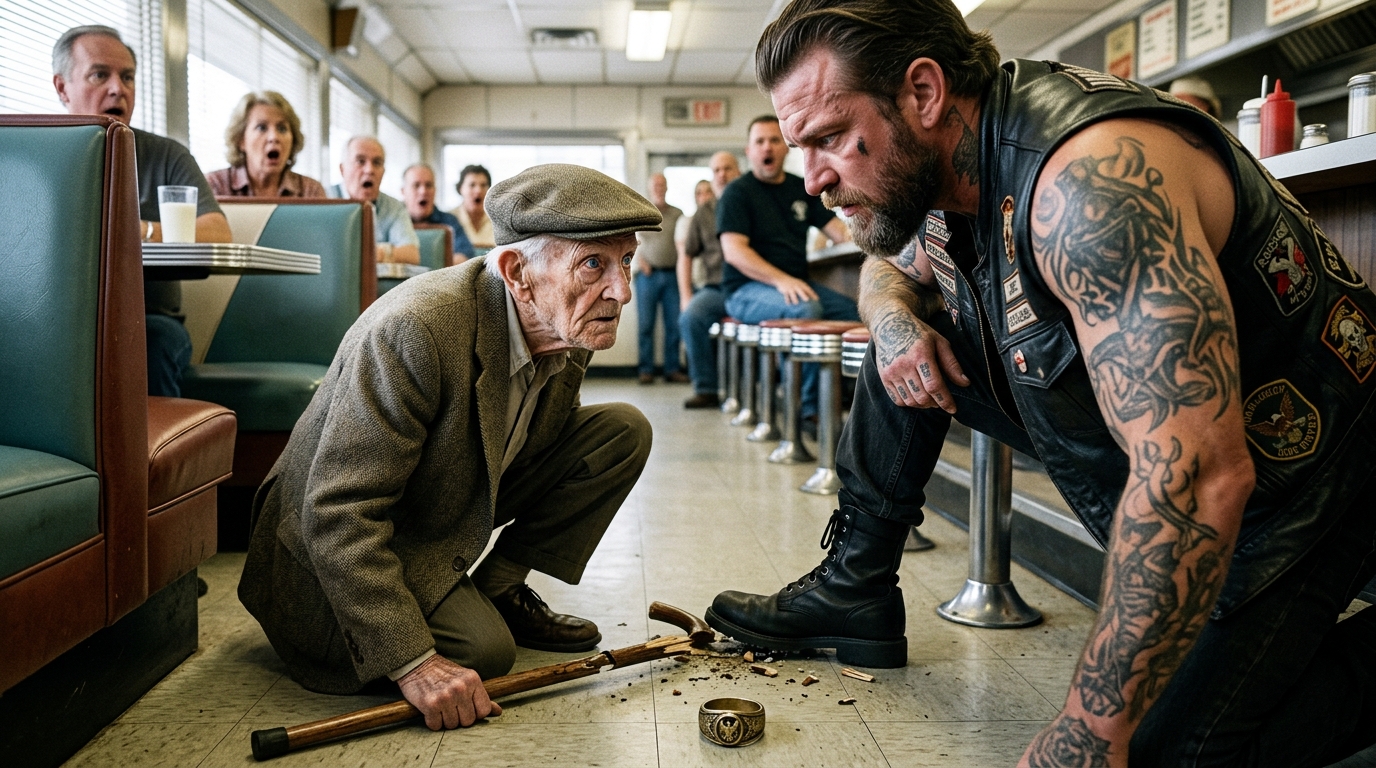
The old man lay on the linoleum floor beside table three.
Frail.
Thin.
White-haired.
One hand braced against the tiles.
His walking cane had rolled away when he fell, and now it lay beneath a heavy black boot.
The biker wearing that boot was named Vince Rourke.
At least, that was the name stitched on the leather vest stretched across his broad back.
He was huge, tattooed up both arms, with a shaved head, a thick beard, and a grin that made people instinctively lower their eyes. His motorcycle club patch showed a black serpent coiled around a red blade.
The Serpent Kings.
Everyone in Millstone County knew better than to stare at that patch.
Vince looked down at the old man.
Then slowly pressed his boot harder.
The cane cracked.
A small gasp moved through the diner.
Then—
Snap.
The walking stick split beneath his heel.
The old man’s fingers twitched against the floor.
Vince laughed.
“Guess you’ll have to crawl now.”
A few of his friends chuckled.
Not loudly.
Even they seemed unsure.
The old man had done nothing except enter the diner during the lunch rush, moving slowly between tables, one careful step at a time. He had asked for black coffee and toast. He had lowered himself into a booth near the window with visible effort.
Then Vince’s chair had been in the aisle.
The old man’s cane had tapped it lightly.
Not struck.
Tapped.
“Excuse me,” the old man had said.
Vince had turned as if insulted by the existence of age itself.
And now the old man was on the floor.
His cane shattered.
The diner silent.
Vince leaned closer, his voice dropping into something uglier than shouting.
“You should watch where you’re going, grandpa.”
The old man slowly raised his head.
His face was pale from pain, but his eyes were clear.
Ancient blue.
Cold.
Not afraid.
Something in those eyes made Vince’s grin twitch.
Then a small metallic sound broke the silence.
Clink.
Something had fallen from the broken cane.
It rolled once across the linoleum and stopped near Vince’s boot.
A ring.
Dull gold.
Old.
Heavy.
Not jewelry for display.
A signet.
Engraved with a symbol nearly worn smooth by time.
A raven with one wing spread over a five-pointed star.
Vince’s gaze dropped to it.
His smirk vanished.
Not faded.
Vanished.
The blood drained from his face so fast even the waitress noticed.
One of the bikers behind him stood halfway.
“Vince?”
Vince did not answer.
He stared at the ring like it had opened a grave beneath his feet.
The old man reached for it.
His hand shook, but not from fear.
Vince stepped back.
Actually stepped back.
The room saw it.
The cruel man who had laughed at a fallen elder now looked as if he had stumbled into something far older, deeper, and more dangerous than a diner fight.
The waitress whispered, “What is that?”
The old man closed his fingers around the ring.
Then looked up at Vince.
His voice was soft.
But it carried to every corner of the diner.
“You know what this means.”
Vince swallowed.
His throat bobbed.
“I didn’t know it was you.”
The old man’s eyes did not blink.
“No,” he said. “You didn’t.”
The diner stayed frozen.
Because everyone understood, all at once, that Vince Rourke had not just broken an old man’s cane.
He had broken open a secret he had spent years running from.
The Man With The Raven Ring
The old man’s name was Arthur Bell.
Most people in Millstone knew him as Mr. Bell from the north road.
A widower.
A quiet man.
A veteran, maybe, though no one knew from which war because he never wore medals or told stories over coffee like some old men did.
He lived alone in a small white house at the edge of town, where the fields turned into pine woods and the road narrowed toward the abandoned quarry. Every morning, weather permitting, he walked two miles to Marla’s Diner, ordered black coffee, buttered toast, and one boiled egg.
He tipped exactly two dollars.
Always folded once under the saucer.
He spoke little.
Thank you.
Morning.
Rain coming.
That was usually it.
People mistook quiet for emptiness.
They often do.
But Arthur Bell had once been the kind of man whose name traveled in rooms where no one raised their voice.
Before the cane.
Before the limp.
Before the white hair and careful steps.
He had been Arthur Bellamy, a decorated investigator with the state attorney general’s organized crime division, known in confidential files as Raven One.
The raven signet ring had not been an official badge.
Official badges could be copied.
Flashed.
Stolen.
The ring belonged to a small task force formed thirty-eight years earlier to dismantle a network of corrupt sheriffs, outlaw clubs, stolen freight brokers, and judges who knew how to look away profitably.
Five investigators.
One prosecutor.
One undercover marshal.
They called themselves the Raven Unit because ravens remember faces, return to old places, and feed on what the powerful try to leave buried.
Arthur hated the nickname.
But the work mattered.
For six years, the Raven Unit did what no county office had been able or willing to do. They followed money through salvage yards and truck stops. They linked warehouse fires to insurance fraud. They found bodies in quarry pits and names in ledgers. They put away men who believed rural counties were too poor, too scared, and too connected to ever fight back.
Then came the Millstone massacre.
That was what newspapers called it later.
The case involved the Iron Saints motorcycle club, a predecessor to the Serpent Kings. A stolen arms shipment had vanished between a military depot and a private contractor warehouse. Three deputies were bribed. A judge buried warrants. A shipping manager disappeared.
The Ravens got close.
Too close.
An informant named Caleb Rourke came forward.
Vince’s father.
Caleb was not innocent. He had ridden with the Iron Saints for fifteen years, moved guns, collected debts, broken knees, and delivered threats. But after the club killed a teenager mistaken for a rival courier, Caleb broke.
He contacted Arthur.
“I got a boy,” Caleb said in a motel room outside Trenton, rain hammering the roof. “He’s nine. He still thinks I fix motorcycles for a living. I want him out before he learns my hands.”
Arthur remembered the boy.
Vince.
Small then.
Dark-eyed.
Sitting in the motel office with a soda and a comic book while his father traded secrets for a chance at witness protection.
Caleb gave them ledgers, routes, names, and one coded storage map hidden inside a cane made by his father.
That cane.
Arthur’s cane.
The one Vince had just shattered beneath his boot.
During the final operation, the Iron Saints were supposed to be arrested at a warehouse outside Millstone.
But someone leaked the raid.
Gunfire erupted before the Ravens arrived.
Two investigators died.
Caleb Rourke was shot in the back while trying to get his son out through a service door.
Arthur found Vince hiding beneath a workbench, hands over his ears, his father’s blood on his jacket.
Arthur carried him out.
That was the part no file recorded cleanly.
A boy screaming for a criminal father.
An investigator holding him while flames rose behind them.
Caleb died in Arthur’s arms before the ambulance arrived.
His last words were not about forgiveness.
They were about the cane.
“Keep it,” he rasped. “Until the boy is old enough to know where not to go.”
Arthur kept it.
He also kept the raven ring hidden inside the cane’s hollow handle, along with the final piece of the coded map Caleb had never finished explaining.
After the raid, the Iron Saints fractured, but not all of them went to prison.
One man escaped.
Silas Morrow.
Club treasurer.
Informant handler.
The man Arthur believed had leaked the operation and ordered Caleb killed.
There was never enough evidence.
Morrow vanished into freight work, then private security, then real estate, then respectable business.
Years later, the Serpent Kings appeared in Millstone County.
Different patch.
Same routes.
Same fear.
And leading their local crew was Vince Rourke.
Caleb’s son.
Arthur watched from a distance.
He saw the boy become the very thing his father had died trying to prevent.
He wanted to intervene.
But what do you say to a grown man who has built his life around hating the people who failed to save him?
I carried you from the fire.
Your father tried to change.
The men you follow killed him.
Arthur told himself the time would come.
Then his wife got sick.
Then the limp worsened.
Then files went cold.
Then years taught him that some promises do not disappear.
They wait inside broken things.
The Diner That Went Silent
Vince Rourke did not recognize Arthur at first.
Why would he?
The man who pulled him from the warehouse fire had been forty-two, broad-shouldered, black-haired, moving through smoke with blood on his face and a pistol in one hand.
This man was eighty.
Bent.
Thin.
Supported by a cane.
But Vince knew the ring.
Every child raised around outlaw clubs knows symbols before they understand words.
The raven and star.
The mark his father had cursed and then whispered about.
The ring appeared in old stories, half threat, half legend.
Raven Unit.
The men who broke the Iron Saints.
The men blamed for Caleb Rourke’s death by every criminal who needed the truth buried.
Vince had grown up hearing that Ravens were traitors, liars, state dogs.
He had also heard, once, from an old mechanic drunk enough to forget fear, that a Raven carried little Vince out alive.
The mechanic disappeared two days later.
Vince never asked again.
Now the ring lay in Arthur Bell’s hand.
And Vince suddenly remembered smoke.
A man’s arm around him.
A voice saying, “Keep your eyes closed, son.”
He stepped back from the broken cane.
“Who are you?” he whispered.
Arthur slowly pushed himself up on one elbow.
His face tightened with pain.
Marla, the diner owner, rushed forward.
“Mr. Bell, don’t move. I’m calling an ambulance.”
Arthur lifted one hand.
“Not yet.”
Vince looked around.
Everyone was watching him now.
Not with fear of him.
With fear for what he had done.
He hated that.
So he reached for anger because anger was familiar.
“You think some old ring means something to me?”
Arthur’s eyes held his.
“It did a moment ago.”
One of Vince’s men, a wiry biker named Nash, stepped closer.
“Boss, let’s go.”
Vince snapped, “Shut up.”
Arthur looked at Nash.
Then at the other two.
His gaze lingered on their patches.
Serpent Kings.
A black serpent around a red blade.
“Morrow’s design,” Arthur said.
Vince’s head turned sharply.
“What did you say?”
Arthur slid the ring onto his finger.
It fit loosely now.
“Silas Morrow always liked snakes. Said ravens were only useful once something was already dead.”
Vince’s face hardened.
“You don’t know Silas.”
“I knew him before you knew how to spell your name.”
The diner seemed to shrink around them.
Marla stood near the counter, phone in hand, not yet dialing because she sensed the story had not finished opening.
Vince’s voice lowered.
“You were there.”
Arthur nodded.
“Yes.”
“My father died because of you.”
“No.”
The word was quiet.
Final.
Vince stepped forward.
Arthur did not flinch.
“Say that again.”
Arthur looked at him with tired, merciless eyes.
“Your father died because Silas Morrow sold him out.”
Nash cursed under his breath.
Vince’s hand closed into a fist.
“You lying old—”
Arthur reached toward the broken cane.
The hollow shaft had split open. A narrow metal tube lay inside the wood, dark with age, sealed at both ends.
Vince stared at it.
“What is that?”
Arthur picked it up.
“Your father’s last insurance.”
Vince’s anger flickered.
The diner door opened behind them.
Two deputies entered, likely responding to Marla’s earlier panic call from the kitchen after she saw Vince harassing Arthur.
The first deputy stopped when he saw Vince.
Everyone in Millstone knew the Serpent Kings.
The second deputy’s hand moved to his belt.
Arthur held up the metal tube.
“No one moves.”
That should not have worked.
But it did.
Even the deputies paused.
Arthur looked at Vince.
“Caleb hid records before the warehouse raid. Names. Payment routes. Storage locations. He gave me part of it. Said the rest was in the cane if anything happened.”
Vince’s breathing changed.
Arthur continued.
“I never opened it.”
“Why not?”
“Because after the raid, the remaining files were buried. Witnesses vanished. My unit was dismantled quietly. Morrow had protection higher than we knew.”
He looked down at the broken cane.
“And because I promised your father I would not bring the boy back into blood until he was old enough to choose differently.”
Vince stared at him.
The words landed somewhere behind all the tattoos and years of violence.
Then Nash spoke.
“Boss, he’s playing you.”
Arthur looked at Nash again.
“No. He is.”
Vince turned.
“What?”
Arthur’s eyes narrowed.
“Your friend there has Morrow’s old prison ink on his wrist.”
Nash went still.
The diner looked at his wrist.
A faded symbol beneath his sleeve.
A tiny red blade.
Arthur’s voice hardened.
“Silas sent someone to watch you, didn’t he?”
Nash lunged.
Not at Arthur.
At the metal tube.
Vince moved first.
He grabbed Nash by the collar and slammed him into the counter so hard coffee cups jumped.
The deputies drew their weapons.
Marla screamed.
Nash spat blood and laughed.
“You stupid son of a traitor,” he hissed. “Morrow said you’d crack if someone showed you Daddy’s ghost.”
Vince’s face went white.
Arthur closed his hand around the tube.
The diner, which had watched an old man humiliated minutes before, now watched a criminal network begin to unravel over broken wood and an old ring.
The Cane That Held A Map
The ambulance took Arthur to County General with a bruised hip, a fractured wrist, and a blood pressure reading that made the paramedic mutter things under his breath.
Vince followed.
Not in the ambulance.
In handcuffs, at first.
Then not.
The deputies detained Nash after finding a concealed knife and a phone containing encrypted messages with someone listed only as S.M.
Vince had assaulted Arthur, yes.
He had also stopped Nash from seizing evidence.
The legal difference was messy.
The emotional one was worse.
Arthur refused pain medication until the metal tube was placed in the hands of Detective Elena Cross, the only investigator in Millstone County he still trusted.
Elena was forty, sharp-eyed, and had spent three years trying to connect the Serpent Kings to freight thefts, fentanyl movement, illegal gun storage, and a series of suspicious fires. Every time she got close, witnesses stopped talking.
When she saw the raven ring on Arthur’s finger, she looked at him differently.
“My grandfather talked about you,” she said.
Arthur winced as the doctor wrapped his wrist.
“Kindly?”
“Not always.”
“Smart man.”
Detective Cross opened the metal tube under evidence recording.
Inside was a rolled strip of oilcloth.
A microfilm sleeve.
And a small handwritten note.
Arthur recognized Caleb Rourke’s handwriting immediately.
If Raven One has this, I’m dead or running. Morrow keeps two books. The public one in the shop. The real one under Saint Jude at the quarry chapel. Don’t trust Judge Harlan. Don’t trust Deputy Briggs. Get my boy out.
Vince stood behind the glass partition, watching through the open blinds of the hospital conference room.
He could not hear every word.
He saw enough.
Arthur looked through the glass at him.
Vince looked away.
The oilcloth contained a coded map of the abandoned quarry north of town. Not the main pit, which had filled with rainwater decades earlier, but the old chapel built by immigrant miners before the county existed. Saint Jude’s Chapel had burned, been rebuilt, abandoned, vandalized, and mostly forgotten.
Under Saint Jude.
Detective Cross sent a team that night.
Arthur insisted on going.
The doctor said absolutely not.
Arthur said several things that made the nurse threaten to sedate him.
In the end, he went in the passenger seat of Cross’s unmarked car with his wrist in a brace and pain making his face gray.
Vince came too.
That was Cross’s decision.
Arthur objected.
Cross ignored him.
“If this is a trap, I want to see who tries to kill him,” she said.
Vince sat in the back seat, silent.
For the first ten minutes, no one spoke.
Then Vince said, “Did my father really give you that cane?”
Arthur looked out at the dark road.
“Yes.”
“Why would he trust you?”
“He didn’t at first.”
“Then?”
“He decided saving you mattered more than hating me.”
Vince’s jaw worked.
Arthur continued.
“He was not a good man. But near the end, he tried to do one good thing.”
Vince laughed bitterly.
“Funny. No one told me that part.”
“No. They needed you angry.”
Vince looked at him through the rearview mirror.
“And you? Why didn’t you tell me?”
Arthur’s eyes closed briefly.
That question had waited thirty years.
“Because I was injured. Because the unit was broken. Because your guardians refused contact. Because Morrow’s people were watching. Because I told myself later would be safer.”
He opened his eyes.
“And because I was a coward in the shape of a patient man.”
Vince said nothing.
The quarry road appeared through the trees.
Detective Cross killed the headlights before the final bend.
The old chapel stood beyond the pit, half-collapsed, moonlight cutting through the broken roof. Saint Jude’s statue remained in a niche at the back, faceless from weather and vandalism, one hand missing.
Cross’s team had already secured the perimeter.
Beneath the statue, behind a stone panel, they found a rusted lockbox wrapped in tar cloth.
Inside were ledgers.
Photographs.
Bank routing numbers.
Names.
Judges.
Deputies.
Sheriff’s staff.
Freight brokers.
Club officers.
Payments from Silas Morrow going back decades.
And more recent entries.
Serpent Kings.
Vince Rourke listed as local president.
Nash listed as “Morrow oversight.”
Arthur watched Vince read that line.
Something in the biker’s face emptied.
“Morrow was using me.”
Detective Cross said nothing.
Vince turned pages with shaking hands.
There were payments tied to illegal shipments he had authorized without knowing the contents.
Protection fees.
Debt collections.
Fire orders.
Names of businesses pressured into laundering freight revenue.
Then one entry made Vince stop completely.
C. Rourke termination bonus.
Date: the day after the warehouse raid.
Paid to S. Morrow by Harlan judicial channel.
Vince stared.
His father had not died in crossfire because of a botched raid.
He had been paid for.
Sold.
Executed for trying to save him.
Arthur stepped closer.
“I am sorry.”
Vince’s face twisted.
“For what?”
“For not finding a way to give you this sooner.”
Vince’s laugh broke halfway.
“I broke your cane.”
“Yes.”
“I knocked you down.”
“Yes.”
“I called you—”
“I remember.”
Vince looked at him.
“Why are you apologizing to me?”
Arthur’s eyes were tired.
“Because your father trusted me with the truth. I kept it safe. That is not the same as using it in time.”
The old chapel was silent around them.
Then a radio crackled.
One of Cross’s officers spoke sharply.
“Movement east side. Two vehicles approaching.”
Detective Cross drew her weapon.
Arthur closed the ledger.
Vince looked toward the dark tree line.
He knew before anyone said it.
Silas Morrow had come for his books.
The Man Who Thought Fear Still Worked
Silas Morrow arrived in a black SUV with three men and a confidence built over decades of going unpunished.
He was seventy now, but age had not softened him.
It had only dried him out.
Thin face.
Silver hair slicked back.
Eyes flat as old coins.
He stepped into the broken chapel with his hands visible, smiling as if he had come to settle a property dispute.
“Elena Cross,” he said. “Still digging in other people’s graves.”
Detective Cross kept her weapon aimed low but ready.
“Silas Morrow.”
His gaze moved to Arthur.
For the first time, the smile faded.
“Well,” Morrow said. “Raven One.”
Arthur looked at him.
“Still afraid of dead birds?”
Morrow chuckled.
“I heard you were living on toast and coffee.”
“I heard you were respectable.”
“Both rumors exaggerated, apparently.”
Then Morrow saw Vince.
His expression shifted into something almost paternal.
“Vincent.”
Vince stared at him.
“You killed my father.”
Morrow sighed.
Arthur recognized the performance immediately.
Grief management.
Control through disappointment.
“Your father betrayed everyone who ever stood beside him.”
“He tried to get me out.”
“He tried to sell us to save himself.”
Vince lifted the ledger.
“You paid to have him killed.”
Morrow’s eyes flicked to the lockbox.
Then to Detective Cross’s body camera.
He smiled faintly.
“Old paper. Old stories. Hardly admissible without context.”
Detective Cross said, “Then you won’t mind letting us keep it.”
One of Morrow’s men shifted.
Vince recognized him.
A Serpent King from the northern chapter.
Another piece clicking into place.
“How long?” Vince asked.
Morrow tilted his head.
“How long what?”
“How long have you had people in my crew?”
Morrow looked almost amused.
“Vincent, it was never your crew.”
The words struck harder than any punch.
Morrow continued.
“You were useful. Caleb’s boy wearing leather, snarling at the world, keeping local fear alive. Sentimental, really.”
Vince’s hands closed.
Arthur stepped slightly between him and Morrow.
“Don’t.”
Vince’s voice was low.
“Move.”
“No.”
“He deserves—”
“He deserves a courtroom.”
Morrow laughed.
“You still believe in those?”
Arthur turned the raven ring on his finger.
“I believe in records. Witnesses. Cameras. And old men who finally stop waiting.”
Detective Cross’s radio crackled again.
“Backup two minutes out.”
Morrow heard.
His smile thinned.
Then everything moved.
One of Morrow’s men lunged toward the lockbox.
Vince tackled him into a broken pew.
Another drew a gun.
Cross fired first, striking the man’s shoulder.
The chapel erupted into shouts, dust, and splintering wood.
Arthur, injured and old but not helpless, swung the metal tip of his broken cane into the knee of the third man as he rushed forward. The man collapsed with a scream.
Morrow backed toward the side exit.
Vince saw him.
So did Arthur.
For one second, both men moved.
Arthur was too slow.
Vince was not.
He caught Morrow at the doorway and slammed him against the stone wall.
Morrow gasped.
Vince’s forearm pressed against his throat.
“You raised me on a lie.”
Morrow choked, but managed a smile.
“I raised you strong.”
Vince’s eyes burned.
“No. You raised me useful.”
Morrow’s hand moved toward a knife at his belt.
Arthur shouted.
“Vince!”
Vince caught the wrist just in time.
The knife clattered to the floor.
By then, sirens were rising through the quarry road.
Red and blue light flashed across the chapel walls.
Morrow looked past Vince at Arthur.
“You think this fixes anything?”
Arthur picked up the ledger with his good hand.
“No.”
Then he looked at Vince.
“But it starts telling the truth.”
Morrow was arrested in the chapel beneath the faceless statue of Saint Jude, patron of lost causes.
Arthur found that appropriate.
Vince did not speak as officers cuffed the man who had shaped his life around revenge aimed in the wrong direction.
Only when Morrow was led away did Vince turn to Arthur.
“I don’t know what I am now.”
Arthur leaned on what remained of the cane.
“No one does at first.”
Vince looked at the broken wood.
“I’ll replace it.”
Arthur looked down.
“No.”
Vince frowned.
Arthur’s face softened slightly.
“That cane did its last job.”
The Diner Where The Apology Happened
The arrests tore Millstone County open.
Silas Morrow’s ledgers named men who had spent thirty years being called honorable.
A retired judge.
Two former deputies.
A sitting county commissioner.
Three freight company owners.
A bank officer.
Several Serpent Kings officers.
Businesses once afraid to report extortion came forward after Detective Cross released a statement confirming federal protection for witnesses. The state reopened cold cases tied to the Iron Saints and later Serpent Kings. Families who had been told old deaths were accidents began demanding records.
Nash took a deal.
Not from remorse.
From terror.
His testimony tied Morrow to recent trafficking routes and historic murders, including Caleb Rourke’s execution.
Vince was arrested too.
He expected that.
He had committed crimes.
Debt collection.
Assault.
Intimidation.
Freight theft.
He did not pretend otherwise.
But he cooperated fully, turning over club records, storage locations, and names of those still loyal to Morrow. His cooperation did not erase harm. It reduced some charges, not all. He served time.
Before sentencing, he asked for one meeting.
Not with the prosecutor.
Not with Detective Cross.
With Arthur Bell.
They met at Marla’s Diner.
Same booth.
Same floor, though the linoleum had been scrubbed so hard the tiles near table three looked lighter than the rest.
Arthur arrived with a new cane he clearly hated.
Vince stood when he entered.
He looked different without the vest.
Still broad.
Still tattooed.
But stripped of the costume that had taught people how to fear him.
Marla watched from behind the counter, pretending not to.
Arthur lowered himself into the booth.
Vince remained standing.
“Sit,” Arthur said.
Vince sat.
For a while, neither spoke.
Then Vince placed something on the table.
A piece of polished wood.
Dark walnut.
Carved by hand.
The handle of a cane.
Inside the handle, set beneath smooth resin, was a small strip of the old shattered cane.
Arthur looked at it.
Vince’s voice was rough.
“I made it in the county workshop.”
Arthur touched the wood lightly.
“You always carve?”
“My father did.”
Arthur looked up.
Vince swallowed.
“I didn’t remember that until lately.”
Marla poured coffee without asking.
Then walked away quickly.
Vince stared into his cup.
“I’m not asking forgiveness.”
“Good.”
That startled him.
Arthur’s mouth twitched.
“Forgiveness is not a coupon you request before sentencing.”
Vince almost smiled.
Then did not.
“I hurt people.”
“Yes.”
“I scared people who had nothing to do with Morrow.”
“Yes.”
“I became exactly what my father tried to stop.”
Arthur did not soften the truth.
“Yes.”
Vince looked at him.
“But he wasn’t what they told me.”
“No.”
“He tried to save me.”
“Yes.”
Vince closed his eyes.
When he opened them, they were wet.
“I don’t know what to do with that.”
Arthur took the cane handle and slid it back across the table.
“Carry it differently.”
Vince stared.
“I made it for you.”
“No,” Arthur said. “You made it because you needed your hands to do something other than damage. Keep it.”
Vince looked down.
The old man continued.
“When you get out, you will have choices. Bad ones will recognize you first. They always do. Make them wait.”
Vince’s jaw tightened.
“Why do you care?”
Arthur looked toward the window.
Because I carried you once.
Because your father asked.
Because old promises rot if never opened.
Instead, he said, “Because enough men have profited from you being angry.”
Vince lowered his head.
Sentencing came two weeks later.
Vince received prison time, but also a structured cooperation agreement and mandatory restitution. Some victims objected. They had that right. Vince listened to them in court without looking away.
Arthur testified briefly.
He did not call Vince a good man.
He did not call him redeemed.
He said only, “He is a man who was fed a lie young and chose violence from it. Now he has told the truth at cost to himself. Both facts matter.”
The judge considered that.
So did Vince.
Years passed.
Arthur kept walking to Marla’s Diner, though shorter distances now. Detective Cross visited often, usually under the pretense of coffee. Marla replaced the broken cane’s metal tube with a framed copy of the ledger note above the counter after the case ended.
Arthur hated that too.
Marla ignored him.
Beneath it, she placed a small sign:
DO NOT MISTAKE QUIET FOR WEAK.
People asked about it.
Sometimes Arthur answered.
Usually he did not.
Vince was released after serving his sentence.
He did not return to the Serpent Kings.
There were barely any left to return to.
He took work in a carpentry shop outside the county, then later started a small program teaching woodwork to boys coming out of juvenile detention.
The first thing he taught them was how to make a cane.
“Why canes?” one boy asked.
Vince ran sandpaper along a smooth piece of ash wood.
“Because people lean on things,” he said. “You should know how to make something that holds.”
On the anniversary of the diner incident, Vince returned to Millstone.
He walked into Marla’s at lunch.
The room went quiet at first.
Old fear has muscle memory.
Vince accepted it.
He walked to Arthur’s booth and stood beside it.
Arthur looked up from his coffee.
“You’re blocking my light.”
Vince set a new cane against the table.
This one was simple.
Strong.
No hidden compartment.
No symbols.
Just good wood, shaped well.
“For you,” Vince said.
Arthur studied it.
Then him.
“Any secrets inside?”
“No.”
“Good. I’m too old for secrets.”
Marla snorted from behind the counter.
Arthur took the cane.
This time, he kept it.
The Ring That Returned Home
Arthur died three winters later.
Not dramatically.
Not violently.
Not in a blaze of old glory.
He fell asleep in his chair beside the window, the new cane within reach, the raven ring on the table beside a half-finished cup of tea.
Marla found him when he did not come for breakfast.
The funeral was small at first.
Then it grew.
Detective Cross came.
State investigators.
Old agents from the dismantled Raven Unit, fewer than anyone expected.
Families from reopened cases.
A woman whose father’s death had finally been reclassified.
A man whose business had been freed from Serpent King debt.
Marla brought coffee in a thermos and cried angrily whenever anyone tried to comfort her.
Vince stood near the back.
No leather vest.
Dark suit.
Hands folded.
He had not been sure he should come.
Detective Cross saw him and nodded once.
That helped.
After the service, Arthur’s attorney approached Vince.
“You’re Mr. Rourke?”
Vince braced himself.
“Yes.”
“He left you something.”
Vince frowned.
The attorney handed him a small wooden box.
Inside was the raven ring.
And a note.
Vince read it standing under a bare oak tree while winter wind moved across the cemetery.
Your father hid the truth in wood. I hid from it in time. You broke the cane and freed us both from our excuses.
This ring does not make you a Raven. It does not make you clean. Symbols do not absolve men.
But it is proof that a man may inherit a lie and still choose not to pass it on.
Carry truth better than we did.
A.B.
Vince closed the box.
His throat worked.
Marla appeared beside him.
“He was annoyingly fond of you.”
Vince gave a broken laugh.
“He had a terrible way of showing it.”
“So do most old men.”
He looked at her.
“I don’t deserve this.”
Marla’s eyes softened.
“Probably not.”
He nodded.
She continued.
“But deserving is not always the point of a burden.”
Years later, people still told the story of the biker who shattered an old man’s cane in a diner, only to go pale when a hidden ring rolled onto the floor.
Some versions made Arthur a secret mob boss.
Others claimed the ring belonged to a lost military order.
A few said Vince vanished that night and was never seen again.
Small towns are terrible at leaving truth alone.
The real story was less clean.
An old investigator kept a dead informant’s promise too late.
A boy grew into a violent man because a lie gave his grief somewhere to point.
A criminal empire survived by teaching children false history.
A cane broke.
A ring fell.
A diner saw fear change direction.
And for once, a mistake did not stay buried under pride.
Vince kept the raven ring in the carpentry shop, locked in a glass case near the first cane he ever made. He showed it only to boys who were ready to hear the story without turning it into legend.
“This,” he would say, “is not power.”
They always looked disappointed.
Teenage boys often prefer power.
Vince would tap the glass.
“This is consequence. This is memory. This is what happens when the thing you thought made you strong turns out to be the thing someone else used to steer you.”
Sometimes, if a boy was quiet enough, he told them about Caleb Rourke.
Not as a hero.
Not as a monster.
As a man who did terrible things and then tried, too late but truly, to save his son from becoming his echo.
He told them about Arthur Bell.
The old man he knocked down.
The old man who told the truth anyway.
The old man who could have hated him cleanly and chose something harder.
And he told them about the diner.
The laughter that did not last.
The silence after the ring fell.
The moment Vince saw dread in his own reflection and understood that humiliation is a weapon that often turns in the hand.
On the wall above the workshop door, Vince hung a sign.
MAKE SOMETHING THAT HOLDS.
He meant wood.
He meant promises.
He meant boys.
He meant himself.
Every so often, he returned to Marla’s Diner.
He always sat at table three.
He always ordered black coffee and toast.
He always tipped two dollars, folded once under the saucer.
Marla pretended not to notice.
One afternoon, a young biker passing through town laughed at an elderly man struggling near the door.
Not cruelly at first.
Just careless.
Vince stood.
The room quieted.
He walked over, picked up the man’s cane from where it had slipped, and handed it back.
Then he looked at the young biker.
“Careful,” Vince said.
The young man frowned.
“With what?”
Vince’s hand moved unconsciously toward the scarred place on his wrist where the old club ink had been covered by a raven feather tattoo.
“With what you think is funny.”
The biker looked away.
The old man nodded his thanks and moved toward a booth.
Vince returned to his coffee.
Outside, motorcycles passed on the highway, loud and temporary.
Inside, the diner settled back into the ordinary music of plates, cups, soft conversation, and footsteps.
Arthur Bell’s framed note remained above the counter.
DO NOT MISTAKE QUIET FOR WEAK.
The raven ring stayed locked away miles down the road, but Vince felt its weight anyway.
Not on his finger.
In the choices it left behind.
He had once broken a cane to prove an old man helpless.
Instead, he broke the hiding place of the truth.
And when that small gold ring clinked against the diner floor, it did not make Arthur powerful.
It made Vince responsible.
That was far more dangerous.
And far more necessary.