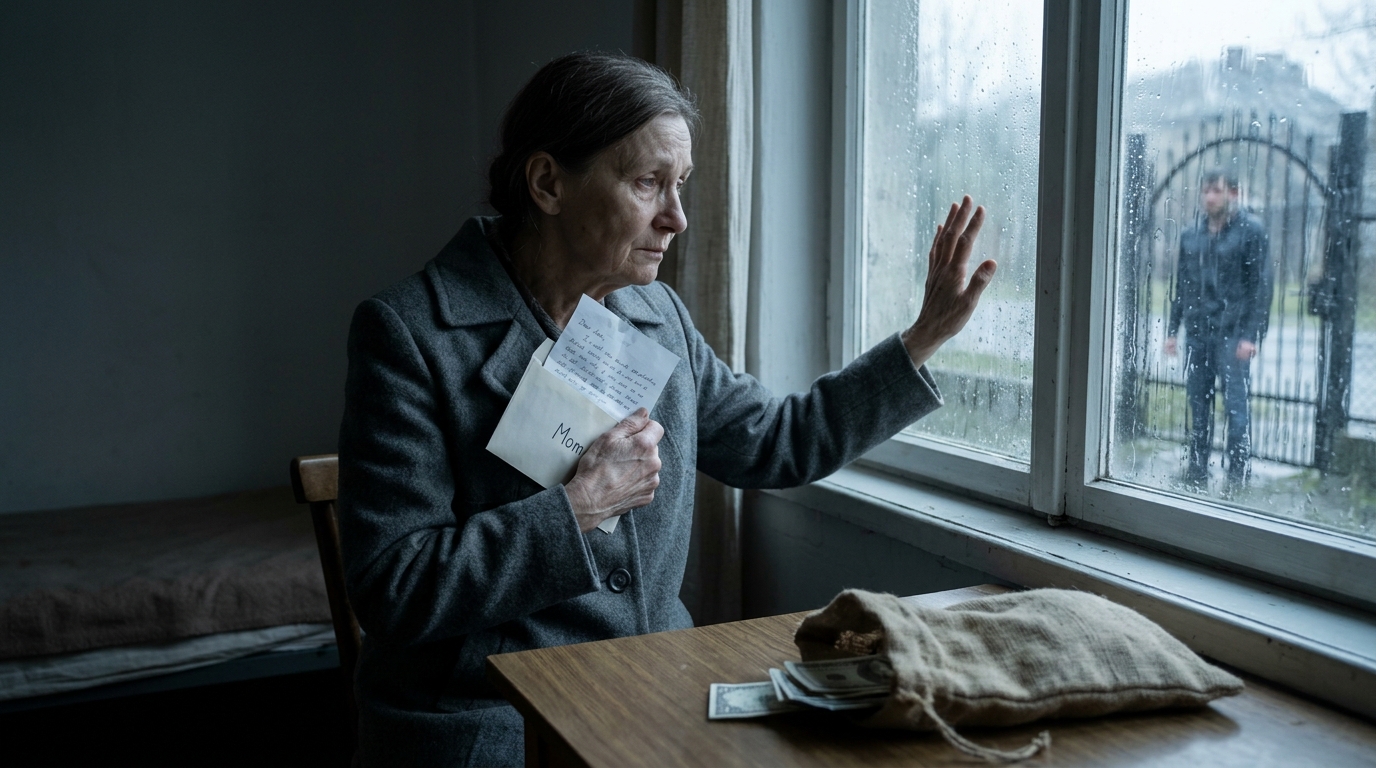
The rain made everything look harsher than it already was.
The black iron gate rattled in the wind.
Water ran down the stone path in thin silver streams, slipping between the cracks, gathering near the roots of the old magnolia tree, soaking the hem of the elderly woman’s gray coat.
Mara Whitfield stood outside her son’s house with both hands clasped in front of her.
She was seventy-two years old.
Small now.
Smaller than she had been when Elias was young and still believed his mother could fix anything with soup, thread, and a stern look.
Her shoulders bent from years of carrying too much without complaint. Her hair, once dark and thick, was pinned beneath a damp wool scarf. Rain slid down the deep lines of her face, though not all the wetness there came from the sky.
In front of her stood her son.
Elias Whitfield.
Forty-three.
Broad-shouldered.
Soaked through his black jacket.
His jaw was tight, his eyes fixed somewhere past her left shoulder as if looking directly at his mother might break whatever cruel shape he was forcing himself to hold.
Behind him, in the doorway of the large white house, his wife watched.
Claire.
Young, beautiful, and still as a knife.
She stood with one hand resting against the doorframe, her pale silk blouse untouched by rain, her expression unreadable except for the sharpness around her eyes.
Mara saw her.
Of course she did.
Mothers notice the person their child is afraid to look at.
Elias stepped forward quickly.
Too quickly.
He shoved a heavy burlap sack into Mara’s arms.
She gasped and nearly lost her balance. The sack struck her chest hard enough to make her stumble back, one shoe slipping on the wet stone.
Elias reached out instinctively.
Then stopped himself.
His hand hovered for half a second before dropping to his side.
“Take the rice and go, Mom.”
The words were rough.
Too rough.
Like stones thrown by someone who hated the sound of them leaving his own mouth.
Mara looked at him.
“Elias…”
“Go.”
His voice cracked at the edge.
A tiny fracture.
One he tried to hide beneath the rain, beneath the anger, beneath Claire’s silent presence in the doorway.
Mara clutched the sack to her chest.
It was heavier than rice should have been.
Not by much.
Enough.
She knew then.
Not what was inside.
But that something was wrong.
Still, she nodded once.
Not because she believed his cruelty.
Because mothers sometimes accept cruelty gently when they recognize it is only pain wearing the wrong face.
Claire shifted in the doorway.
The movement was small, but Elias reacted to it.
His shoulders stiffened.
His face hardened again.
“I said go.”
Mara swallowed.
“Yes,” she whispered. “I heard you.”
He flinched.
Just once.
Then looked away.
So Mara turned and walked down the slick stone path, through the iron gate, into the rain, carrying the sack with both arms.
She did not look back until she reached the corner.
When she did, Elias was still standing by the gate.
Claire had gone inside.
He was alone.
His head was bowed.
Rain ran from his hair down his face, but Mara knew her son’s tears from weather.
She raised one hand toward him.
He did not see.
Or maybe he did and could not bear to answer.
Then he turned toward the house.
And as he lifted his hand to wipe his face, Mara saw something that made the cold air vanish from her lungs.
His wedding ring was gone.
The Note Beneath The Grain
Mara lived in one room behind the old laundromat on Parker Street.
It was not where Elias wanted her to live.
That was the part outsiders never understood.
They saw the rich son and the poor mother and built easy stories from the distance between them.
Ungrateful son.
Proud mother.
Greedy wife.
Bitter family.
Some of those things were partly true.
None of them were the whole truth.
The room was simple.
A narrow bed.
A wooden table.
A kettle with a chipped handle.
A single framed photograph of Elias at eight years old, missing his front tooth, holding a paper airplane he had insisted would fly to the moon if the wind was in a good mood.
Mara shut the door behind her and leaned against it, breathing hard.
The sack sagged in her arms.
Her coat dripped onto the floor.
For a moment, she just stood there.
Listening.
Rain tapped against the small window.
A pipe groaned in the wall.
Somewhere beyond the laundromat, a bus hissed at the corner stop and pulled away.
Mara lowered the sack onto the table.
Her hands shook as she untied the rope.
She expected rice.
She expected shame.
She expected the small dignity of cooking what her son had thrown at her like a beggar’s offering.
But no rice spilled out.
Inside the burlap was another cloth bag, smaller and dry, wrapped tight with twine.
She opened that too.
A white envelope lay on top.
On the front, in Elias’s handwriting, was one word.
Mom.
Mara’s breath caught.
She sat down slowly before her knees gave out.
For several seconds, she could not open it.
That handwriting pulled her backward too quickly.
To lunchbox notes.
School permission slips.
Bad birthday cards.
A teenage apology after he dented the neighbor’s fence with her car.
Elias had always pressed too hard with a pen.
As if every word needed to leave a mark.
She slid one finger beneath the flap.
Inside was a thick stack of cash.
More money than she had held in both hands in years.
And a folded note.
Her fingers trembled so badly she almost tore it unfolding it.
The first line broke her.
I’m sorry, Mom.
Tears filled her eyes at once.
She pressed the paper to her mouth.
Then forced herself to keep reading.
I couldn’t say it in front of her.
Mara looked toward the rain-dark window.
The room seemed to grow still around her.
She read on.
Claire has people watching the house. Maybe watching you too. I had to make it look like I was sending you away. I had to make her believe I chose her side. I didn’t.
Mara’s hand tightened around the paper.
Please listen carefully. Do not come back to the house. Do not call me from your phone. Do not trust anyone Claire sends. Take the money and go to the Greyhound station tomorrow morning. Locker 17. The key is inside the seam of the sack.
Mara stared at the burlap.
Her pulse thudded in her ears.
She turned the sack over and felt along the bottom seam.
Something hard pressed beneath the rough fabric.
She found a small tear, worked her fingers into it, and pulled out a brass key wrapped in plastic.
Locker 17.
Her son had planned this.
Not in panic.
In fear.
There is a difference.
She returned to the note.
There is a blue folder in the locker. It proves what she did. To Dad. To me. Maybe to others. If anything happens to me, take it to Detective Anya Cross. Not the local station. Not Father Paul. Not Claire’s lawyer. Only Anya Cross. Her number is in the folder.
Mara’s vision blurred.
Dad.
Elias’s father.
Thomas Whitfield.
Dead twenty-one years.
Or so Mara had believed.
The note continued.
I found out why Dad “died.” He didn’t die the way they said. Claire’s family was involved. I think she married me to find what he left behind.
Mara stood so suddenly the chair scraped backward.
“No,” she whispered.
The word meant nothing.
It stopped nothing.
She read the final lines.
I took off my ring today because I couldn’t wear it while lying to you. I’m sorry I hurt you. I’m sorry I waited so long. If I make it through tonight, I’ll come to you. If I don’t, remember this: I did not stop loving you. I was trying to keep you alive.
Your son,
Elias
Mara sank back into the chair.
The rain tapped harder.
Her son’s face appeared in her mind as he stood by the gate, soaked and crying, one hand bare where his ring had been.
She covered her mouth with both hands.
For years, she had told herself Elias had changed after marrying Claire.
That money had made him distant.
That the large house, the polished friends, the dinners where Mara felt like an unwanted relic, had pulled him away from the woman who raised him.
But now, looking at the cash, the key, the warning, and the note stained by her tears, Mara understood something far worse.
Her son had not abandoned her.
He had been trapped close enough for her to see and too far for her to reach.
A soft knock came at the door.
Mara froze.
Not the polite knock of a neighbor.
Not the quick tap of the laundromat owner checking the pipes.
Three slow knocks.
A pause.
Then two more.
Her eyes dropped to the note.
Do not trust anyone Claire sends.
The knock came again.
“Mara?” a woman’s voice called softly. “It’s Claire. I think Elias was too harsh with you. Can we talk?”
Mara’s blood went cold.
She looked at the sack.
The key.
The money.
The letter.
Then she quietly folded the note, tucked it inside her blouse, and reached for the old cast-iron pan hanging beside the stove.
Claire knocked again.
“Mara?”
Mara turned off the lamp.
And did not answer.
The Daughter-In-Law At The Door
Claire Whitfield had never raised her voice at Mara.
That was part of what made her frightening.
She was not cruel in obvious ways.
Obvious cruelty gives people something to point to.
Claire preferred softness sharpened at the edges.
“Mara, you must be exhausted.”
“Mara, you’re confused.”
“Mara, Elias worries when you upset yourself.”
“Mara, perhaps it’s time we discuss assisted living.”
Always Mara.
Never Mom.
Never Mrs. Whitfield.
Always her first name, spoken like a gentle correction.
When Elias first brought Claire home, Mara tried to like her.
She truly did.
Claire arrived with wine too expensive for the meal, flowers arranged by someone else, and a smile that revealed nothing behind it. She complimented Mara’s cooking, asked questions about Elias’s childhood, and touched his arm whenever he spoke, as if reminding everyone she had a claim.
After dinner, while Elias took out the trash, Claire stood beside Mara at the sink drying plates.
“You did everything alone?” Claire asked.
“After Thomas passed, yes.”
“How difficult.”
“It was.”
“And Elias never knew his father well?”
Mara paused.
“He knew enough to miss him.”
Claire smiled faintly.
“What exactly happened to Thomas?”
The question was ordinary.
The way she asked was not.
Mara told the story she had told for twenty-one years.
Thomas worked at Northline Quarry as a safety inspector. There had been a collapse in an old shaft after heavy rain. His body was recovered three days later, identified by his wedding ring, belt buckle, and work badge. The company paid a small settlement. Mara signed papers she barely understood. Life became survival.
Claire listened closely.
Too closely.
“What a tragedy,” she said.
Mara dried her hands.
“Yes.”
Claire looked toward the back door where Elias was returning.
“And did he leave anything behind? Papers? Records?”
Mara frowned.
“Why?”
“Sentimental curiosity.”
The answer came too quickly.
Mara remembered that later.
After the wedding, Elias changed gradually.
At first, he called less.
Then visited less.
Then apologized more.
Claire said his new role at Vale Meridian Holdings required total focus. Elias had gone from managing a small construction supply company to overseeing logistics for one of Claire’s family-linked investment firms. The promotion came suddenly, generously, suspiciously.
“You deserve comfort now,” Claire told Mara one afternoon.
But comfort never came.
Instead, Mara found herself slowly moved out of Elias’s life.
Sunday dinners became impossible because Claire had events.
Phone calls became shorter because Elias was in meetings.
When Mara visited the house, Claire watched everything.
Once, while Elias helped Mara carry groceries inside, Claire appeared in the hallway.
“Darling,” she said lightly, “you have a call.”
Elias looked at his phone.
It was not ringing.
Still, he went.
Mara saw then that the calls did not need to exist.
Claire’s word was enough.
The worst change came after Mara found Thomas’s old toolbox missing from her storage room.
It had been there for two decades.
Dented red metal.
Inside were rusted wrenches, measuring tape, a broken headlamp, old receipts, and a small leather notebook Thomas used at the quarry.
She called Elias.
He sounded strange.
“Claire had it moved to the house for safekeeping.”
“Without asking me?”
“She thought—”
“I don’t care what she thought. It was your father’s.”
Silence.
Then Elias whispered, “Mom, let it go.”
She knew something was wrong then.
But knowing is not the same as having proof.
Two months later, Elias arrived at Mara’s room late at night with the toolbox.
He looked pale.
“Don’t ask,” he said.
He set it down and left before she could stop him.
The notebook was gone.
When Mara asked again, he snapped.
For the first time in his life, her son snapped at her.
“I said let it go!”
His voice broke afterward.
But he still left.
That became the pattern.
Cruel words.
Broken eyes.
Distance whenever Claire was near.
Apologies that never arrived in speech.
Small repairs instead.
A paid electric bill.
Medicine delivered anonymously.
A winter coat left with the laundromat owner.
And now the sack of rice that contained no rice.
Outside Mara’s door, Claire sighed.
“I know you’re in there.”
Mara tightened her grip on the pan.
Claire’s voice softened.
“Elias feels terrible. You know how men are. They get emotional and say things badly.”
Mara said nothing.
A shadow moved beneath the door.
Claire was standing close.
Too close.
“You should give me the sack, Mara.”
Mara’s heartbeat slammed once.
Claire continued, still gentle.
“The rice may have gotten wet. I’ll replace it tomorrow.”
Mara backed away from the table.
So Claire knew.
Or suspected.
The brass key felt suddenly hot in Mara’s pocket.
“I’m tired,” Mara called out, forcing her voice to sound weak. “Go home.”
A pause.
Then Claire said, “Did Elias put something inside?”
Mara closed her eyes.
There it was.
The softness gone.
The blade showing.
“I don’t know what you mean.”
Another pause.
Then Claire laughed quietly.
“Oh, Mara.”
The sound was almost tender.
“You are not good at lying.”
Mara looked toward the window.
The room was on the ground floor, facing a narrow alley behind the laundromat. The latch was old. The screen torn at one corner. She had meant to ask the landlord to fix it for months.
Now it looked like a door.
Claire tried the knob.
Locked.
“Mara,” she said, “open this door before something happens that Elias cannot fix.”
Mara moved quickly then.
Faster than her old knees wanted, faster than fear usually allowed. She stuffed the cash back into the cloth bag, shoved the note into her blouse, grabbed the burlap sack, and climbed onto the chair beneath the window.
The latch stuck.
Behind her, Claire knocked once.
Hard.
“Mara.”
The latch gave.
Cold rain blew in.
Mara pushed the screen outward, threw the sack through first, then climbed after it, one leg shaking, hip screaming in protest.
As she dropped into the muddy alley, she heard the door to her room crack open behind her.
Not unlocked.
Forced.
Claire’s voice cut through the dark.
“Mara!”
Mara grabbed the sack and ran.
Not far.
Not gracefully.
But enough.
At the end of the alley, a car waited with its headlights off.
For one terrifying second, Mara thought it belonged to Claire.
Then the driver’s window lowered.
A woman leaned across the seat.
Short dark hair.
Sharp eyes.
A badge clipped to her jacket.
“Mara Whitfield?”
Mara froze.
The woman held up both hands.
“My name is Detective Anya Cross. Elias sent me.”
Mara nearly collapsed.
Behind her, footsteps splashed in the alley.
Claire had come through the window too.
Detective Cross’s voice hardened.
“Get in.”
Mara did.
The car pulled away just as Claire reached the alley mouth, rain plastering her perfect hair to her face, her expression stripped of every lovely lie.
For the first time, Mara saw her daughter-in-law clearly.
Not suspicious.
Not cold.
Terrified.
The Locker At Dawn
Detective Anya Cross did not take Mara to the police station.
That alone made Mara trust her a little.
Instead, she drove through the rain without turning on the radio, checking the mirror every few seconds until the laundromat disappeared behind them.
“Is Elias alive?” Mara asked.
The question came out before anything else.
Detective Cross’s hands tightened on the wheel.
“As of twenty minutes ago, yes.”
“As of?”
“He’s at the house. Claire’s people are there. I have units nearby, but he asked me not to move until you were safe and the folder was recovered.”
Mara pressed one hand to her chest.
“My son asked you?”
“He called me three weeks ago.”
“Three weeks?”
Cross glanced at her.
“He said he had spent years thinking his father died in an accident. Then he found something that suggested otherwise.”
Mara’s stomach turned.
“The notebook.”
“Yes.”
“You know about it?”
“I know enough to believe Elias is in danger.”
Mara clutched the sack in her lap.
“What did Thomas find?”
Cross did not answer immediately.
Rain streaked the windshield.
Finally, she said, “Northline Quarry wasn’t just a quarry. It was used for illegal dumping. Chemical waste. Construction debris. Some of it tied to companies that later became part of Vale Meridian Holdings. Thomas Whitfield documented it before the collapse.”
Mara could not speak.
Cross continued.
“Elias found references to his father in old environmental filings. The death record has inconsistencies. The body identification was rushed. The settlement included a confidentiality clause that should never have been presented to a grieving widow without counsel.”
Mara remembered signing papers at a kitchen table while a company man in a gray suit told her it was standard.
She remembered Elias asleep in the next room, six years old, clutching Thomas’s work jacket.
She remembered feeling too tired to read.
“What are you saying?” she whispered.
Detective Cross looked at her.
“I’m saying Thomas may not have died in that collapse.”
The world became very quiet.
Mara stared at the rain.
For twenty-one years, she had lived as a widow.
Twenty-one years of sleeping alone.
Raising Elias alone.
Missing a man whose grave she visited every spring with wildflowers because Thomas hated roses.
“Where is he?” she asked.
“We don’t know.”
The answer was cruel.
It was also honest.
Mara nodded once.
Honesty, even cruel, was better than Claire’s softness.
Cross pulled into a twenty-four-hour bus station just before dawn. The rain had slowed to mist. Fluorescent lights buzzed over rows of plastic seats. A vending machine hummed near the restrooms. Two tired travelers slept under coats in the corner.
Locker 17 stood along the back wall.
Mara held the brass key so tightly it left an imprint in her palm.
Detective Cross watched the entrance while Mara unlocked it.
Inside was a blue folder.
A burner phone.
A small wooden box.
And a second note from Elias.
Mara opened the note first.
Mom, if you are reading this with Detective Cross, good. If she isn’t with you, call her from the phone before opening anything else.
Mara looked at Cross.
The detective gave a short nod.
Mara continued.
Claire’s father is Martin Vale. His companies bought Northline after Dad’s “death.” I found transfers from Northline to a private medical facility outside Albany. One patient admitted twenty-one years ago under the name T.W. No discharge record.
Mara’s hand flew to her mouth.
The wooden box contained Thomas’s wedding ring.
Not the one supposedly recovered from his body.
The real one.
Scratched inside with a mark only Mara knew.
A tiny crooked M Thomas had carved himself the night they married because he could not afford engraving.
Mara made a sound that seemed to come from somewhere deeper than her lungs.
Cross leaned closer.
“That proves the ring used for identification was not his.”
Mara held the ring between two fingers.
For years, she had imagined it buried with him.
Instead, it had been hidden in a bus station locker by their son.
The blue folder was thicker than it looked.
Inside were printed emails, land transfer records, old incident reports, scanned notebook pages, photographs of the quarry, payments from Northline to a facility called St. Bartholomew’s Rehabilitation Center, and a recent photograph taken through a fence.
The photo showed an elderly man sitting in a courtyard.
Thin.
Gray-haired.
His face turned slightly away from the camera.
But Mara knew the slope of his shoulders.
The shape of his hands.
The way he leaned forward as if listening to a machine no one else could hear.
Thomas.
Her Thomas.
The folder slipped from her lap.
Detective Cross caught it.
Mara clutched the ring and bent forward, shaking.
Not crying.
Not yet.
The feeling was too large for tears.
“If he’s alive,” she whispered, “why didn’t he come home?”
Cross’s face softened.
“Elias thinks he was declared cognitively impaired after the collapse. Hidden under a false identity. Possibly told you and Elias were dead.”
Mara closed her eyes.
Claire’s voice echoed in her memory.
Your mother is confused.
Elias worries when you upset yourself.
Perhaps it’s time we discuss assisted living.
A paper cage.
That was what they had done to Thomas.
And what Claire had begun preparing for Mara.
The burner phone buzzed.
Both women froze.
Detective Cross picked it up.
A text appeared from Elias.
IS SHE SAFE?
Cross typed back.
YES. HAVE FOLDER.
Three dots appeared.
Then:
CLAIRE KNOWS. DON’T COME TO HOUSE. SHE’S CALLING HER FATHER.
A second message followed immediately.
I THINK THEY’RE TAKING ME TO ST. BARTHOLOMEW’S.
Mara stood.
“We have to go.”
Cross was already moving.
The Wife Who Called It Concern
Claire Whitfield’s greatest talent was turning control into concern.
That was how she moved through the world.
If Elias questioned her, she was worried about his stress.
If Mara resisted, Claire feared for her health.
If staff left the house abruptly, Claire had discovered dishonesty.
If money moved through accounts connected to her father, Claire called it family restructuring.
Elias had not seen it clearly at first.
Not because he was stupid.
Because Claire entered his life through grief.
He met her at a charity dinner honoring workplace safety reform, of all things. She told him she admired people who built from difficult childhoods. She asked about his mother with convincing warmth. She listened when he spoke of Thomas, the father he barely remembered.
“You carry absence like a responsibility,” she said.
That line hooked him.
Not because it was profound.
Because it was accurate.
Elias had spent his life trying to become the man his father never got to be. Stable. Successful. Protective. He bought Mara groceries before he bought himself new shoes. He fixed neighbors’ porches for extra cash. He built his small supply business from nothing and told himself every long day was proof he had outrun tragedy.
Claire made him feel seen.
Then useful.
Then chosen.
Her father, Martin Vale, invested in his business. Then acquired it. Then promoted Elias into a larger role. The money was good. The house came with the new position. Claire said Mara should move in with them eventually.
At first, Elias thought he had finally won.
For his mother.
For his father’s memory.
For the hungry boy he had once been.
Then Claire began asking about Thomas’s belongings.
The toolbox.
Old papers.
The settlement.
Mara’s memories.
When Elias asked why, Claire said, “I’m trying to understand your family.”
He believed her until he found Thomas’s notebook hidden in her desk.
The pages were brittle, oil-stained, and full of measurements from Northline Quarry.
At first, Elias did not understand them.
Then he found names.
Vale Holdings.
Illegal dumping.
Shaft 6 unstable.
Report to county Monday.
The final page was dated two days before the collapse.
If anything happens, Mara must know the map is behind the stone.
The stone.
Elias remembered a memorial marker at the quarry.
Not a grave. The company had placed it after the collapse with Thomas’s name and two others etched into black granite near the entrance road.
When Elias confronted Claire, she did not deny taking the notebook.
She cried.
That worked once.
“I was afraid,” she said. “My father’s company was connected to Northline later. I didn’t want you dragging up something painful based on old scribbles.”
He wanted to believe her.
Then that night, he woke and found her standing over him with his phone in her hand.
After that, every room in the house felt watched.
Every conversation with Mara became dangerous.
Claire’s father visited more often. Men Elias did not know sat in the library with him. Legal documents appeared. A physician Claire called “a family friend” suggested Elias was showing signs of stress-related paranoia.
That was when Elias understood.
Not all at once.
But enough.
They were preparing to make him unbelievable.
Just as they had made Thomas disappear.
He began copying files quietly.
He contacted Detective Anya Cross after finding her name attached to a cold environmental investigation into Northline. He met her in parking lots. Sent documents through dead drops. Hid the wedding ring in Locker 17 after finding it wrapped inside the lining of Thomas’s old toolbox.
And he pushed Mara away in public because Claire had started asking if his mother was “meddling.”
The rice sack was the only way.
He knew Claire would watch.
He knew Mara would understand something.
He prayed she would understand enough.
Now, inside the mansion, Elias stood in the library with blood on his lip while Claire held his phone.
She had found the second burner hidden behind the loose brick in the garden wall.
That was his mistake.
Or maybe he had simply run out of time.
Claire stood near the fireplace, rain ticking against the tall windows behind her. Her father, Martin Vale, sat in Elias’s chair as if he owned the house, which in practical terms he nearly did.
Martin was seventy but looked younger in the way rich men do when other people carry their stress. Silver hair. Navy suit. Calm eyes.
Two men stood near the door.
Not security, officially.
Security, actually.
Claire looked at Elias with genuine disappointment.
That was almost funny.
“You gave her the sack.”
Elias wiped blood from his mouth.
“Yes.”
“You humiliated your own mother.”
He laughed once.
“You were watching.”
“I was giving you a chance to prove where your loyalty was.”
“My loyalty was standing in the rain.”
Claire’s eyes hardened.
Martin lifted one hand.
“Enough.”
The room obeyed him.
Elias turned toward his father-in-law.
“You kept Thomas alive.”
Martin did not blink.
“Thomas Whitfield was a reckless man who threatened many livelihoods.”
“He found your dumping records.”
“He misunderstood industrial logistics.”
“You buried him in a facility under a false name.”
Martin sighed.
“Do you know how expensive containment becomes when emotional people insist on using words like buried?”
Elias stared at him.
“You’re confessing?”
“No,” Martin said. “I’m explaining why men like you should not open doors they lack the courage to walk through.”
Claire stepped closer.
“Elias, we can still fix this.”
He looked at her.
His wife.
The woman he once believed loved the wounded places in him.
“What does fix mean?”
Her voice softened.
“Treatment. Rest. A statement saying grief led you to misinterpret old documents. Your mother can be cared for. We can protect her too.”
There it was.
The same cage with fresh bedding.
Elias glanced at his bare ring finger.
“I took it off,” he said.
Claire’s eyes flicked to his hand.
For the first time, pain crossed her face.
Real pain.
Not love, maybe.
But possession wounded.
“Put it back on.”
“No.”
The word echoed softly through the library.
Martin stood.
“Then we proceed.”
The two men moved toward Elias.
He did not fight at first.
There were too many of them.
But when one grabbed his arm and the other opened a black medical transport bag, Elias drove his elbow backward into the first man’s throat and lunged toward the desk.
Not for a weapon.
For the paperweight.
Thomas’s old brass level, taken from the toolbox and kept hidden beneath account files.
He swung it hard into the second man’s wrist.
The syringe fell.
Claire screamed.
Outside, through the rain, red and blue lights flashed against the windows.
Martin turned toward the drive.
Detective Cross had arrived early.
With Mara.
And the truth.
The Stone Behind The Name
The raid on the Whitfield house did not end cleanly.
Nothing that old ever does.
Martin Vale was not arrested that night.
He was too experienced for obvious possession of guilt.
His men were detained for assault and unlawful restraint. Claire was taken in for questioning after police found Elias’s confiscated phone, medical restraint supplies, and documents related to an involuntary psychiatric evaluation scheduled for the next morning.
Martin left with his attorney at 3:17 a.m., smiling slightly as he stepped into the rain.
Mara watched from the porch.
Elias stood beside her, one eye swelling, lip split, shoulders shaking from adrenaline.
When he saw his mother watching him, the hard mask he had worn for months disappeared.
“Mom,” he whispered.
She crossed the porch and took his face in both hands.
He was taller than she was.
Stronger.
Grown.
Wounded.
Still her boy.
“I read the note,” she said.
His eyes filled.
“I’m sorry.”
“I know.”
“I had to make her believe—”
“I know.”
“I hated saying it.”
“I know.”
He broke then.
Not loudly.
He folded forward, arms around his mother, sobbing into her shoulder like the child who had once cried after Thomas’s funeral because he thought forgetting his father’s voice meant he was a bad son.
Mara held him in the rain until Detective Cross gently told them they needed to move.
The folder from Locker 17 was not enough to bring Martin down immediately.
But it was enough to reopen Thomas Whitfield’s death.
The next morning, Mara, Elias, and Detective Cross drove to Northline Quarry.
The place had been closed for years, fenced off and overgrown. Trees pushed through gravel. Warning signs leaned crookedly. The black granite memorial stood near the old entrance road, rain-washed and half-covered in moss.
Three names were carved into it.
Thomas Whitfield.
Arthur Lane.
Miguel Santos.
Mara stood before her husband’s name and held his real wedding ring in her palm.
Behind the stone.
That was what Thomas had written.
Cross had brought a forensic team.
It took two hours to remove the memorial safely.
Behind it, wrapped in oilcloth and sealed in a rusted metal box, were documents Thomas had hidden before the collapse.
Photographs.
Waste manifests.
Water contamination results.
A map of Shaft 6.
A letter to Mara.
And a cassette tape.
The letter was short.
Mara, if you are reading this, I am either in trouble or dead. I found proof Northline is taking illegal chemical waste from Vale companies and burying it in the old shafts. I told the county inspector. He told Martin Vale. I think they know I copied the files.
Mara pressed the paper to her chest.
Elias stood beside her, pale.
The cassette was played later in Detective Cross’s office.
Thomas’s voice came through rough and alive beneath the hiss of old tape.
“Mara, I’m sorry I didn’t tell you sooner. I thought if I had proof, I could protect you and Elias from the fight. That was arrogant.”
Mara closed her eyes.
His voice.
Older than memory.
Still his.
“If I make it home, burn this after I use it. If I don’t, take it to someone outside the county. Not Sheriff Bell. Not Judge Harlan. Vale has them.”
The tape clicked.
Then continued.
“There’s something else. Shaft 6 isn’t collapsing naturally. They’re blasting it tonight. I heard them talking. If I can stop it, I will. If I can’t—”
A noise interrupted.
Thomas whispered, “Someone’s here.”
The recording ended.
Elias stared at the machine.
“They knew.”
Detective Cross nodded.
“Yes.”
The investigation widened.
Arthur Lane and Miguel Santos, the other two men listed as dead in the collapse, had families who had accepted settlements too. Their records showed inconsistencies. One body had never been fully identified. Another had been cremated before relatives could object.
The county inspector from that time had died years earlier, but his son turned over boxes from his garage after seeing the news. Inside were bribe records, letters, and a photograph of Martin Vale standing beside Northline executives two weeks before the collapse.
Then came St. Bartholomew’s.
It was not a hospital, not exactly.
A private rehabilitation and long-term care facility hidden behind manicured hedges outside Albany. It specialized in “complex neurological cases” and “protective residential care,” which sounded compassionate until investigators began reviewing the names of patients whose families believed they were dead, missing, or voluntarily estranged.
Thomas Whitfield had been admitted under the name Theodore Wren.
Traumatic brain injury.
Memory impairment.
No authorized visitors.
Responsible party: Vale Meridian Holdings medical trust.
Mara did not hear any of that clearly after the first sentence.
Thomas was alive.
Alive.
Not whole, perhaps.
Not unchanged.
But alive.
They found him in a sunroom overlooking a fenced garden, wearing a gray cardigan, a blanket over his knees, staring at a radio that was not turned on.
Mara stopped in the doorway.
Elias stood behind her.
Detective Cross remained back.
For a moment, Mara could not move.
The man in the chair was old.
Older than he should have been.
Thinner.
His hair white.
One side of his face slightly slack from an old injury.
But his hands were the same.
Broad palms.
Scar across the knuckle from fixing the kitchen sink in 1989.
Mara stepped forward.
“Thomas?”
He turned his head slowly.
His eyes were cloudy at first.
Distant.
Then they focused on her face.
Something moved through him.
Not recognition like lightning.
Like dawn.
Slow.
Impossible to stop once it began.
“Mara?” he whispered.
She made a sound that shattered Elias where he stood.
Thomas looked past her.
At their son.
His brow furrowed.
“Eli?”
Elias covered his mouth with both hands.
Thomas began to cry.
Not as a man understanding twenty-one years at once.
No mind could bear that.
But as a father whose body remembered the shape of his child before memory arranged the facts.
Elias crossed the room and knelt beside him.
Thomas lifted one trembling hand and touched his son’s face.
“You got tall,” he whispered.
Elias laughed and sobbed at the same time.
Mara sank into the chair beside them, still holding Thomas’s wedding ring.
“I kept it,” she said.
Thomas looked at the ring.
Then at her.
“I tried to come home.”
“I know.”
“I tried.”
“We know.”
Outside the sunroom, Detective Cross wiped one eye quickly and pretended she had not.
The Ring Returned
Bringing Thomas home was not simple.
Mara wanted to take him that day.
Of course she did.
But Thomas needed doctors, evaluations, legal restoration, trauma care, and protection. He had lived for two decades inside a controlled facility that told him his memories were unreliable, his wife was gone, his son unreachable, his questions symptoms.
Captivity can survive locked doors.
It also survives repeated doubt.
Some days Thomas remembered everything clearly.
The quarry.
The blast.
A man standing over him saying, “If he lives, he forgets.”
The facility.
Years of medication.
The sound of Mara’s name in his own mouth when nurses told him not to upset himself.
Other days, he confused Elias at forty-three with Elias at six. He asked if the school bus had come. He worried Mara would burn dinner because she always read while cooking. He cried when told his mother had died fifteen years earlier.
Mara learned to answer gently.
Again and again.
No, love, Elias is grown.
Yes, I’m here.
No, you didn’t abandon us.
Yes, we found the box.
Yes, I still have the ring.
Elias struggled more.
He wanted his father restored fully, immediately, as if truth could reverse time once exposed.
It could not.
One afternoon, after Thomas failed to remember Claire’s name for the third time, Elias slammed his hand against the hospital vending machine hard enough to dent it.
Mara found him there.
“Eli.”
He shook his head.
“I spent my whole life needing him. And now he’s here, but—”
“But not the way you imagined.”
His eyes filled with anger.
“That’s not fair.”
“No.”
“I don’t know how to be his son now.”
Mara touched his arm.
“The same way he has to be your father now. One day at a time. Badly at first.”
Elias laughed through tears.
“You make everything sound like laundry.”
“Most things are laundry. Messy, repetitive, necessary.”
He leaned against the wall and cried.
She stayed beside him.
Claire was indicted six months later.
Martin Vale took longer.
Men like Martin build distance between themselves and orders. They rarely sign the ugliest instructions. They let companies, trusts, doctors, lawyers, and frightened subordinates hold the bloody edges.
But the old documents, the St. Bartholomew’s records, Claire’s communications, and testimony from one of the men who tried to take Elias that night eventually closed the distance.
The trial became national news.
Corporate environmental crimes.
False death records.
Unlawful confinement.
Fraudulent medical guardianship.
Attempted psychiatric commitment.
The press loved the phrase “the widow whose husband was alive.”
Mara hated it.
She was not a headline.
Thomas was not a twist.
Elias testified first.
He described the notebook, the rice sack, the threats, the way Claire weaponized concern. He admitted he had shoved the sack into his mother’s arms and spoken cruelly in front of his wife.
The defense tried to use that.
“So you admit you were emotionally unstable that night?”
Elias looked at the jury.
“No. I admit I was afraid.”
“Afraid of your wife?”
“Yes.”
A murmur moved through the courtroom.
“And yet you want us to believe she was the dangerous one?”
Elias’s jaw tightened.
“I want you to believe the documents, the medical restraints, the forged filings, the hidden facility, and the man they kept from his family for twenty-one years.”
The defense sat down sooner than expected.
Mara testified after him.
She wore a dark dress and Thomas’s wedding ring on a chain around her neck.
Claire would not look at her.
Martin did.
Calmly.
That calm almost undid Mara.
Then she remembered Claire at her door in the rain.
You are not good at lying.
Mara was not good at lying.
So she told the truth.
About the settlement papers.
The missing notebook.
The years of grief.
The way Claire slowly isolated Elias.
The rice sack.
The key.
The photograph.
The first time Thomas whispered her name in the sunroom.
The prosecutor asked, “Mrs. Whitfield, what did you feel when you learned your husband was alive?”
Mara looked down.
For a long moment, the courtroom waited.
“I felt grateful,” she said. “Then angry. Then guilty for being angry. Then angry again. People think miracles are clean. They are not. Sometimes they come covered in everything stolen from you.”
No one spoke.
Thomas testified by recorded deposition because the court-appointed neurologist determined live testimony would harm him. In the video, he sat beside Mara, one hand in hers, answering slowly but clearly enough.
He remembered Shaft 6.
He remembered hiding the box.
He remembered being struck from behind.
He remembered waking in a clinic and being told his wife died.
He remembered asking for Elias until they medicated him.
When asked if he recognized Martin Vale, Thomas looked toward a photograph.
His hand shook.
“That man,” he said, “stood at the foot of my bed and told me my family was better off with a settlement than with a broken man.”
Martin Vale showed no emotion in court.
Claire did.
She cried when the verdict came.
Guilty on conspiracy, fraud, unlawful restraint, attempted unlawful commitment, evidence tampering, and financial coercion.
Martin was convicted on broader conspiracy, environmental crimes, false documentation, and unlawful confinement through corporate agents. The sentences were long enough that neither would likely regain the power they had used so casually.
After sentencing, Claire asked to speak to Elias.
He almost refused.
Then agreed in the presence of attorneys.
She looked smaller without the house, the silk, the doorway behind her.
“I did love you,” she said.
Elias looked at his bare ring finger.
“No,” he said quietly. “You loved being believed.”
Claire flinched.
He left.
The House With The Open Gate
Elias sold the white house with the black iron gate.
He did not ask Mara if she wanted to live there.
They both knew the answer.
Instead, he bought a small farmhouse outside town with enough land for Thomas to sit in the sun and enough rooms for everyone to close a door without feeling locked in.
Mara moved in first.
Then Thomas, after months of medical stabilization.
Elias took the bedroom at the far end of the hall.
“Temporary,” he said.
Mara looked at him over her tea.
“You own the house.”
“Still temporary.”
It was not temporary.
Not really.
But they let the word sit there because sometimes adults need softer names for healing.
Thomas improved slowly.
Some memories returned.
Some did not.
He remembered how to sharpen garden shears but forgot the word for refrigerator. He remembered the song Mara hummed while making bread but not that he had missed his fiftieth birthday, then sixtieth, then seventieth.
He and Elias built a birdhouse together one spring.
It leaned badly.
Thomas blamed Elias.
Elias blamed the wood.
Mara blamed both.
They kept it anyway.
The first time Thomas walked to the mailbox alone, Mara cried behind the kitchen curtain where she thought no one could see.
Elias saw.
He said nothing.
Just washed the dishes.
Badly.
The rice sack stayed folded in a drawer for a year.
Mara could not throw it away.
Elias could not look at it.
Then one winter evening, Thomas found it while searching for a deck of cards.
“What’s this?” he asked.
Mara and Elias went still.
Elias took it from him gently.
“Something I used to get Mom out.”
Thomas touched the rough burlap.
“Rice?”
Elias smiled faintly.
“No rice.”
Thomas looked confused.
Then, slowly, Mara told him the story.
The gate.
The rain.
The note.
The key.
Thomas listened, his fingers resting on the sack.
When she finished, he looked at Elias.
“You hurt your mother to save her.”
Elias lowered his eyes.
“Yes.”
Thomas nodded slowly.
“Don’t make a habit of that.”
Mara laughed before she could stop herself.
Then cried.
Then all three did both until the room felt lighter.
Years passed.
The lawsuits took longer than the criminal trials. The quarry site was declared contaminated and forced into remediation. Families of workers received settlements that could never equal truth but at least put records right. St. Bartholomew’s closed after dozens of cases were reopened.
Detective Anya Cross became a regular at the farmhouse.
She claimed it was because Mara made good pie.
Elias claimed it was because she liked judging his coffee.
Both were true.
Mara eventually gave Thomas his ring back.
He tried to put it on his finger, but his knuckles had changed too much.
So he wore it on a chain beside hers.
“Still counts,” he said.
“It always did,” Mara answered.
On rainy days, Elias grew quiet.
Mara noticed.
One afternoon, during a storm much like the night at the gate, she found him standing under the porch roof, watching water run down the path.
His left hand was bare.
He had never worn another ring.
Mara stood beside him.
“I knew,” she said.
He turned.
“Knew what?”
“That night. When you shoved the sack at me. I knew you weren’t only being cruel.”
His face tightened.
“I still said it.”
“Yes.”
“I still hurt you.”
“Yes.”
He swallowed.
“Do you forgive me?”
Mara looked at the rain.
Then at her son.
“I forgave you before I understood. But forgiveness does not mean pretending it didn’t hurt.”
He nodded slowly.
“That’s fair.”
“Mothers are often fair after making you wait.”
He laughed softly.
She reached for his hand.
He let her take it.
“You came back,” she said.
“I almost didn’t.”
“I know.”
“I was scared.”
“I know that too.”
He looked toward the open gate at the end of the drive.
“I thought being strong meant handling it alone.”
Mara squeezed his hand.
“That foolishness runs in your father.”
From inside, Thomas shouted, “I heard that.”
Mara smiled.
“Good.”
Years later, people still told the story of the son who shoved a sack of rice into his elderly mother’s arms and told her to go, only for her to discover cash, a hidden key, and a note that exposed a family conspiracy.
Some told it like betrayal.
Some like redemption.
Some focused on the missing wedding ring.
Some on the rain.
Some on the husband found alive after twenty-one years.
But Mara remembered the smallest thing.
Not the cash.
Not the key.
Not even Thomas’s face in the sunroom.
She remembered Elias’s hand hovering for half a second when she nearly fell.
The way instinct reached for love before fear pulled it back.
That was when she knew her son was still inside whatever trap had been built around him.
And Elias remembered something else.
His mother walking away without begging him to explain.
She had trusted the part of him that could not speak.
That trust saved her life.
It saved his too.
The burlap sack was eventually framed in the hallway of the farmhouse.
Not prettily.
Mara refused anything sentimental.
It hung in a simple wooden frame, the seam still torn where the brass key had been hidden.
Beneath it, Thomas carved a small plaque.
NO RICE. ONLY TRUTH.
Mara said it sounded ridiculous.
Thomas said truth usually did.
One evening, a young advocate from the workers’ rights coalition visited to interview the family about Northline. She stood in front of the framed sack and asked Mara what lesson she wanted people to take from everything that happened.
Mara thought for a long time.
Then said, “Cruel words are not always the truth. But they still wound. So if you must hide love inside harshness, spend the rest of your life making sure the person you hurt knows why.”
Elias looked down.
Mara continued.
“And if someone tells you an old story is settled, ask who benefited from closing it.”
The advocate wrote that down.
Later, after she left, Thomas stood by the window watching Elias repair the porch railing.
“He’s a good man,” Thomas said.
Mara smiled.
“He always was.”
“He got lost.”
“So did you.”
Thomas looked at her.
“Did you wait?”
She walked to him and adjusted the blanket over his shoulders.
“I lived,” she said. “Waiting was only part of it.”
He nodded.
That was another truth they had learned.
Love can survive absence.
But it should not be asked to survive on absence alone.
On the anniversary of the day Thomas came home, the family gathered at the farmhouse.
No speeches.
No ceremony.
Just soup, bread, rain outside, Detective Cross bringing pie, and Elias burning the first batch of coffee badly enough that everyone accused him of attempted poisoning.
After dinner, Mara stepped onto the porch.
The storm had passed.
The gate at the end of the drive stood open.
Elias joined her.
For a while, they stood quietly.
Then he said, “Mom?”
“Yes?”
“I’m sorry.”
She looked at him.
He had said it many times by then.
In words.
In repairs.
In appointments driven.
In bills handled transparently.
In nights sitting with Thomas when memory failed.
In never again letting Claire’s voice, or anyone’s, stand between him and his mother.
Still, he needed to say it.
So she let him.
“I know,” she said.
He breathed out.
Inside, Thomas called for help finding his glasses, which were on his head.
Mara rolled her eyes.
Elias smiled.
They went in together.
The rain had washed the path clean.
The sack on the wall held no rice.
The ring on Thomas’s chest caught the kitchen light.
And in a house with an open gate, the family stolen by silence, money, and fear sat down together at last, no longer pretending that survival was the same as peace.
Peace was harder.
Messier.
Slower.
It had to be cooked, repaired, remembered, and chosen.
Every day.
But this time, when love sounded rough, they stopped and translated it.
This time, no one walked away alone in the rain without being followed by truth.